
Sandpoint's Depot and the Work of Keeping History Visible
Sandpoint's history is visible in more than dates. A depot's windows, a repaired roof and objects recovered from the ground offer different ways to understand a place. Read together, they show why preservation involves both caring for buildings and keeping the evidence that helps explain them.
Three local examples make that connection tangible: the railway station, the Sand Creek Byway archaeological collection and a community walking tour. Each invites a different question: what survives, what has been recovered, and how can people learn from it?
A station worth looking at closely
Amtrak's Great American Stations history dates Sandpoint's red-brick depot to 1916 and describes its Gothic Revival design. Its central gabled section has Gothic-arched windows. A projecting bay gave the station master views along the tracks, connecting a distinctive architectural feature with everyday railway work. The building entered the National Register of Historic Places in 1973. Read Amtrak's station history.
That account also records a later preservation effort. As highway planning raised questions about the station's future, city officials and residents advocated keeping it near downtown. After rehabilitation, the building reopened to passengers in spring 2015. Work included brick repairs, wall reinforcement and a new roof. These are historical milestones, not a promise about today's station services or access.
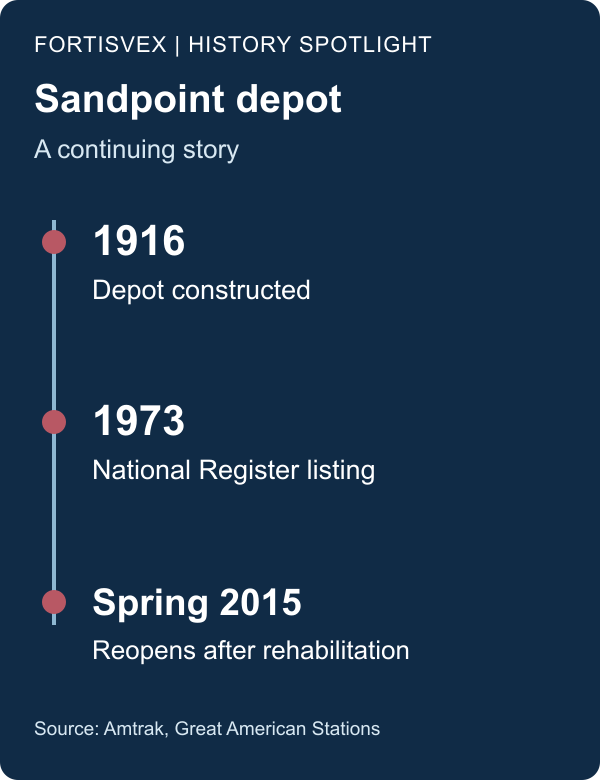
At a glance: construction, recognition and rehabilitation describe different stages in a building's life. Preserving a place means understanding those distinctions, not treating every date as a founding date.
History recovered from the ground
The Bonner County Historical Society & Museum's Dig Room account describes another kind of preservation. The Sand Creek Byway Archaeological Project recovered almost 600,000 artifacts across three sites. The museum reports three years of excavation and two years of laboratory work, and describes a display drawn from a University of Idaho loan.
A collection on that scale is not simply a pile of old things. Its usefulness depends on the work of recording and interpreting it. For readers, the practical lesson is to ask where an object came from and what evidence supports the story attached to it. An attractive object alone cannot answer every question about the people who used it.
Connecting records with downtown buildings
The museum also describes a walking-tour brochure created with Sandpoint's Arts, Culture & Historic Preservation Commission. Its named examples include the Panida Theater and Northern Mercantile. The museum's tour information connects that local partnership with ways to explore historic buildings; check the museum directly for current arrangements.
Use a historic walk as an invitation to look more carefully. Which details belong to the original design? Which reflect later changes? What does a source actually establish? Being included in a tour does not, by itself, establish a building's age or current public access.
Continue exploring how places and records inform American history in the FORTISVEX History & Reference guide. For a classroom or community display connecting local history with state identity, browse our Idaho state flags, choosing dimensions and attachment details for the actual display.
Sources and further reading
- Amtrak, Great American Stations: Sandpoint — historical narrative on construction, architecture, listing and rehabilitation.
- Bonner County Historical Society & Museum: Dig Room — archaeological project and collection.
- Bonner County Historical Society & Museum: Tours — Historic Walking Tour section and community partnership.
HTML sources consulted October 29, 2026. Historical descriptions are distinguished from current visitor information.
Recent Posts
-
Choosing a Historical Flag Reproduction: More Than Counting Stars
Before choosing a historical flag for a classroom or display, finish this sentence: “This flag will …Oct 29th 2026 -
The Flag, the Pledge and the Anthem: A Clear Ceremony Cue Sheet
A flag enters the room, a host invites the Pledge of Allegiance, and a musician begins the national …Oct 29th 2026 -
Welcoming International Guests: Plan a Multi-Nation Flag Display
A display for visiting international guests begins with a different question from a display of the …Oct 29th 2026