

Rupert, Idaho: Read the History Around the Town Square
Rupert’s historic square rewards a closer look than a quick photograph. Its buildings record changes in banking, freight delivery, postal service and agricultural trade. The useful question is not simply “How old is this building?” It is “Which parts of its story belong to the site, which to the surviving structure, and which to a later business?”
The opening image is an original FORTISVEX explanatory diagram based on the official building records cited below, not a historic photograph. Enlarge the site, structure and use diagram.
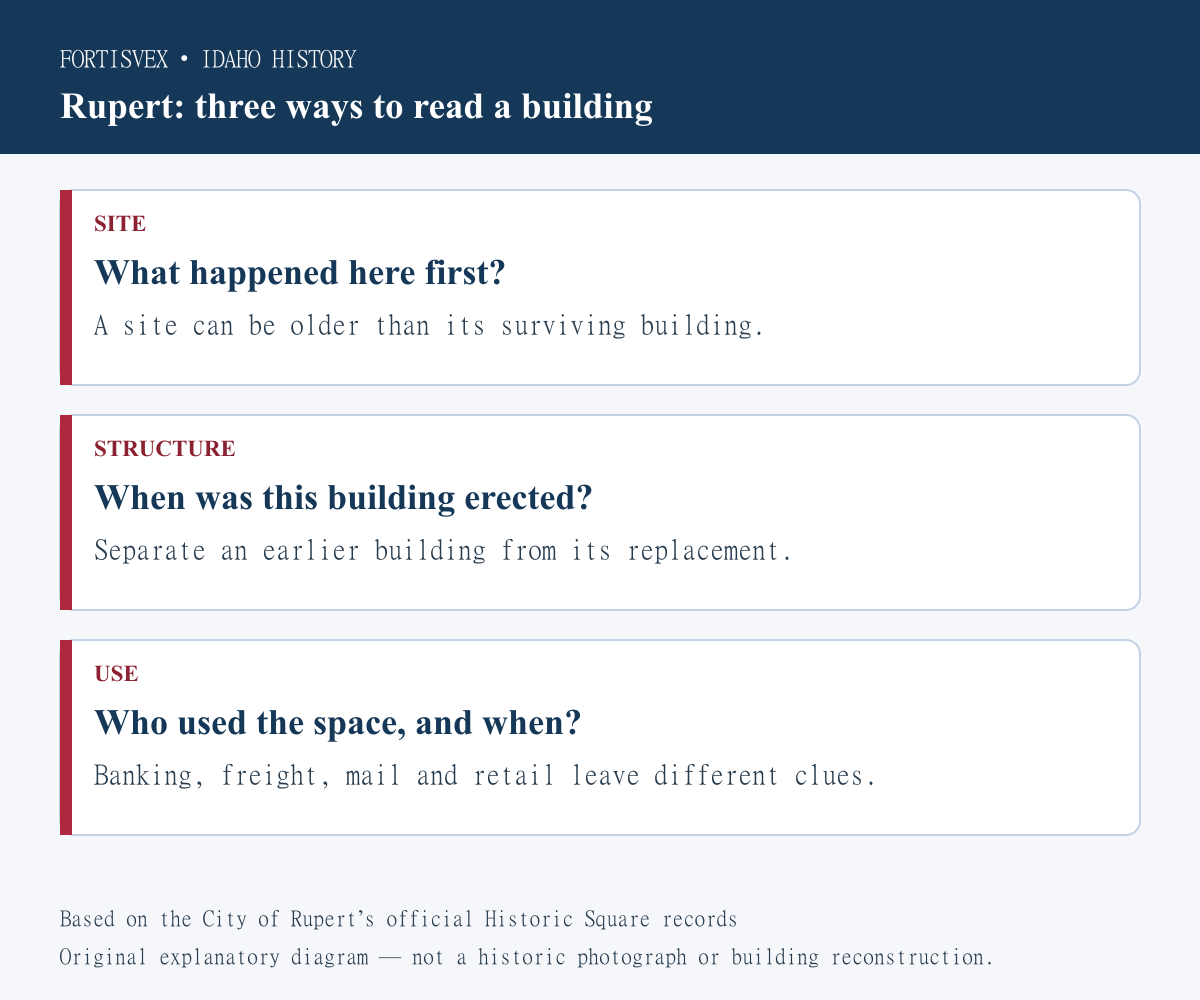
Begin with the square, not a list of dates
The city’s history of Rupert dates the community’s beginnings to 1904. It recounts an early name, Wellfirst, associated with a local well, and attributes the eventual name to railroad mail carrier John Henry Rupert. The city also identifies a post office established in July 1905 and a town layout designed by Reclamation Service engineers. Incorporation followed in 1906.
For today’s reader, the official Historic Rupert Square tour supplies the organizing tool: numbered building entries and a map. Follow that numbering if you want a location-based route. The comparisons below instead group buildings by what they reveal about the town’s changing activities.
A bank building with details worth noticing
The city’s Original First National Bank Building entry describes a brick building erected in 1909 on a site previously occupied by a small wooden shop. It identifies banking uses followed by retail uses and calls it the historic district’s oldest surviving building.
Look at the kinds of evidence the entry records: a decorative brick cornice, tiles at the base of the front and an entry-tile motif. The account also notes a preserved painted vault door. That last feature is a reason to read the record carefully, not a promise that a visitor can enter and see it. Exterior observation and interior access are different activities.
A change of business does not necessarily erase a building’s earlier role. At the same time, a historical bank name does not identify the current occupant. Using the city’s historical title is a way of identifying the record, not a recommendation of a present-day business.
Freight and mail: a site with more than one building story
The Craven’s Transfer and U.S. Post Office entry traces the site to a 1905 Reclamation Service bunkhouse. It describes a freight-delivery operation in the 1920s and a brick structure built after World War II. A post office occupied the western section from late 1950 until its relocation in 1963.
Those dates should not be collapsed into a claim that the present brick building was built in 1905. The site has a longer history than that particular structure. The city’s account also identifies loading-dock elements on the south side, connecting the physical record with the movement of goods.
This is a useful stop for anyone researching how a small town handled everyday necessities. Freight brought goods from the railroad to local businesses; postal service connected households and businesses beyond the square. The record makes those functions visible without requiring an imagined scene or an unsupported story about a particular resident.
Seeds, supplies and a changing commercial interior
The Rupert Electric and Rupert Seed & Milling entry describes seed and garden-supply trade associated with Grant Catmull in a brick building by the late 1930s. It records later combination with the neighboring building as a commercial mall and subsequent remodeling. Decorative brickwork remains part of the city’s architectural description.
That sequence offers a different way to read a storefront. A shared interior or later remodel can join spaces whose earlier uses were separate. The current appearance is therefore not a complete floor plan of the past. For a student project, put the documented uses in chronological order and label uncertain transitions instead of filling them with guesses.
| Record | Question to bring |
|---|---|
| Original bank | Which details preserve an earlier use after businesses change? |
| Freight and post office | Are we dating the site, an earlier structure or the surviving building? |
| Seed and milling premises | How did combined spaces and remodeling change the building? |
Bring the history into a present-day civic display
The square is also a place for community gatherings. A city notice dated June 15, 2026 described its role in Independence Day events. That is a dated notice, not a confirmed schedule for a future year. Check current city information before making event plans.
If you are assembling a classroom or community display about Rupert, use a short map-based story and clearly credited building captions. An Idaho state flag can identify the state context, while an American flag can support a present-day civic observance. Neither should be presented as an original object from the buildings’ early history.
Recent Posts
-
Rupert, Idaho: Read the History Around the Town Square
Rupert’s historic square rewards a closer look than a quick photograph. Its buildings record change …Oct 29th 2026 -
Reading the Swiss Flag: Shape, Cross and Context
The Swiss flag is easy to recognize, but its simplicity rewards a closer look. Its ordinary national …Oct 29th 2026 -
Why the European Flag Keeps Twelve Stars
Twelve gold stars form a circle on a blue field. The European flag is easy to recognize, but its nu …Oct 29th 2026