
Replacing a Flagpole Cleat: Measure the Bolt Centers Before You Shop
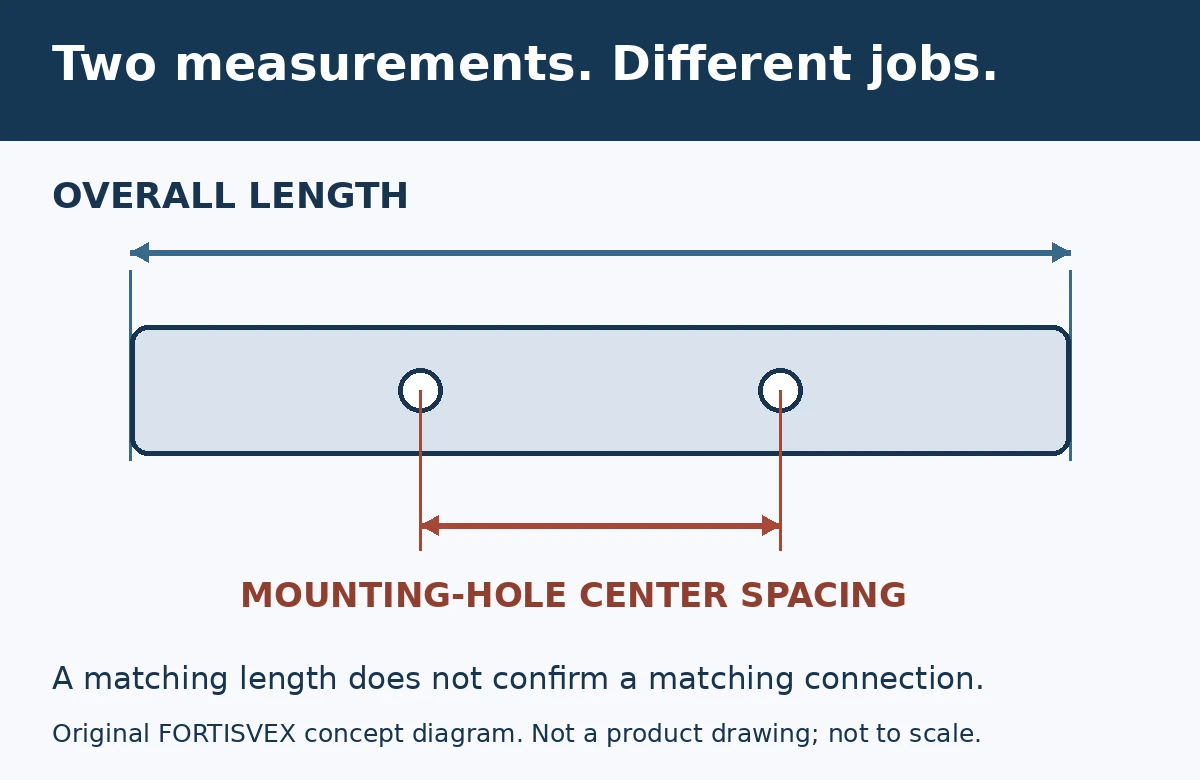
A replacement cleat needs more than a similar silhouette. Record its mounting pattern separately from its overall length before comparing parts.
Start with the part you need to replace
A worn or missing cleat can make a simple purchasing task surprisingly confusing. Two listings may both say “six inch,” yet describe different mounting patterns or supplied screws. Shopping by appearance alone leaves the most important compatibility questions unanswered. This guide is a purchasing worksheet, not a drilling or installation procedure. Keep the pole’s own specifications and applicable service instructions with your notes; an unidentified pole should not be modified to accommodate a convenient replacement.
Two six-inch cleats can have different mounting patterns
The silver-cleats listings provide a particularly useful comparison: light-duty part 350009 and standard part 350000 both have a six-inch overall length, but their listed mounting centers and screws differ.
| Listed part | Overall length | Bolt centers | Supplied screws |
|---|---|---|---|
| 350009, light-duty silver | 6 inches | 1 inch | Two #10 × 5/8-inch self-tapping screws |
| 350000, standard silver | 6 inches | 2 inches | Two 1/4-inch-20NC stainless-steel screws |
| 350003, standard bronze | 9 inches | 2¾ inches | Two 1/4-inch-20NC stainless-steel screws |
Read the screw notation as well as the cleat dimensions. The light-duty listing gives a numbered screw size and length with a self-tapping description. The standard listings give a 1/4-inch-20NC designation. These are different specifications; neither the shared six-inch cleat length nor the fact that two screws are supplied establishes interchangeability. This comparison is for selecting documented parts, not choosing a tapping method or modifying a pole.
Make a short purchasing record
Use four headings: pole identification, existing cleat identification, mounting pattern and replacement listing. Under pole identification, record any model information already available in the facility’s records. Under the existing part, record its markings and dimensions only where these can be checked safely. Under mounting pattern, retain the exact unit and the phrase “center to center.” Under the candidate listing, record its part number and link.
Do not record “about two inches” as a confirmed two-inch match. If a measurement is uncertain, mark it uncertain. Photographs can help preserve the context, but a perspective view is not a substitute for a reliable measurement or the original specification.
A hypothetical comparison
Suppose a purchasing note says: “Existing cleat approximately six inches long; recorded mounting centers two inches; pole model still unknown.” The two-inch spacing makes part 350000 worth investigating, but the unknown pole model prevents a complete compatibility decision. A useful next step is to find the applicable pole record, not to assume that matching one number settles the order.
Now suppose another candidate is also six inches long but has different mounting centers. It should not be treated as equivalent simply because its length matches. This example is invented to demonstrate the comparison method; it does not certify either part for an unidentified pole.
Check what comes with the replacement
A listing may describe supplied screws, but that does not establish that those screws suit every mounting surface or every existing pole. Keep the hardware description attached to the exact part number. Avoid substituting a general statement such as “hardware included” for the actual screw specification. If your approved maintenance record calls for different hardware, resolve that discrepancy before buying or installing the part.
Color can be considered after the interface is settled. A finish preference is a useful filter for appearance, but it should not move an otherwise incompatible item onto the shortlist. Keep quantities explicit too: ordering two replacement cleats is different from ordering a cleat supplied with two screws.
Build a two-part comparison, not a ranking
For the two standard cleats discussed here, a compact comparison separates the matching feature from the difference: both listings specify two 1/4-inch-20NC screws, but their overall lengths and bolt-center spacings differ. That shared screw description does not cancel the spacing difference. If the existing approved mounting pattern is two inches, the nine-inch candidate’s two-and-three-quarter-inch pattern is a mismatch that needs resolution, not a reason to enlarge holes.
Ask whether you are replacing a missing component in an identified assembly or reviewing a proposed change to that assembly. The first task seeks a documented replacement. The second needs the applicable approval and technical information before the product choice is settled. Keeping those branches separate prevents a maintenance purchase from quietly becoming a redesign.
What should a purchasing request say?
A useful request might read: “Please verify a replacement against our recorded pole model. Our existing record lists a six-inch cleat and two-inch mounting centers. Candidate 350000 lists those dimensions and 1/4-inch-20NC screws. Please confirm the applicable mounting specification and supplied hardware before the order is finalized.” This is sample wording, not a claim that the candidate fits your pole.
What if the old cleat is missing? Start with the pole’s records rather than guessing its length from the mounting area. What if the mounting holes appear damaged? Treat that as a separate maintenance issue; buying a different cleat does not establish that the mounting condition is acceptable. What if only the finish is different? Verify the mechanical specification first, then decide whether the finish difference is acceptable for the display.
Recent Posts
-
South Korea’s Taegeukgi: Check the Four Trigrams and Artwork Orientation
The South Korea flag, known as the Taegeukgi, is a good example of why artwork review should go beyo …Nov 2nd 2026 -
Brazil Flag Artwork: Check the Star Map Before Approving the Proof
The blue globe on a Brazil flag rewards a closer look. When buying a flag or reviewing a production …Nov 2nd 2026 -
Mexico Flag: The Eagle Is Part of the Design, Not an Optional Logo
A Mexico flag can look familiar at a glance while still needing a closer artwork check. When compari …Nov 2nd 2026