
How to Read a Museum Flag Record Without Mistaking It for a Product Description
Material, measurement, date and catalog number answer different questions. Here is a practical way to read an institutional flag record closely.
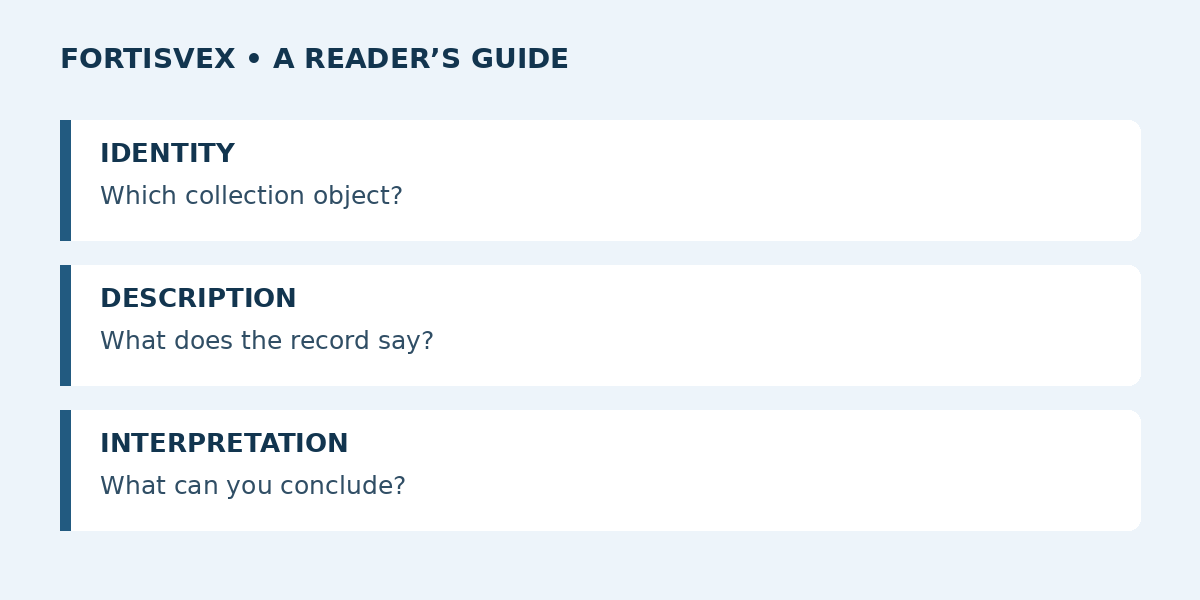
Begin with the identifier
Write down the institution, object title, record URL and identifying numbers together. A title such as “flag” is too general to reliably find the same object later. Preserve the labels attached to each number. If a page has an accession number, a catalog number and a record ID, do not merge them into a single homemade reference. A reader following your citation should be able to locate exactly the object you used. When a record does not explain a number, copy its label rather than guessing what the institution uses it for.
Practice with an explicitly invented record
Consider this teaching example, not an actual museum object: “Flag; material: cotton; date: approximately 1920–1940; overall: 90 × 150 cm; folded: 30 × 25 cm.” These invented entries let us practice reading without borrowing the authority of a real collection. The material field describes this hypothetical object. It does not establish the material of every flag bearing the same design. The date range is not an exact manufacturing date. The two measurement pairs are not competing estimates of the same thing: their labels identify different physical states.
Ask what was measured
In the example, selecting the folded dimensions would make a large textile appear much smaller than the overall dimensions indicate. Copy the entire measurement phrase, including units and qualifiers, before comparing objects. Also preserve dimension order when the record explains it; do not silently assume that the first number always means width. If you convert centimeters to inches for a display caption, keep the original alongside the conversion and avoid adding false precision. A rounded catalog measurement does not become more accurate because a calculator supplies many decimal places.
Notice how description is organized
The Library of Congress guide to books with accompanying materials gives a useful comparison from library cataloging. It separates extent, other physical characteristics, dimensions and accompanying material within a physical-description field. It also recommends specific, neutral language. That guidance concerns books and their accompanying items, not a universal standard for museum textiles. The transferable reading habit is simpler: identify what each field describes before combining its contents into a claim. A box measurement, an object measurement and a page count answer different questions even when they appear together.
Do not turn a range into an exact birthday
Our invented 1920–1940 range must not become “made in 1920” because that is its first year. Nor should “approximately” disappear when a caption is shortened. If your project needs an exact year, the next step is more evidence rather than greater confidence. A modest label can preserve the range and explain why that uncertainty matters. Readers should be able to distinguish a fact supplied by the institution, a qualification supplied by the institution and an interpretation supplied by you.
Separate the object from its photograph
A photograph shows one view under particular conditions. A catalog record may describe features that are folded away or outside the frame. Conversely, a detail visible in a photograph may not be interpreted in the text. Keep your own observations separate from the institution’s statements. “The record identifies wool” attributes a catalog fact. “The photograph appears to show a fold” reports a visual observation. Neither sentence establishes how a flag was originally used. If the record does not explain a feature, leave room for uncertainty instead of assigning a dramatic story to it.
Keep reproduction decisions separate
Finding an image useful for research does not settle whether it belongs in your published display. Read the institution’s stated reuse conditions for the particular asset and retain the source and credit information with your notes. If the record leaves that question unresolved, use a text reference or link rather than assuming permission. This article uses an original explanatory diagram instead of a collection photograph. It illustrates the reading process, not the appearance of any historical flag, and the invented measurements above should never be entered into a real collection record.
Build a comparison that can be checked
Try a short worksheet with four rows: identity, date, material and measurements. In each row, put the institution’s wording on the left and your interpretation on the right. In the identity row, include the stable identifier. In the date row, preserve uncertainty. In the materials row, avoid translating historical terms into modern fabric claims without evidence. In the measurements row, retain the measured state and units. Finally, add a line explaining why this object belongs in your project. That gives your research a purpose beyond collecting impressive-looking facts.
Source and scope
Library of Congress: Books With Accompanying Materials supports the comparison with library physical-description fields. The museum-reading worksheet and invented flag example are original editorial teaching tools, not an institutional cataloging standard.
Recent Posts
-
South Korea’s Taegeukgi: Check the Four Trigrams and Artwork Orientation
The South Korea flag, known as the Taegeukgi, is a good example of why artwork review should go beyo …Nov 2nd 2026 -
Brazil Flag Artwork: Check the Star Map Before Approving the Proof
The blue globe on a Brazil flag rewards a closer look. When buying a flag or reviewing a production …Nov 2nd 2026 -
Mexico Flag: The Eagle Is Part of the Design, Not an Optional Logo
A Mexico flag can look familiar at a glance while still needing a closer artwork check. When compari …Nov 2nd 2026