
Reading a Flag Fabric Description: Fiber, Weight and Performance Are Different Claims
A useful flag comparison starts with a pencil, not a winner. Put two descriptions beside each other and separate what the fabric is made from, what a measurement measures, and what the finished product is claimed to do. Those are different questions. A detailed answer to one does not fill the blanks in the others.
Begin with the exact item
Open the description for the size and finish you are considering. Write down its product identifier and the date you read it. A description for another size may be useful background, but it is not a substitute for the selected item’s specifications. If a selector changes the product, check whether the description and measurements change with it.
When browsing FORTISVEX American flags, use the individual product details to build this comparison. A category name helps you find candidates; it does not establish every candidate’s fabric weight, attachment arrangement or performance.
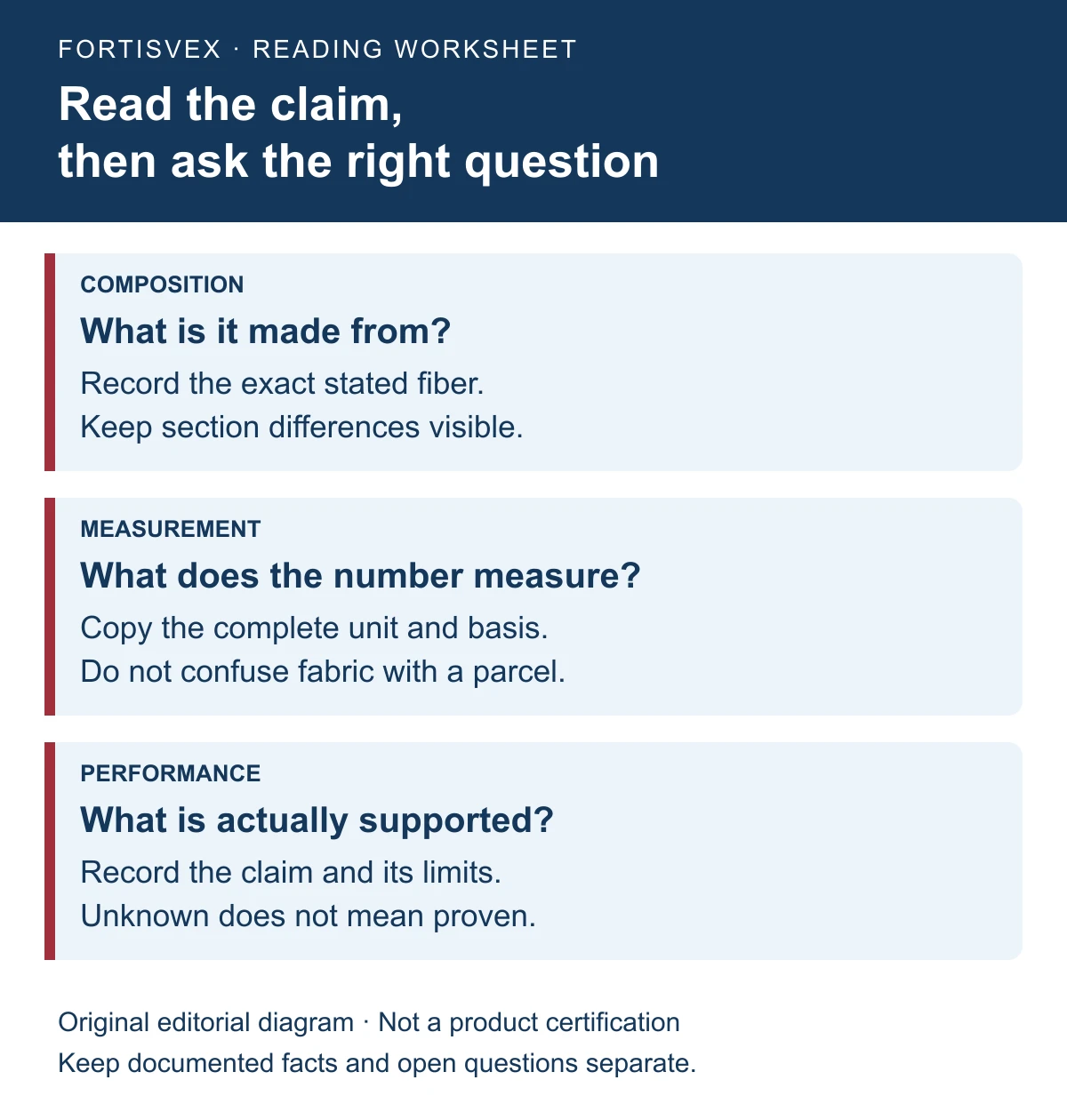
Fiber content answers a composition question
The FTC’s textile guidance specifically includes flags with a heading and flags larger than 216 square inches among covered products. Its guidance describes generic fiber names and percentages by weight for covered textile products, while also explaining exceptions and separate wool rules. This is flag-relevant guidance, not an assumption that every clothing-label requirement applies to every flag. See the FTC’s scope and fiber-content explanation.
For your worksheet, copy the stated composition faithfully. Do not turn a partial description into a percentage that was never supplied. If different sections are described separately, retain that distinction instead of treating one material name as a complete inventory of the finished object.
It is reasonable to compare two items made from the same named fiber. It is not reasonable to stop the comparison there. Your worksheet still needs the exact size, finish, measurements and supported use information. This guide deliberately does not declare nylon or polyester the universal winner.
Keep the unit attached to the number
A number without its unit is an incomplete note. “Weight” might refer to a stated mass of the finished item, a shipment, or fabric measured over a defined area. Copy the wording around the number, not just its digits. If the listing does not say which quantity it means, write “basis not specified” and ask for clarification.
For example, grams and grams per square metre answer different questions. The first is a mass; the second expresses mass divided by area. This dimensional distinction does not tell you which flag lasts longer. Nor does a shipping allowance, which may describe a parcel, become a fabric specification merely because it appears beside product information.
Read performance as a separate promise
The FTC’s advertising substantiation policy says objective advertising claims need a reasonable basis before they are made. The level and kind of support depend on the claim. That provides a useful reason to read a performance statement carefully rather than translate a material name into a promise. See the FTC policy on evidence for advertising claims.
Write the actual claim in your comparison. Does it describe resistance to a particular exposure, suitability for a stated use, or a measured result? Then record any stated conditions and limits. “Outdoor” is not a numerical wind rating. A general durability adjective is not a promised replacement interval. If a test is mentioned, look for what was tested and whether it applies to the item you are choosing.
This approach also avoids the opposite mistake: assuming an unspecified result must be poor. “Not documented here” means precisely that. You can request clarification or choose an item whose stated specifications answer your needs without inventing a negative finding.
A comparison worksheet you can actually use
- Identity
- Exact product, selected size and finish, source URL and date checked.
- Composition
- Named fiber and any stated percentages or section-specific information.
- Measurement
- Number, complete unit, measured object and any stated measurement basis.
- Performance
- Exact claim, conditions, supporting evidence and stated limitations.
- Decision
- What is confirmed, what remains unknown, and which unanswered question matters to your intended use.
Suppose one hypothetical description gives a fiber name and another adds a fabric-area measurement. The second offers an additional kind of information; that alone does not prove superior service life. You can make a fairer decision by comparing the missing category directly, rather than awarding a quality score to the longer description.
Finish with a documented choice
Keep the specification you relied on with the order record. That makes a later replacement easier to compare and keeps remembered impressions from becoming invented facts. Use this worksheet alongside the selected flag’s attachment and care information; it is not a flagpole load assessment or a substitute for system instructions.
Return to the American flag collection with a short list of questions, then choose from the details actually documented for the item. A clear comparison is more useful than a blanket material ranking.
Recent Posts
-
South Korea’s Taegeukgi: Check the Four Trigrams and Artwork Orientation
The South Korea flag, known as the Taegeukgi, is a good example of why artwork review should go beyo …Nov 2nd 2026 -
Brazil Flag Artwork: Check the Star Map Before Approving the Proof
The blue globe on a Brazil flag rewards a closer look. When buying a flag or reviewing a production …Nov 2nd 2026 -
Mexico Flag: The Eagle Is Part of the Design, Not an Optional Logo
A Mexico flag can look familiar at a glance while still needing a closer artwork check. When compari …Nov 2nd 2026