
How to Read Boise Valley Railway History: Timetables, Ledgers and Alignment Maps
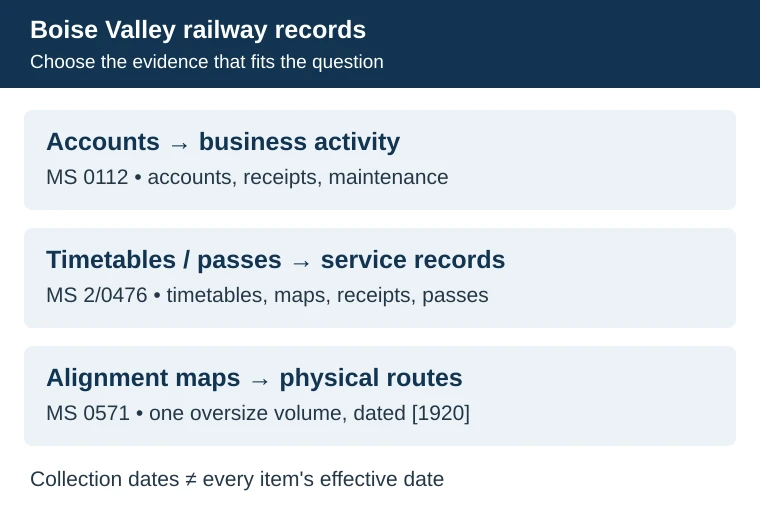
A departure time, a company name and a line on a map answer different questions. That distinction matters when tracing the electric railways of the Boise Valley. A timetable concerns a service offered to passengers. An account book records a business activity. An alignment map documents a physical route. Reading them together is useful; treating them as interchangeable can produce a history that sounds precise but describes the wrong event.
The Idaho State Archives identifies three collections that offer a practical starting point. Their online descriptions tell us which kinds of records survive. They do not reproduce every item, and they should not be mistaken for a fully inspected operating history.
Start with the question, then choose the record
For the business side, Boise Valley Railway Company records, MS 0112, is the relevant lead. The archive describes account books, car receipts, statistics and maintenance information for Boise Valley Railway Company, Ltd., alongside vouchers and a cash book for Boise Traction Company. Its listed extent is fourteen oversize ledgers.
This is a reason to keep company names in your notes, even when a general history groups the railways into one regional system. A record attributed to one business cannot automatically establish what another business owned or operated. The collection description gives a span of 1904–1921; that span describes the archival material, not a verified founding-to-closure timeline for a single company.
Passenger records can narrow a service question
Boise Valley Traction Company records, MS 2/0476, contains a different selection: timetables, route maps, fare receipts, passes and other operating material. The description lists sixteen items in one folder, dated 1907–1922.
These are the kinds of documents to consult when asking about a particular journey. Before quoting a departure, read the timetable's effective date, direction, station names and any service qualifications. A scheduled departure does not, by itself, demonstrate that a particular train ran on a particular day. Likewise, a surviving pass and a fare receipt serve different purposes; neither should be turned into a general fare claim without reading its terms.
A map needs its own date
The Valuation Department alignment maps, MS 0571, are catalogued as one oversize volume with the date shown as [1920]. Preserve those brackets when reporting the catalogue entry rather than presenting a more exact date than the archive supplies.
An alignment sheet can help answer a location question, but its date matters. A route shown on a later map does not establish the day that a connection opened. Nor should a historical alignment be used as present-day walking directions: access, property boundaries and physical conditions require current information.
Keep a local story connected to its evidence
Readers exploring the railway's community setting can continue with FORTISVEX's history of Star and Meridian's depot and library history. Those are place-based narratives; the collections above offer a way to investigate more specific questions without assuming that one town's experience describes the whole network.
A useful research note records four things: the exact question, the collection and item, the relevant date, and what the document actually establishes. Leaving a merger date or an opening day unresolved is better than borrowing a plausible date from a different kind of record.
Recent Posts
-
South Korea’s Taegeukgi: Check the Four Trigrams and Artwork Orientation
The South Korea flag, known as the Taegeukgi, is a good example of why artwork review should go beyo …Nov 2nd 2026 -
Brazil Flag Artwork: Check the Star Map Before Approving the Proof
The blue globe on a Brazil flag rewards a closer look. When buying a flag or reviewing a production …Nov 2nd 2026 -
Mexico Flag: The Eagle Is Part of the Design, Not an Optional Logo
A Mexico flag can look familiar at a glance while still needing a closer artwork check. When compari …Nov 2nd 2026