
Reading Beach Warning Flags: Check the Local Sign, Not Just the Color
A beach warning flag is easier to recognize than to interpret. You may remember a color from another holiday, yet still need to establish what it means at this beach, what the posted message covers and whether the information you saw earlier remains current. Start with the local explanation rather than a remembered color chart.
Find the system used at this beach
The National Weather Service’s before-you-go guidance advises checking surf forecasts and beach advisories or closings before leaving, then reading and obeying entrance signs and warning flags. It also notes that flags are not used everywhere and meanings vary by area. Look for the authority named on the sign and read the definitions posted for that location.
That first step matters even when a flag looks familiar. A photograph from another destination cannot establish the instructions for the beach in front of you. Keep the local sign’s wording attached to any explanation you share with your group.
Separate closure from different kinds of hazard
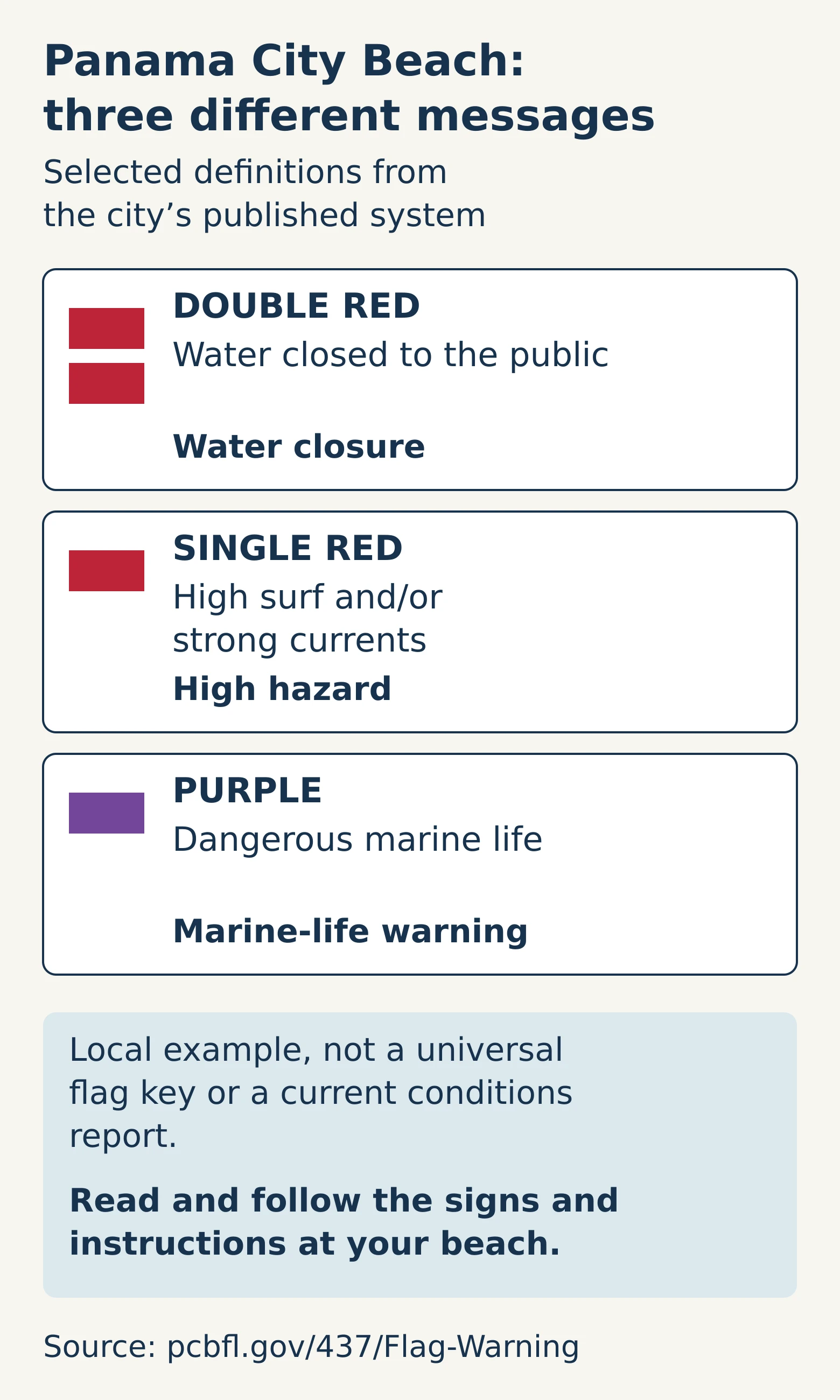
Panama City Beach’s published warning system provides a specific example. Its double red flags mean the water is closed to the public. A single red flag describes a high hazard involving high surf and/or strong currents. Purple identifies dangerous marine life. These are the city’s definitions, not a universal key.
The distinction is practical: a water closure describes an access restriction, while the other messages identify hazards. Double red should not be paraphrased as closing the entire beach. Likewise, purple should not be treated as simply another step above or below red on a single danger scale. NWS Nashville’s beach guidance notes that purple sometimes flies alongside other flags, carrying an additional message.
Panama City Beach describes green as low hazard with caution still required. Do not turn that into swimming permission. The city also warns that missing flags do not establish safe water. Sunny weather is no substitute for checking warnings, either: NWS Nashville notes that rip currents can occur on calm, sunny days.
Check whether an online update still applies
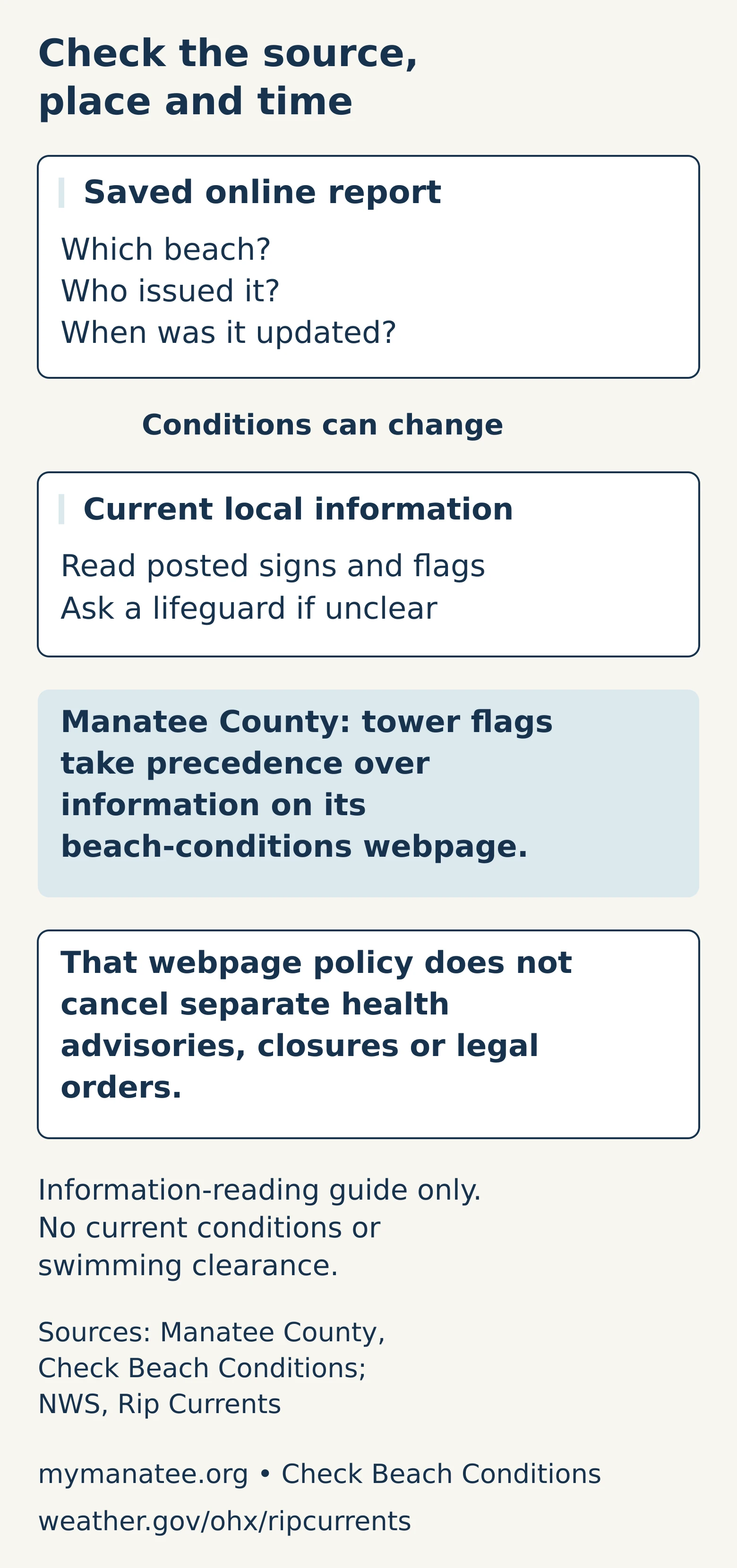
An earlier screenshot preserves an earlier report. Check its location, source and update time rather than assuming it describes conditions now. Manatee County’s beach-conditions page explains that conditions can change quickly and unpredictably. For that page specifically, flags at the lifeguard towers take precedence over the information on the webpage.
The county also describes tower information boards covering conditions, tides, wind and temperatures. Its page directs water-quality inquiries to a separate health-department resource. The webpage-priority statement does not establish that a tower flag cancels a separate health advisory, closure or legal order. Keep those notices in view rather than trying to reduce every source to one flag color.
Ask about the message you actually see
Before relying on a warning, check three things: the beach it applies to, the posted meaning and whether you are reading current information. Read and follow the local instructions; ask a lifeguard if the conditions or message are unclear, as NWS advises. A useful question is, “What do the flags and posted notices here mean today?”
This article explains how to read warning information. It does not report current conditions or provide personal clearance to enter the water.
Recent Posts
-
Norway’s Flag in 1821: Agreement on Design, Disagreement on Authority
In 1821, Norway’s parliament and king accepted the flag’s design while disputing who could determine …Nov 5th 2026 -
Reading Beach Warning Flags: Check the Local Sign, Not Just the Color
A beach warning flag is easier to recognize than to interpret. You may remember a color from anothe …Nov 5th 2026 -
New Zealand’s Flag: From the 1869 Ensign to 1902 Confirmation
New Zealand’s flag history has a maritime beginning and a later milestone in recognition on land. T …Nov 5th 2026