
National Ensigns and Signal Flags: Identity and Messages at Sea
A photograph of a ship can contain several kinds of flags at once. Reading them as one long message misses an important distinction: a flag can express national identity, while another belongs to a system for transmitting information. The colors alone do not tell you which job it is doing.
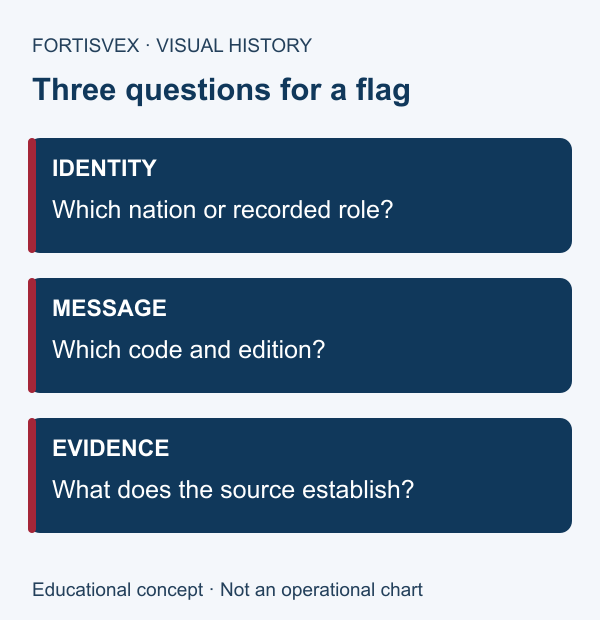
An ensign belongs to a national context
The Naval History and Heritage Command catalogs the flag flown aboard USS Nashville during General Douglas MacArthur’s return to the Philippines in 1944 as a national ensign. Its description identifies the familiar American arrangement: thirteen alternating stripes and a blue canton containing forty-eight stars. That is a national flag aboard a particular vessel, not one letter in a signal alphabet. The museum record ties the object to a ship, an event and an accession number, giving readers more than a generic picture of a flag. Read the Nashville ensign’s museum record.
National arrangements also differ. As one documented example, section 2 of Britain’s Merchant Shipping Act 1995 identifies the red ensign as the flag to which British ships are entitled, subject to stated exceptions. This is a national legal framework, not an entry in an international message dictionary. It should not be borrowed as a rule for another country’s vessels. See the Act’s British flag provisions in the dated version consulted.
The International Code organizes communication
The International Code of Signals addresses communication, especially matters involving navigation and personal safety when language differences create difficulty. Its signals can carry complete meanings. The system therefore asks a different question from national identification: what information is being conveyed?
NGA’s United States edition is dated 1969 and marked revised 2020. Its preface explains that the Code is suitable for visual, sound and radio communication. This matters because the Code is more than colored fabric. A communication system and a physical way of sending it are related, but they are not identical. Consult NGA’s International Code of Signals publication page.
Why an old picture needs an old reference
The Code has a history of revision. NGA traces the first draft to 1855 and publication to 1857, followed by later revisions and international consideration. A twentieth-century or present-day reference should not automatically be used to translate an earlier scene. A caption’s date is part of the evidence, not decorative background.
The same caution applies to naval settings. A museum photograph may document a navy’s practices, a ceremonial display or a particular exercise. Naming the country and year is a useful beginning; it does not establish every signaling rule in force. If the original caption identifies a message, preserve that attribution. If it does not, describe the visible flags without supplying an invented translation.
A practical way to read a museum label
Separate observation from interpretation. “A striped flag with a star-filled canton” describes what is visible. “The museum identifies this as the ship’s national ensign” attributes an identification. “The ship was sending a particular message” is a further claim that needs its own evidence.
For a classroom display or family-history album, a short label can record the vessel, date, collection and catalog number before explaining the flag’s role. Leave uncertain details visibly uncertain. That produces a stronger historical account than a confident caption assembled from a modern alphabet chart.
When the question is about the pieces in a signal set, FORTISVEX’s guide to letters, numbers and substitutes covers that separate subject. The useful distinction here is between recognizing an object’s national role and interpreting a signal within a documented system.
This is an educational guide to historical interpretation, not instructions for vessel identification, navigation or sending operational signals.
Recent Posts
-
South Korea’s Taegeukgi: Check the Four Trigrams and Artwork Orientation
The South Korea flag, known as the Taegeukgi, is a good example of why artwork review should go beyo …Nov 2nd 2026 -
Brazil Flag Artwork: Check the Star Map Before Approving the Proof
The blue globe on a Brazil flag rewards a closer look. When buying a flag or reviewing a production …Nov 2nd 2026 -
Mexico Flag: The Eagle Is Part of the Design, Not an Optional Logo
A Mexico flag can look familiar at a glance while still needing a closer artwork check. When compari …Nov 2nd 2026