
Nampa's Railway Growth and the Streets That Became Its Commercial Center
Nampa's early growth was not one event. Railway service, a connection to Boise, a hotel for travelers and a rebuilt commercial district each changed what the town could do. Following that sequence gives a more useful picture than treating every old building as a relic of a single founding year.
A railway town becomes a junction
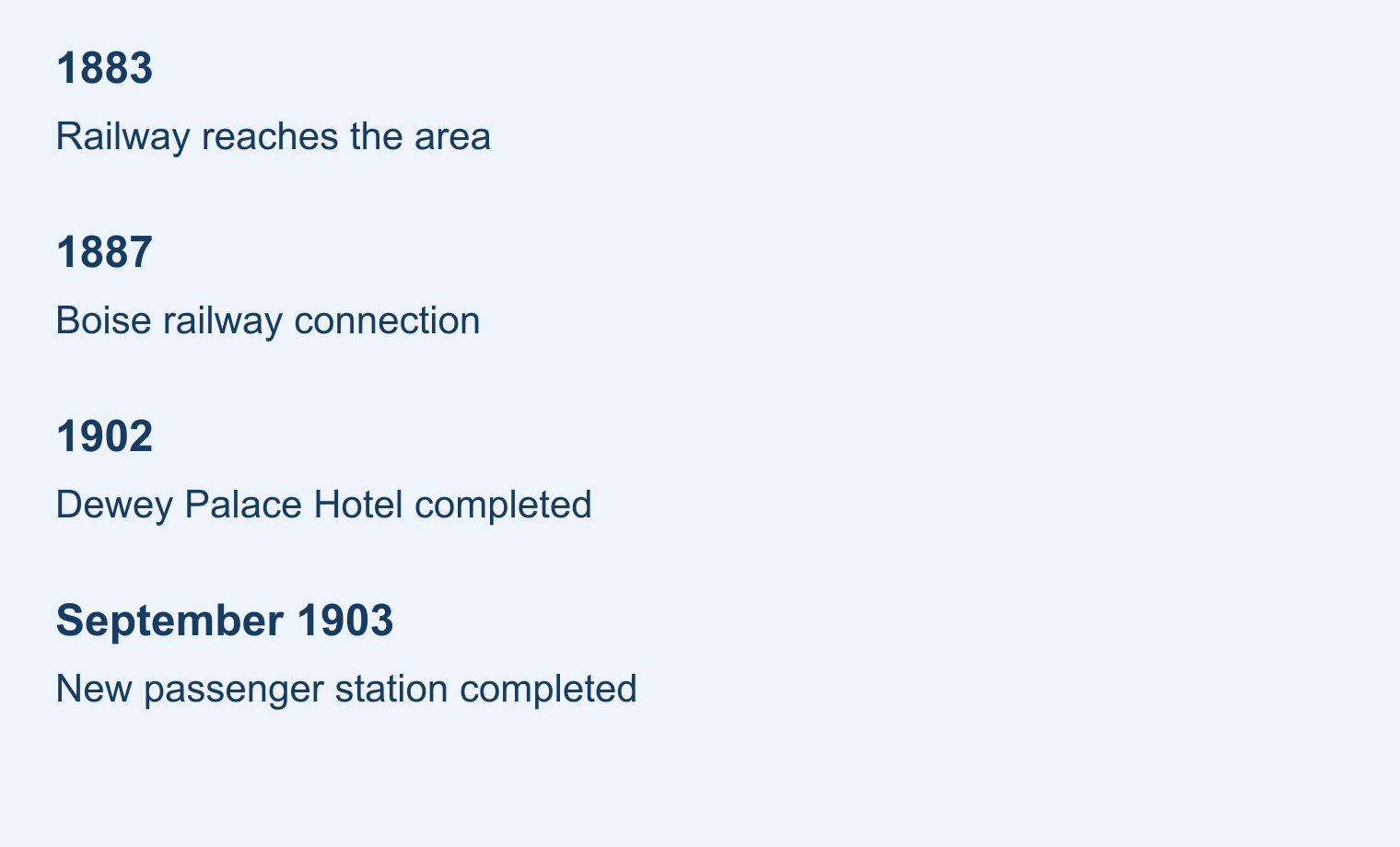
The City of Nampa's historical overview places the railway's arrival in 1883. It records the Nampa Land and Improvement Company's formation in 1886 and incorporation on April 17, 1891. In between, the Idaho Central Railway connected Boise to the Oregon Short Line at Nampa in 1887. These are separate milestones: transportation, organized development and municipal government.
The Boise link is particularly useful for understanding a junction. Nampa was not simply a stop along one route; it connected travel in different directions. The city's account links Colonel W. H. Dewey to further railway development and the hotel project. It dates the Dewey Palace Hotel's completion to 1902 and the new passenger station's completion to September 1903.
A historical display about this period should identify the year it represents. If choosing a reproduction from FORTISVEX historical flag designs, check that individual design against the intended date. The existence of a reproduction does not establish what flew at a particular Nampa building.
The hotel also belonged to the town's civic life
A hotel can appear in local history as more than accommodation for travelers. The Nampa School District's history records the first Nampa High graduation at the Dewey Palace Hotel on May 28, 1903. Nine girls graduated. Its account says each took part in the program, with contributions including essays, orations and the customary commencement addresses.
This specific event gives the hotel a place in the community's educational story as well as its railway story. It also illustrates the difference between a building date and an event date: the hotel's completion and the graduation are separate facts supported by separate institutional accounts. A caption about that ceremony should name the school and occasion, rather than merely label the building an old railway hotel.
First Street South: read the district as a group
The city's historic-district page identifies a concentrated commercial area along First Street South between Twelfth and Fourteenth Avenues. It gives the district a 1905–1920 period of significance and records its National Register listing in 1983. Those dates describe the district; they do not date every building in Nampa.
The city's building table points to features that are useful to compare: upper-story windows, patterned brickwork, cornices and altered storefronts. It describes the Blue Eye Building's name panel and the Hardiman Building's dated inscription. Such details distinguish individual facades without requiring a claim that every visible part is original. The table is historical documentation, not a promise of unchanged present condition or interior access.
The city history records a destructive downtown fire on July 3, 1909. That event helps place rebuilding within the district's wider development period, but it does not mean every listed building was a direct result of the fire. Keep the documented district dates and individual building descriptions separate.
Bringing the history into a present-day display
A contemporary home or community display need not pretend to reconstruct 1903. FORTISVEX American flags offer a separate starting point for that purpose; compare the current listing's dimensions and attachment details with your own equipment. A local-history caption can explain the railway, graduation or commercial district without claiming the flag is an original artifact or that a city institution endorses the display.
Remember this: the railway explains a connection, the graduation gives the hotel a specific civic role, and the district documents a period of commercial building. Read those stories together, while preserving the differences that make each one useful.
Recent Posts
-
South Korea’s Taegeukgi: Check the Four Trigrams and Artwork Orientation
The South Korea flag, known as the Taegeukgi, is a good example of why artwork review should go beyo …Nov 2nd 2026 -
Brazil Flag Artwork: Check the Star Map Before Approving the Proof
The blue globe on a Brazil flag rewards a closer look. When buying a flag or reviewing a production …Nov 2nd 2026 -
Mexico Flag: The Eagle Is Part of the Design, Not an Optional Logo
A Mexico flag can look familiar at a glance while still needing a closer artwork check. When compari …Nov 2nd 2026