
Moscow, Idaho: Three Places That Tell a Community's Story
A library, a post office and a farmers market offer three different ways to read Moscow's history. One records an investment in public learning. Another gives federal government a visible architectural presence. The third brings producers and visitors together through a recurring local market. Their dates, architecture and organizing stories offer a focused way to explore the city.
Moscow is the county seat of Latah County, Idaho. The city's own history places the arrival of the railroad in 1885, incorporation in 1887 and the selection of Moscow for the University of Idaho in 1889. Those dates establish a backdrop for the public buildings that followed. The City of Moscow's history and the university library's Latah County Historic Places project provide starting points for that broader story.
The Carnegie Library: Look Closely at the Building, and Beyond It
The historic Carnegie Library invites attention to details above street level. The Latah Preservation Commission's description, hosted by the University of Idaho Library, identifies Spanish mission architecture, gables and finials. These are specific features to look for when studying a photograph or the building's exterior. They give the library an architectural identity more precise than simply calling it historic.
There is also an organizing story behind the building. In the university library's 2019 article "One More Library," Courtney E. Berge identifies the Moscow Pleiades Club and Ladies Historical Club as champions of the library. That account directs attention toward local participation in creating a public institution, rather than allowing the Carnegie name alone to stand for the whole undertaking.
The surviving descriptions do not give an entirely uniform construction date. The historic-place record describes a 1905 building, while Berge's account says it was finished in 1906. The distinction remains unresolved; neither date is presented here as a verified opening date.
Berge also records an addition in 1983. That later date matters because a historic institution need not remain physically unchanged to have a continuing story. It gives readers a second period to investigate when comparing photographs, although it does not by itself identify every alteration or establish the building's current services.
The Post Office and Courthouse: A Federal Building in the Local Record
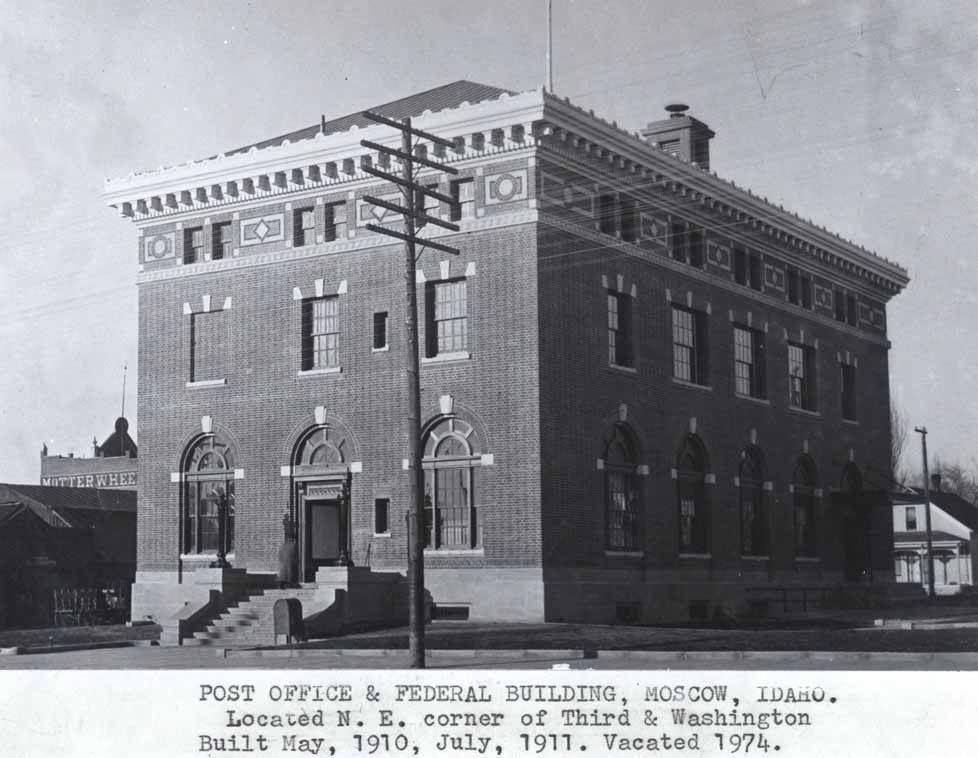
The Post Office and Courthouse record describes a three-story building with ivory terra-cotta trim. It attributes completion to 1911 and the design to the United States Treasury Department during James Knox Taylor's tenure. The original combined purpose makes this a different kind of civic landmark from the library: its identity joined postal and judicial functions in one federal building.
A second record supplies a more precise building timeline. The University of Idaho Library's Ott collection entry for the post office and federal building describes construction from May 1910 to July 1911 and locates it at the northeast corner of Third and Washington streets. Its photograph is catalogued July 1911. These details give readers a dated image to compare with the architectural description, rather than an undated illustration of an old building.
The Ott record also says the building was vacated in 1974. That is a useful later milestone, but it does not identify the dates or details of subsequent conversions. The separate historic-sites exhibit labels a different photograph 1910; that image's catalogue date should not be substituted for the reported July 1911 completion. When comparing photographs, keep each image attached to its own record.
The Farmers Market: Community History That Happens Repeatedly
Moscow's farmers market adds a different timescale to the story. The official city market page dates its inception to 1976 and describes interaction among farmers, artisans, musicians and visitors. Unlike a building's completion date, a market's founding date begins the history of a recurring activity.
The city's description also identifies staff and a Farmers Market Commission within its management and advisory structure. That detail helps explain why the market belongs in a civic history alongside public buildings: it is an organized community institution, not simply a collection of stalls that happens to occupy downtown space.
For someone planning a visit, the most useful link is the current official market page. Check seasonal hours, dates and special events before arranging a trip.
A Short Timeline for Comparing the Sources
- 1885-1889: The city history records railroad arrival, incorporation and university selection in that order.
- 1905/1906: The two library accounts use different dates; the construction/opening distinction remains unverified.
- May 1910-July 1911: The Ott record dates construction of the post office and federal building.
- 1974: The same record says the federal building was vacated.
- 1976: The city's account dates the farmers market's inception.
- 1983: Berge's library history records an addition.
Reading Moscow Through Its Public Places
These three examples invite different questions. At the library, ask about architecture and the people who advocated for public learning. At the post office and courthouse described in the historic-place record, distinguish original purpose from later uses. At the market, consider how a recurring gathering depends on organization as well as participation. Each question leads back to a particular source rather than a general claim about civic pride.
For readers planning a present-day Idaho-themed civic display, FORTISVEX's state flags collection is a separate practical resource. It does not establish which flags appeared at these buildings in earlier periods or imply an affiliation with the city, library or market.
Recent Posts
-
South Korea’s Taegeukgi: Check the Four Trigrams and Artwork Orientation
The South Korea flag, known as the Taegeukgi, is a good example of why artwork review should go beyo …Nov 2nd 2026 -
Brazil Flag Artwork: Check the Star Map Before Approving the Proof
The blue globe on a Brazil flag rewards a closer look. When buying a flag or reviewing a production …Nov 2nd 2026 -
Mexico Flag: The Eagle Is Part of the Design, Not an Optional Logo
A Mexico flag can look familiar at a glance while still needing a closer artwork check. When compari …Nov 2nd 2026