
Lewiston at the Confluence: Three Ways a City Keeps Its History
A city's history can survive in very different forms: a river junction that explains where people met, objects saved after a building disappeared, or a public institution that found a new home. In Lewiston, Idaho, those three threads offer a useful introduction to the community without trying to fit its entire past onto a single timeline.
The City of Lewiston places the community in Nez Perce County, at the confluence of the Clearwater and Snake rivers. Start with that landscape, then look more closely at the Beuk Aie Temple collection and the city library. Together, they raise a question worth carrying into any local-history visit: what has been preserved, who preserved it, and what can it actually tell us?
At the rivers: trade depended on more than a good location
The National Park Service's Confluence Overlook account describes an early trading venture below the viewpoint. Donald MacKenzie established a post there in August 1812. Its position did not guarantee success: the Nez Perce wanted to exchange food and horses, but were unwilling to trap beaver for the enterprise.
In the NPS account, Nez Perce participants chose what they were willing to trade. The post's location alone could not make the venture succeed. Read the landscape alongside that account: the river junction explains where the encounter took place, while the trading choices help explain its outcome.
NPS locates the overlook about eight miles north of Lewiston. It is a regional viewpoint, not a downtown stop. The cited visitor page was last updated in 2018, so use it for historical orientation and check current official access information before planning a visit. An old set of driving directions is not a promise about today's road conditions.
Beuk Aie: the building was lost, but the story was not
Lewiston's Chinese temple was built in 1890 and demolished in 1959. Its surviving artifacts allow a fuller account of community life than a passing mention of miners arriving during a gold rush.
A March 26, 2025 announcement from Lewis-Clark State College traces the collection's later history. An exhibit was dedicated in October 1994; a fire forced its closure in 2009, and it reopened in 2013. The 2025 announcement described an agreement to transfer the collection to the Nez Perce County Historical Society.
This is a story of stewardship as well as survival. Preserving an object means caring for its condition, but also keeping enough context to explain whose life it belonged to. A temple collection deserves to be understood through its community and purpose, rather than treated as decoration from a vanished past.
The library: a civic project with more than one address
According to the Lewiston City Library's history, women of the Tsceminicum Club founded the library in 1901 and sought support from Andrew Carnegie. The city describes a civic commitment behind that effort: Carnegie responded, and the city committed to maintaining the library after its completion. The institution's story extends beyond that first building.
The original Carnegie facility closed in 1999. A second library location on Thain Road operated from 1973 to 2013. The city describes today's downtown library as a reuse of a building complex whose original 1896 structure housed a hardware business. It is not the original Carnegie building.
Those distinctions make the story more interesting, not less. “The library” can mean a building, a collection, or the continuing public service that connects several addresses. Lewiston's account gives readers a way to follow that continuity without pretending the institution stayed in one place.
A short timeline, with different kinds of milestones
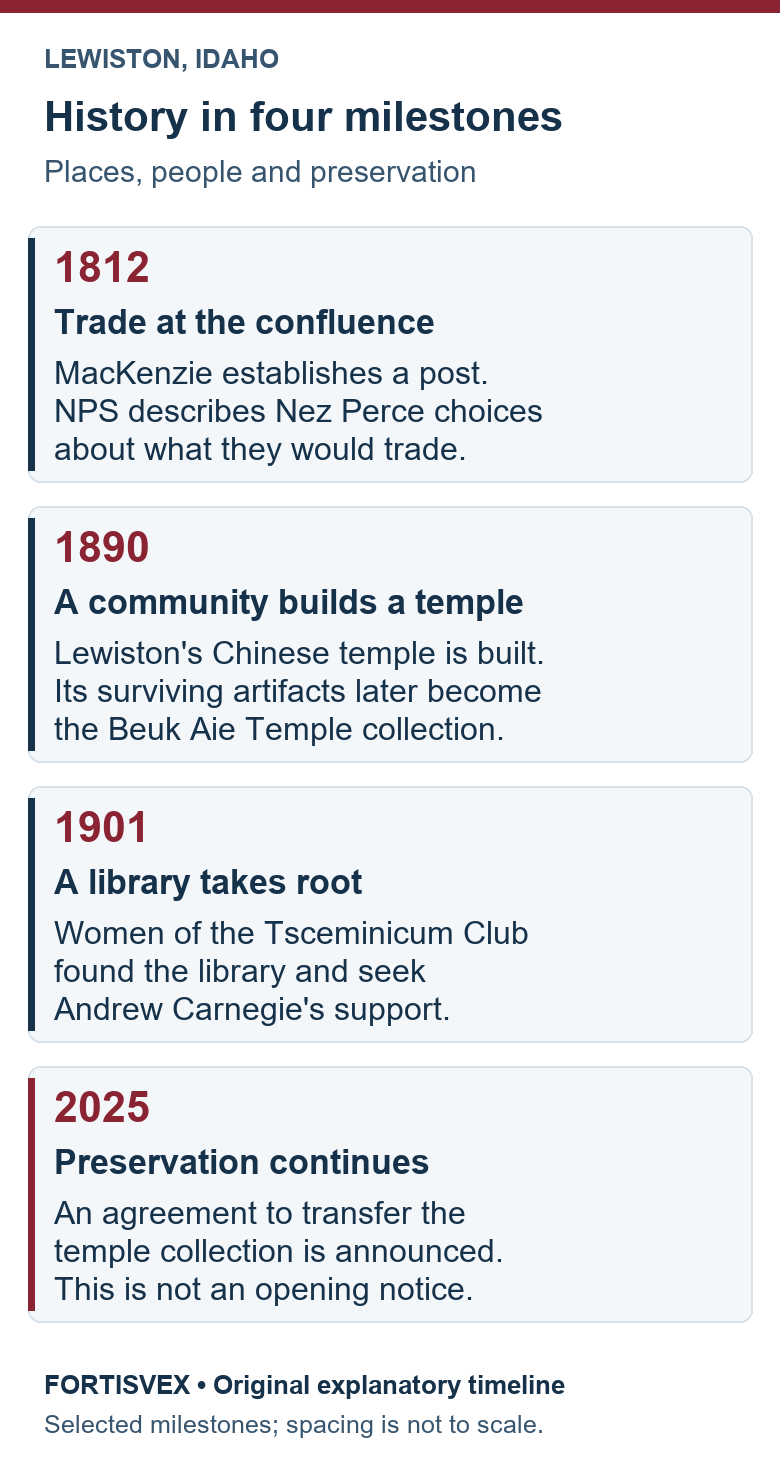
- 1812: MacKenzie's trading post — a commercial venture at the confluence.
- 1890: Chinese temple built — a community's place of worship.
- 1901: library founded by women of the Tsceminicum Club - a civic institution that would serve the community in several locations.
- 2025: temple collection agreement announced — a preservation decision, not proof of current exhibition access.
How to turn these stories into a useful local-history visit
Choose a question before choosing a route. At the confluence, ask how the landscape shaped an encounter and whose choices determined its outcome. With a museum collection, look for the distinction between an original object, a reconstruction and a later interpretation. At a reused building, ask which features belong to its earlier purpose and which serve its present one.
Keep historical dates and practical details in separate notes. An institution's founding date can remain sound while its hours, entrance or exhibition location changes. Check access with the organization responsible for the site, and do not assume that a regional attraction is within city limits or part of a continuous walking route.
For a classroom or community project, a simple source sheet can be more valuable than an overloaded display: record the place, the date being discussed, the organization supplying the information and one question still unanswered. That makes it easier for someone else to follow the evidence rather than repeat a story because it sounds familiar.
If your project also includes an Idaho flag display, the FORTISVEX Idaho state flag collection provides a place to compare individual listings. Check the specified size, material and attachment style against your own display equipment. These shopping links do not imply institutional endorsement or a required purchase.
The strongest local-history display leaves room for both what is known and what still needs checking. Lewiston's rivers, preserved temple artifacts and changing library spaces each reward that approach: look closely, name the evidence, and give the people behind it more than a date on a sign.
Recent Posts
-
Charcoal Weber Kettle Pulled Pork with Mustard-Cider Dressing
Pork shoulder rewards a steady fire and a texture check. This version uses paprika and fennel in th …Nov 4th 2026 -
Chubbuck, Idaho: From a Fire-Station Chalkboard to Places for a Growing Community
Chubbuck's civic history includes an emergency address written on a fire-station chalkboard, expand …Nov 3rd 2026 -
Garden City, Idaho: Chinese Gardens, Creative Work and a Living Landscape
Garden City's name carries a history that can be easy to miss from the road. Before the studios and …Nov 3rd 2026