
Idaho Falls and Public Power: Reading the River's Working History
Idaho Falls’ riverfront tells a story of construction as well as scenery. The falls have changed as the city built generating facilities, recovered from a flood and renewed its equipment. Understanding those changes makes the riverfront more interesting: a view of water also becomes a view of decisions about street lighting, public ownership and rebuilding.
The municipal utility’s River Walk history panels offer a useful starting point. Their subjects include the falls, individual plants, turbine technology and the Teton Dam flood. The linked HTML accounts let you follow that history before a visit or return to a particular question afterward. This guide focuses on those published accounts, rather than treating every structure along the river as a survivor of the same period.
1900: electricity for downtown streets
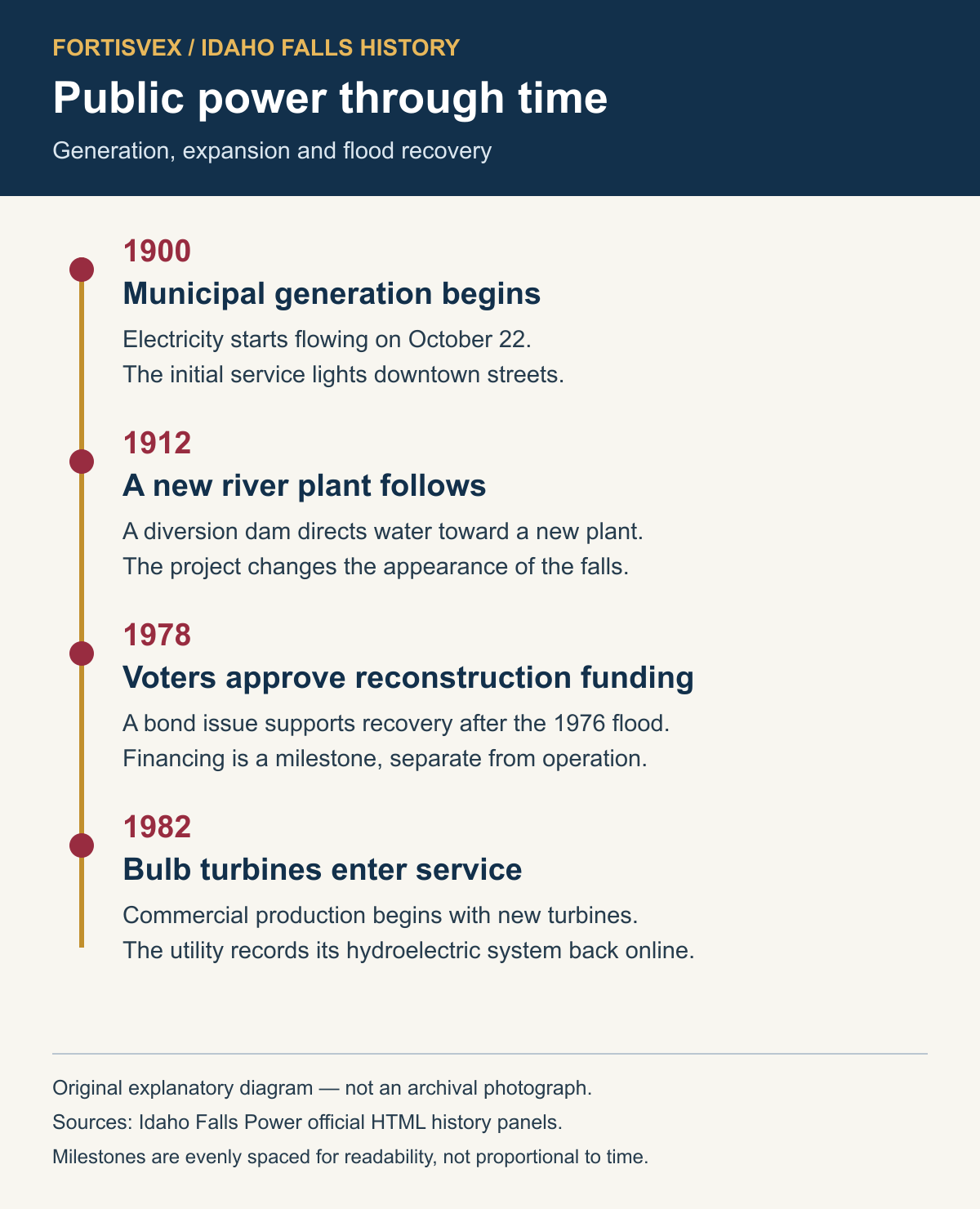
According to the utility’s early-history panel, Mayor Joseph A. Clark promised public power in 1900, and voters approved a bond to buy a turbine generator. Generation began on October 22 that year, supplying downtown street lights. Expansion followed in 1902 as homes and businesses adopted electricity.
These milestones separate the beginning of municipal generation from its growth into a broader service. Street lighting was an initial use; the customer base expanded afterward. When comparing an old photograph or family account with this chronology, ask whether it describes the first lighting system or a later stage of electrification.
1912: a river plant changes the view
The same early-history account describes a new hydroelectric plant on the Snake River in 1912. The utility’s falls panel explains that a diversion dam directed water toward the plant and identifies it as the city’s first run-of-river electric plant. Electricity generation helped shape a feature that would become central to the city’s visual identity.
That does not make the river itself artificial. It distinguishes the river’s natural setting from changes made to direct its flow. An older view of rapids and a later view of a long falling-water feature may document different stages of the same place. Use the photograph’s date and location before assuming the difference is an artistic choice.
1976–1982: rebuilding after the flood
Idaho Falls Power’s Teton Dam flood account records the dam’s failure on June 5, 1976. It says the flood destroyed the City Plant and damaged the Upper and Lower Plants. Recovery involved the generating facilities, the dam and spillway, and the falls themselves.
The account identifies two distinct milestones in rebuilding: voters approved a $48 million bond issue in 1978, and bulb turbines began commercial production in 1982. It also records a $7.3 million federal energy grant for licensing and construction. Those are historical project amounts, not present-day rates or cost estimates.
The gap between disaster, financing and renewed production is part of the story. A recovery date can mean several things: a vote, construction work or equipment entering service. Keeping those stages separate helps explain why the public record contains more than one date for the rebuilding effort.
The Lower Plant: renewal rather than a frozen relic
The utility’s Lower Plants account describes a further renovation beginning in 2014. It included two new turbines and refurbishment of the original generators; the plant returned online in 2016. The history of a working facility can include both retained equipment and replacement components.
This makes a useful question for anyone reading industrial history: what, exactly, is old? A plant name, a building and the equipment inside it need not share one installation date. The published account supports a story of continued renewal, not a claim that every part of the plant remains as first built.
Follow the panels with a few specific questions
Before setting out, use the official history-panel directory to choose the subjects that interest you. Its web entries are also useful if you cannot visit. They do not, by themselves, establish current access conditions or authorize entry into an operating facility.
- Which plant or river feature is this account describing?
- Does the date mark construction, a financing decision, renovation or operation?
- Which details describe the past, and which require a current source?
For a small home or community history display, pair a short, dated explanation with the relevant official source. If you include an American flag, compare FORTISVEX American flags by the size, material and attachment details stated on the listing. A modern flag display can introduce a discussion of local history without implying that a particular flag or seller was part of the historic project.
Recent Posts
-
Choosing a Historical Flag Reproduction: More Than Counting Stars
Before choosing a historical flag for a classroom or display, finish this sentence: “This flag will …Oct 29th 2026 -
The Flag, the Pledge and the Anthem: A Clear Ceremony Cue Sheet
A flag enters the room, a host invites the Pledge of Allegiance, and a musician begins the national …Oct 29th 2026 -
Welcoming International Guests: Plan a Multi-Nation Flag Display
A display for visiting international guests begins with a different question from a display of the …Oct 29th 2026