
How the words of the Pledge of Allegiance changed
The Pledge of Allegiance has a history of writing, revision and official recognition. Those are different events. Its first publication was not an act of Congress, and later changes to instructions for delivering it were not necessarily changes to the words being recited. Reading those layers separately helps explain why historical versions differ.
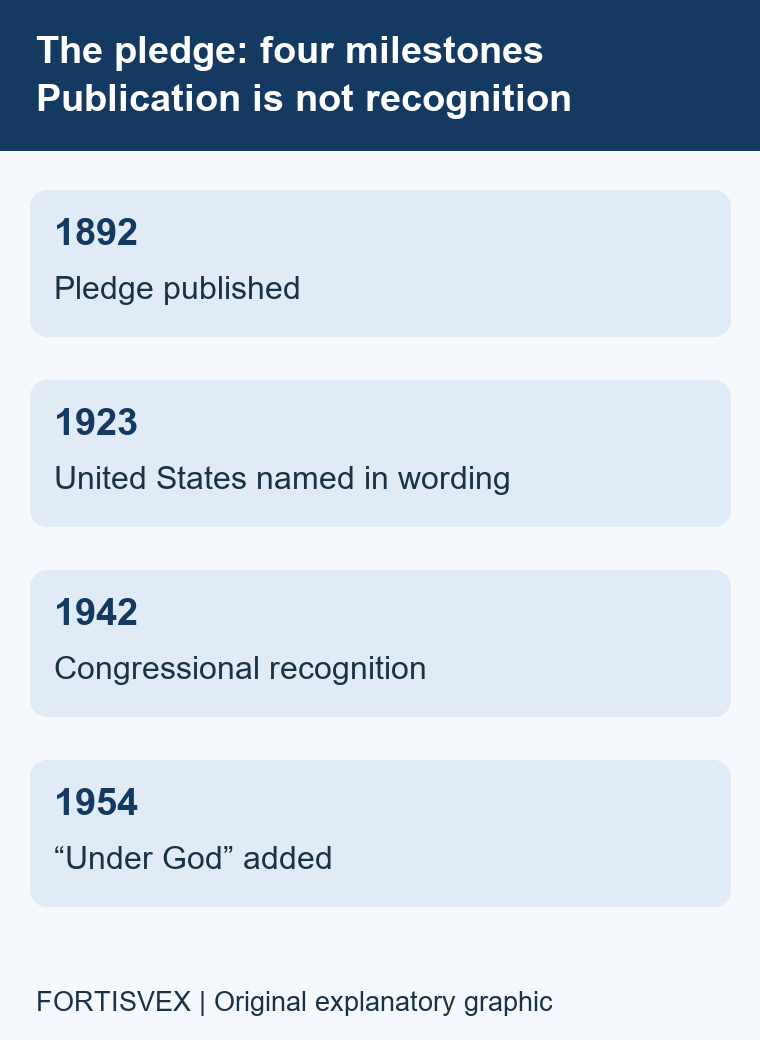
1892: a published pledge for a school celebration
The Government Publishing Office’s account of the pledge’s origins credits Francis Bellamy with the first version in 1892 and identifies its publication in the Boston magazine The Youth’s Companion. It was written for a celebration marking the four-hundredth anniversary of Columbus’s arrival in the Americas. That explains the setting of the publication; it does not make the pledge a founding-era text.
The National Museum of American History identifies September 8, 1892, as the magazine issue in which a version appeared. Its account places the pledge within a wider school culture of flags and patriotic imagery. This was a specific publishing and educational setting, not a text that had existed unchanged since the American Revolution.
For a historical display, separate the date of a printed source from the date of an event described in it. September publication and an autumn school celebration are different milestones. A caption can explain that connection without guessing which version every school used or making an unsupported claim about a particular classroom.
1923: naming the country in the words
Congress’s published history Our Flag, page 45 in its printed pagination, describes the replacement of “my flag” with wording identifying the flag of the United States. It attributes that change to the National Flag Conference in 1923. The publication explains the conference’s stated concern about ambiguity for people born outside the United States.
This was a change in the object named by the sentence: the speaker’s flag became an explicitly identified national flag. Describing the conference’s stated rationale is historical reporting, not a judgment about immigrants’ loyalty or a recommendation about how people should express belonging today.
Short quotations are useful here because they isolate the documented change. They do not pretend to reproduce every early edition’s capitalization, punctuation or intermediate wording. A complete transcription should always name its particular source and date.
1942: recognition was not authorship
The Capitol Visitor Center’s historical exhibit distinguishes the 1892 origin from Congress’s recognition of an amended version in 1942 flag legislation. The official Code’s historical source credits identify June 22, 1942. Thus, “Congress recognized the pledge in 1942” and “the pledge was published in 1892” describe different stages rather than contradictory dates.
That distinction also helps when pairing text with historical flag designs. Choose a design and a quoted text for the date your display actually addresses. The availability of a reproduction is not evidence that it appeared at a specific historical ceremony.
1954: a specific addition
The congressional history dates approval of the act adding “under God” to June 14, 1954. The official Code’s historical source table independently lists that date and the citation 68 Stat. 249. The phrase sits after “one Nation” in the current statutory wording.
The Capitol exhibit labels its House resolution artifact June 7, 1954. An artifact’s legislative-stage date need not be the approval date of the completed act. A museum label, a bill and an enacted law can each be accurately dated while recording different steps in the same process.
Read the words separately from delivery instructions
The current Code section contains both the pledge and instructions concerning its delivery. Its amendment notes include later changes addressing military salutes. Those later dates should not be used to suggest that the pledge’s spoken sentence was newly composed then. This article traces wording history; it is not a legal opinion or a direction about anyone’s participation.
For a contemporary display rather than a reconstruction, FORTISVEX American flags provide a starting point. Check the individual listing and your display equipment. The accompanying caption can tell the pledge’s history without turning a product into an alleged historical artifact or an endorsement by a school or government institution.
Its history is clearest when the milestones keep their proper names: publication, wording revision, recognition and amendment. That approach preserves the differences between the records while making a familiar sentence easier to understand.
Recent Posts
-
South Korea’s Taegeukgi: Check the Four Trigrams and Artwork Orientation
The South Korea flag, known as the Taegeukgi, is a good example of why artwork review should go beyo …Nov 2nd 2026 -
Brazil Flag Artwork: Check the Star Map Before Approving the Proof
The blue globe on a Brazil flag rewards a closer look. When buying a flag or reviewing a production …Nov 2nd 2026 -
Mexico Flag: The Eagle Is Part of the Design, Not an Optional Logo
A Mexico flag can look familiar at a glance while still needing a closer artwork check. When compari …Nov 2nd 2026