
Hagerman, Idaho: Fossils, Living History and the Places Between
FORTISVEX | Idaho local history
Hagerman asks visitors to think on more than one timescale. The city is a present-day community; the nearby fossil beds preserve evidence of ancient environments; and the history of people along the Snake River cannot be reduced to the date scientists began excavating. Keeping those stories distinct makes a visit more meaningful.
The fossil beds are not the city’s birthday
The National Park Service’s geodiversity account places Hagerman Fossil Beds National Monument west of town and dates its establishment to November 18, 1988. Its Pliocene fossils belong to a far older story. The account describes sedimentary evidence of wetlands, rivers, lakes and grasslands, rather than a landscape identical to the one visitors see now.
The same NPS account identifies the Hagerman horse, Equus simplicidens, as Idaho’s official state fossil. A fossil name can become a powerful local symbol, but it should not collapse geology into municipal history.
From a local find to scientific expeditions
According to NPS history, rancher Elmer Cook brought attention to fossils in 1928. Cook showed the fossils to H. T. Stearns of the U.S. Geological Survey, who contacted J. W. Gidley at the Smithsonian. The Smithsonian’s four field seasons followed in 1929, 1930, 1931 and 1934.
These dates describe a scientific investigation, not the first human awareness of the landscape. They also distinguish four expeditions from uninterrupted annual excavation. The difference matters when a short timeline is used to explain a much longer history.
A living relationship with the river
The NPS account of the Newenee exhibits describes collaboration with Shoshone-Bannock representatives on wayside text installed in 2021. It also publishes a welcome from the Tribes, which explains that relationships with these lands continue into the present despite forced removal.
That contemporary voice belongs alongside the fossil story, not behind it as a closed chapter. The page credits Shoshone-Bannock artist Derek No-Sun Brown for artwork created for the monument. Follow the linked interpretation to see how the artwork and wayside text bring that relationship into the visitor experience.

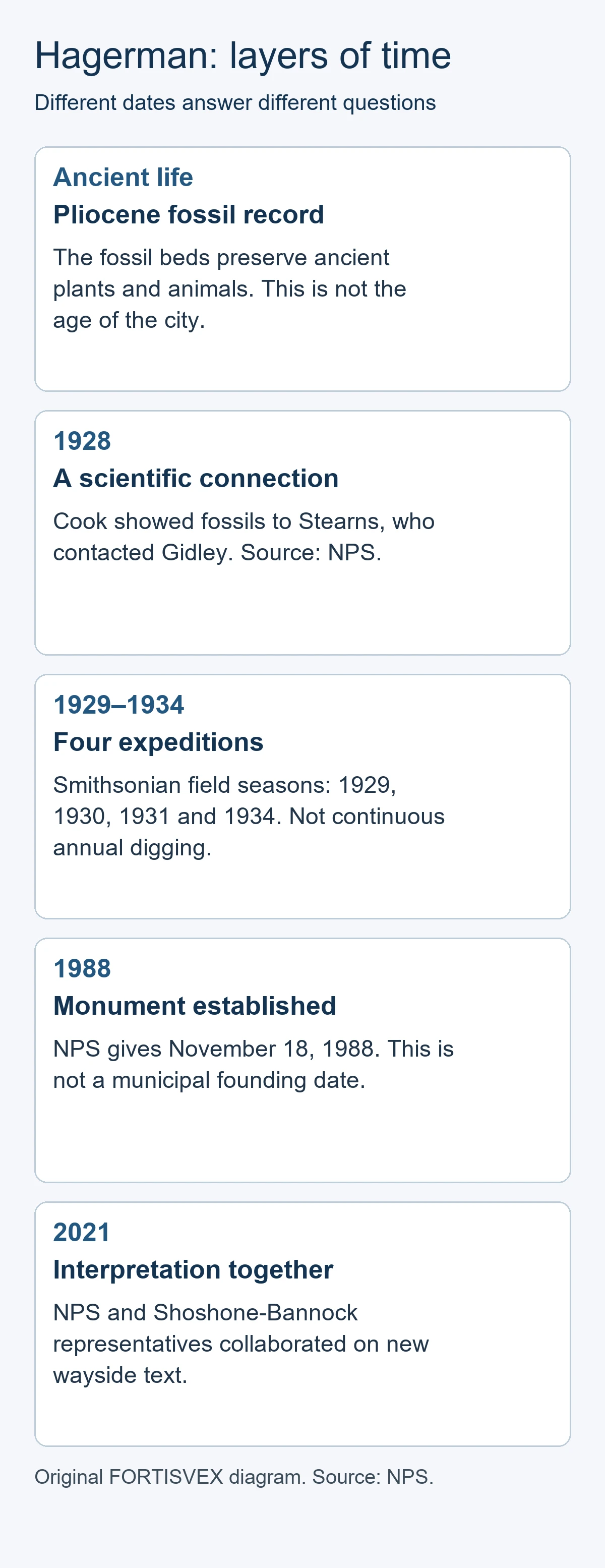
Diagram in text
- Ancient life: the Pliocene fossil record, separate from municipal history.
- 1928: Cook’s specimens connected with scientific institutions.
- 1929, 1930, 1931 and 1934: four Smithsonian expeditions.
- November 18, 1988: national monument established.
- 2021: new interpretation developed with Shoshone-Bannock representatives.
Plan for exhibits and overlooks, not a fossil dig

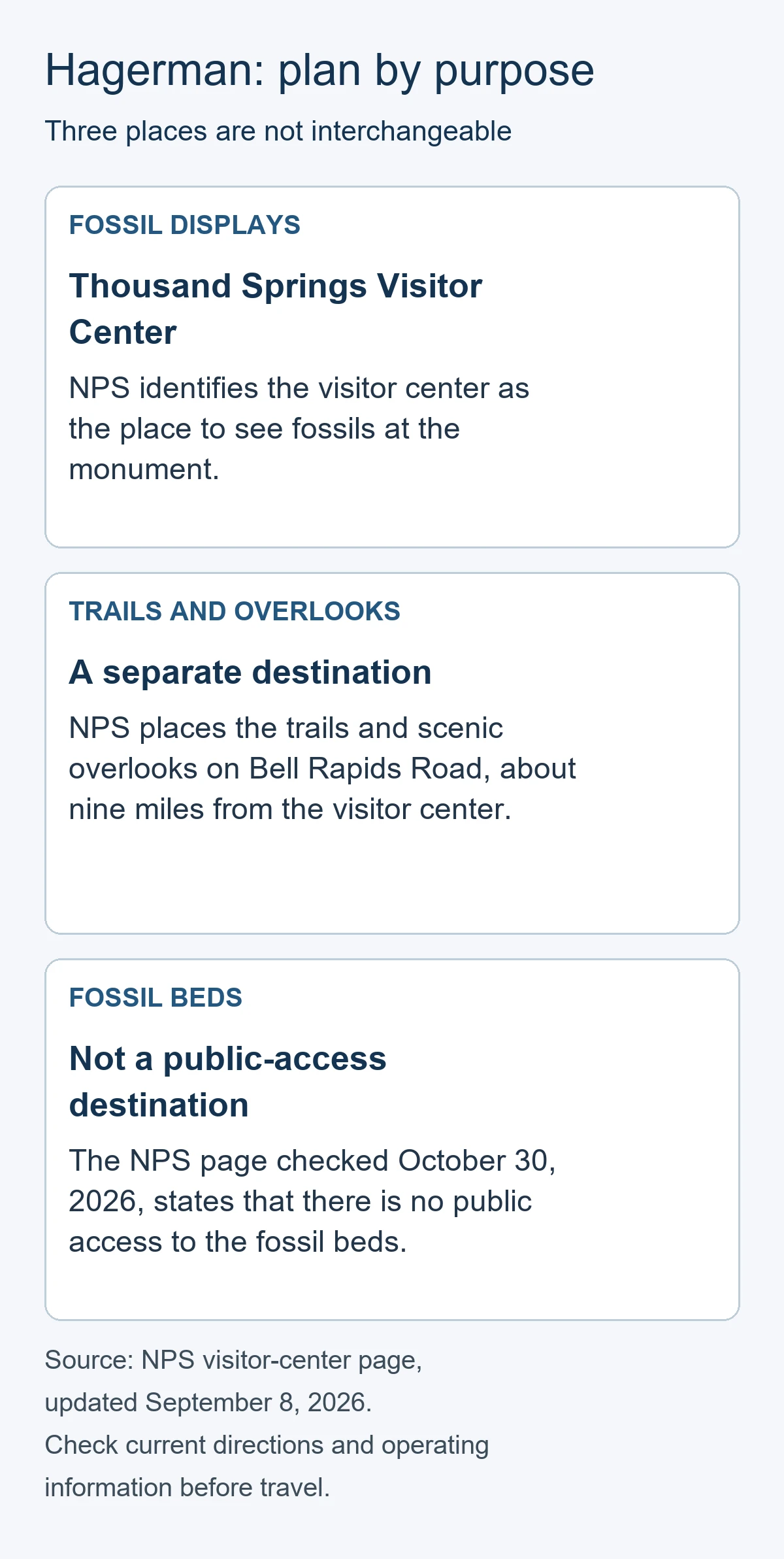
Planning distinctions in text
- Thousand Springs Visitor Center: NPS identifies the visitor center as the place to see fossils at the monument.
- A separate destination: NPS places the trails and scenic overlooks on Bell Rapids Road, about nine miles from the visitor center.
- Not a public-access destination: The NPS page checked October 30, 2026, states that there is no public access to the fossil beds.
Use these distinctions to plan separate stops for fossil displays and trails. The NPS information available on October 30, 2026, is a planning reference; check current directions and operating information before travel.
The NPS visitor-center page, updated September 8, 2026, identifies Thousand Springs Visitor Center at 17970 US Highway 30 as the place to see fossils at the monument. It serves both Hagerman Fossil Beds National Monument and Thousand Springs State Park. The monument’s trails and overlooks are separate, approximately nine miles away on Bell Rapids Road.
NPS states that there is no public access to the fossil beds. Read the current directions and operating information before leaving; an old location saved in a navigation app is not a substitute for the park’s instructions. These practical distinctions help turn a place-name search into a workable visit without promising access that the source does not allow.
For a separate home or community display today, explore Idaho state flags by size and configuration. If your display represents more than one state, browse the broader state flag collection. Readers also choosing a United States flag can browse American flags by material for their own setting. These are independent shopping resources, not an NPS endorsement or official monument souvenirs.
Recent Posts
-
Tofu and Broccoli Rice Bowls with Ginger-Garlic Sauce
FORTISVEX · RECIPES A good tofu bowl has more than one texture: golden edges on the tofu, broccoli …Nov 4th 2026 -
Placing an Indoor Flag Display: A Venue-Review Worksheet
An indoor flag display can fit its stand and still be poorly placed in a room. The base occupies on …Nov 4th 2026 -
Charcoal Weber Kettle Cauliflower Steaks with Lemon-Caper Dressing
A cauliflower steak needs two things: enough of the central stalk to hold together and enough cooki …Nov 4th 2026