
Georgetown, Idaho: Twin Creeks, Stringtown and a Community Remembered
Georgetown, Idaho: Twin Creeks, Stringtown and a Community Remembered
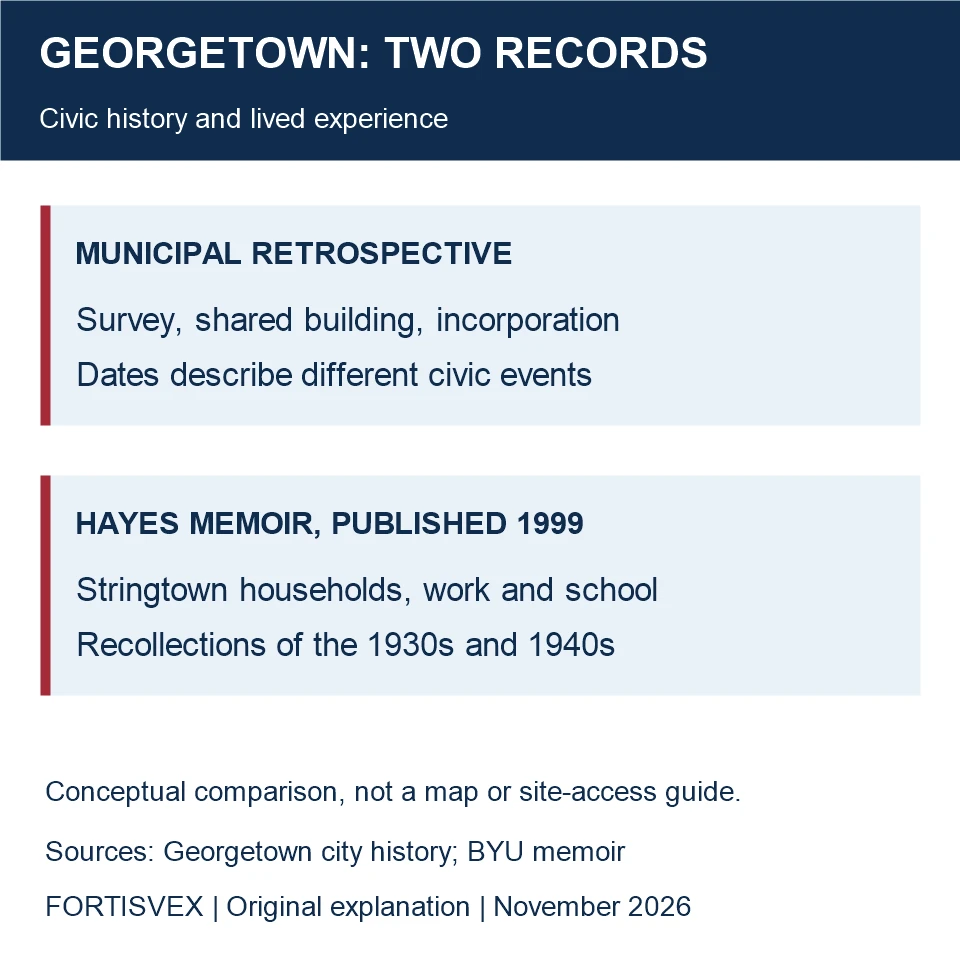
Georgetown's history has more than one scale. Municipal dates describe a town taking legal shape; a resident's memories describe the households and work that made it a community. Read together, they give this Bear Lake County place a richer identity than a founding date alone.
The town in the municipal record
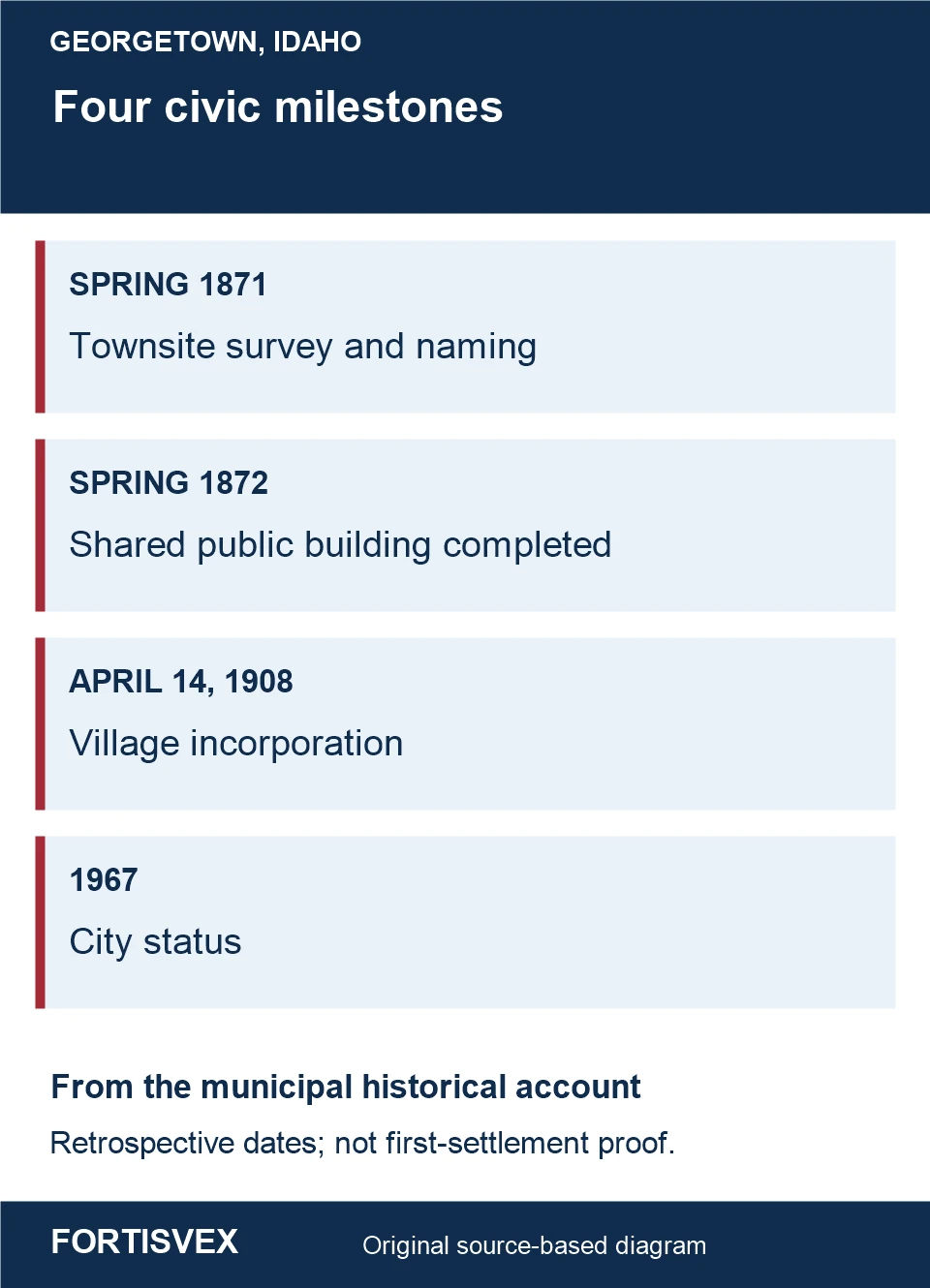
The city's historical account places Georgetown between the Bear River and mountains to the east. It identifies Twin Creeks as an earlier name, then dates a townsite survey and the Georgetown name to spring 1871. Its account attributes the name to George Q. Cannon.
The same retrospective describes a one-room public building completed in spring 1872 for school, church and recreation. It records village incorporation on April 14, 1908, followed by city status in 1967. These civic milestones are useful independently of disputed claims about the area's very first settlement.
Local livelihoods were tied to the surrounding landscape. The municipal account describes sawmills, dairy farms and a cheese factory supplying the region. It offers a historical picture of production and shared services, not a current business directory.
A childhood at the canyon mouth
Darwin L. Hayes's memoir published in BYU's Fall 1999 magazine shifts the focus to Stringtown, near the mouth of Georgetown Canyon. Recalling the 1930s, he describes eleven families along a dirt road and his own family's home in a converted granary beside Big Creek.
His memories connect household life with irrigation, agricultural labor and schooling. He recalls neighbors sharing harvest work and a teacher who challenged pupils to distinguish formal grammar from a person's intelligence or worth. These are a participant's recollections, rather than a census or a complete account of every household.
Hayes also complicates the warm picture of mutual help. He recounts racial hostility affecting friends and families, including events in nearby Montpelier, and rejects the idea that community goodness maintains itself without effort. Keeping that part of his testimony matters: it prevents a local-history feature from turning remembered cooperation into an unqualified golden age.
The canyon beyond the town
The Forest Service's Summit View account places the campground roughly eight miles east of Georgetown in the Bear River Range. Its route description begins at U.S. Highway 30 in town, then follows Georgetown Canyon toward the national forest. This helps locate the mountain setting without treating a forest destination as a city facility.
The page inspected November 1, 2026 displayed a closed-site label alongside general after-season access language. Confirm conditions with the managing agency before travel; this article does not resolve that inconsistency or promise water, road access or an open campsite.
A state symbol without losing the local story
For a family-history gathering, the most valuable material is the identified record: whose recollection, which place, and what date. An Idaho state flag can provide a present-day state setting while the accounts of Twin Creeks and Stringtown remain the focus. It should not stand in for evidence about a flag used by earlier residents.
If your family-history gathering includes records from several states, use the state flag collections to choose present-day symbols for those places. If an American flag is also part of the display, the American flag material-selection page helps you compare fabric categories before checking individual sizes, attachments and intended use. Keep those display choices separate from the historical evidence in each family record.
Recent Posts
-
Grace, Idaho: Understanding the Water Behind the Fields and the Powerhouse
Grace, Idaho: Understanding the Water Behind the Fields and the Powerhouse A canal and a hydroelect …Nov 4th 2026 -
Donnelly, Idaho: The Railroad Town and the Records Behind Its Story
Donnelly, Idaho: The Railroad Town and the Records Behind Its Story Donnelly's municipal history pl …Nov 4th 2026 -
Bovill, Idaho: Reading a Town’s History Through Family, Main Street and Celebration
Bovill, Idaho: Reading a Town’s History Through Family, Main Street and Celebration A family standi …Nov 4th 2026