
Garden Flag Sizes: Read Height, Width and Holder Fit Before Buying
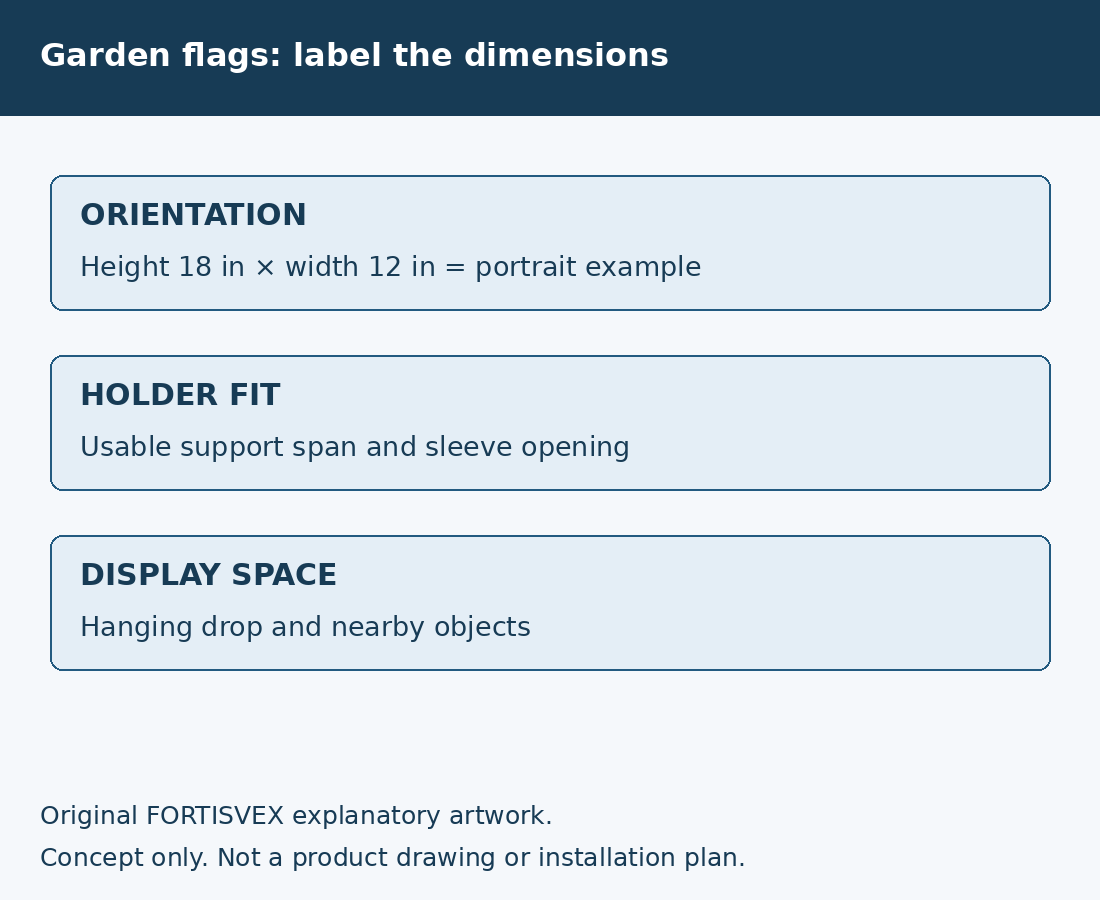
An 18-by-12-inch garden flag is a portrait-shaped display when the listing specifies height first. Check that orientation before matching the flag to an existing holder.
Start with the view you want in the garden
A small flag near a planting bed is often chosen for its design first. The useful buying questions begin one step earlier: which way will it hang, how much space will the picture occupy, and what support will hold its upper edge? A flag that looks proportionate on a product page may be too wide for an existing holder or too low for the intended spot. Read the dimensions as a labeled description rather than a familiar pair of numbers.
Do not silently reverse the dimensions
A label reading “12 by 18” may appear to contain the same information as “18 by 12,” but the order matters when it represents width and height. Write the words beside the numbers: height 18 inches, width 12 inches. This avoids an accidental quarter-turn in your plan. Rotating a flag to make the numbers fit a holder can also rotate the design or put its sleeve on the wrong edge.
For a comparison sketch, draw the intended upright rectangle and label its upper edge. Do not use a square thumbnail as a scale reference; website images can have surrounding space or be cropped. A dimensioned product description gives you information that a photograph alone may not provide.
Compare the holder’s usable span, not its overall silhouette
If you already own a holder, identify its model and the flag sizes it is intended to support. Its overall width may include a decorative curl, stop or other feature beyond the usable supporting section. Keep that overall measurement separate from the span available to the flag. A listing that calls a holder “garden size” still needs enough detail to confirm the intended flag.
The sleeve opening is a separate compatibility question. A twelve-inch-wide flag does not establish the opening’s diameter or prove that it passes over a particular holder end. Use the applicable holder and flag specifications; do not force the sleeve over a feature or improvise a modification because the visible widths seem close. This is a buying comparison, not an installation procedure.
Plan the hanging drop as well as the width
The flag’s height determines how far the fabric extends below its supported top edge. Check the intended display area with that drop in mind. Consider the ground, edging, plants and any other objects beneath or beside it. The holder’s total advertised height does not necessarily tell you where the supporting arm will sit in the finished setup. Follow the holder’s own use instructions rather than subtracting an invented insertion depth.
A simple paper rectangle or labeled sketch can help visualize the fabric’s area without claiming to model its movement outdoors. Leave room to assess the whole display, not only whether a rectangle fits between two objects in a photograph. Placement near a walking route also needs the ordinary site-specific clearance review before use.
An explicitly hypothetical fit comparison
Suppose a buyer has a documented holder intended for a flag twelve inches wide and eighteen inches high. That makes an 18-high-by-12-wide garden flag a sensible candidate for further review. It does not settle the sleeve opening or retaining arrangement; those details still need to match the holder.
Now suppose the only note says “holder approximately 18 inches wide.” That number may describe the entire object rather than its usable support. Buying an 18-inch-wide flag from that note would introduce an unsupported assumption. The right next step is to identify the holder’s stated flag-size compatibility, not to use the largest remembered measurement as the purchase size. Both examples are invented teaching cases, not fit approvals.
Check the design from the intended viewing direction
Think about where people will see the flag: from a path, a window or opposite sides of a bed. If readable text or a particular emblem orientation matters, examine the exact product’s construction and reverse-side description. Do not assume that a small garden flag has a separately readable image on both sides merely because the front photograph looks clear.
Similarly, a military design in garden format should be selected deliberately, rather than substituting another organization’s flag because it shares a color. The Air Force category contains several formats; the garden dimensions identify the small upright version discussed here. This article does not make a ceremonial-use claim for that product.
Separate the textile purchase from the holder purchase
The Air Force garden flag listing states that the garden flag stake is sold separately. For any other selected offer, check whether it includes only the flag or a stated set of components. A lifestyle photograph containing a holder does not establish that the holder is included. If you are buying a gift, clarify whether the recipient already has a compatible holder; otherwise a suitable textile can arrive without a usable display arrangement.
Keep the flag and holder as separate lines in your comparison. That is more useful than assuming that any accessory bearing the word “garden” will complete the purchase.
Recent Posts
-
Tofu and Broccoli Rice Bowls with Ginger-Garlic Sauce
FORTISVEX · RECIPES A good tofu bowl has more than one texture: golden edges on the tofu, broccoli …Nov 4th 2026 -
Placing an Indoor Flag Display: A Venue-Review Worksheet
An indoor flag display can fit its stand and still be poorly placed in a room. The base occupies on …Nov 4th 2026 -
Charcoal Weber Kettle Cauliflower Steaks with Lemon-Caper Dressing
A cauliflower steak needs two things: enough of the central stalk to hold together and enough cooki …Nov 4th 2026