
Reading the 2008 Flags of Our Nation Stamps Without Mixing Up the Dates
A stamp can show a flag, a landscape and a postal issue date at once. The 2008 series offers a practical lesson in keeping those layers separate.
Begin with what USPS actually announced
The 2008 USPS series overview described Flags of Our Nation as a planned sixty-design series featuring the United States flag and flags of the states, territories and District of Columbia. It outlined a multi-year release plan. That page is evidence of what USPS announced at that time, not proof that every later release followed the original schedule. When writing about a particular issue, use its own dated release announcement as well. This is a useful research habit beyond stamps: a prospectus and a completion record answer different questions.
The second set provides a concrete example
A USPS announcement dated September 2, 2008 identifies the second set as ten designs: District of Columbia, Florida, Georgia, Guam, Hawaii, Idaho, Illinois, Indiana, Iowa and Kansas. The list is especially helpful because it shows why “ten state flags” would be an inaccurate shorthand. The District of Columbia and Guam appear in the group alongside states. A caption can avoid that problem by saying “ten flag designs” and naming the places shown. Precision here does not require a lengthy political explanation; it requires choosing the right collective noun.
Alphabetical order is not historical order
The series overview explained that the designs were arranged alphabetically in strips of ten, with five repeating strips making a coil of fifty stamps. That arrangement is not a ranking of places, a statehood sequence or a timeline of flag adoption. A separated stamp loses the visual context supplied by its neighbors, so a collector’s display should explain the ordering if it matters to the story. A straightforward label such as “second set, issued in 2008” tells readers more than suggesting that its position reveals when the depicted flag originated.
The background is a snapshot, not an automatic official emblem
USPS described the backgrounds as snapshots associated with each place and expressly explained that they were not restricted to official birds, flowers, products or landmarks. That distinction matters when a student uses a stamp as a research starting point. A flower drawn beside a state flag may be part of an artist’s scene rather than evidence that the flower is the state’s legally designated floral emblem. Treat the scene as a prompt for another question. If the project needs an official-symbol claim, verify that claim separately with the relevant government source instead of inferring it from the stamp.
Separate issue date from flag-design date
The September 2008 announcement tells you when that postal set was released. It does not, by itself, establish when each depicted flag was adopted, when the artwork was completed or when a particular mailed envelope traveled. Those dates can all differ. On a classroom label, put “stamp issue date” before the postal date and “flag adoption date” before any independently researched adoption date. If you have not researched the latter, leave it out. A blank field or a narrower caption is better than silently assigning the stamp’s year to the design it portrays.
Use postal vocabulary only when it helps
The USPS overview uses the term “se-tenant” for attached stamps that differ in design, color or denomination. In this series, the differing flag designs explain why that term is useful. A general audience does not need a glossary before it can enjoy the stamps, but one short definition helps explain a strip containing several images. Pair the term with a plain-language phrase rather than replacing a clear description with specialist vocabulary. Likewise, distinguish a single design from a strip and a coil. Counting pictures and counting physical stamps are not always the same task.
Build a caption from three evidence layers
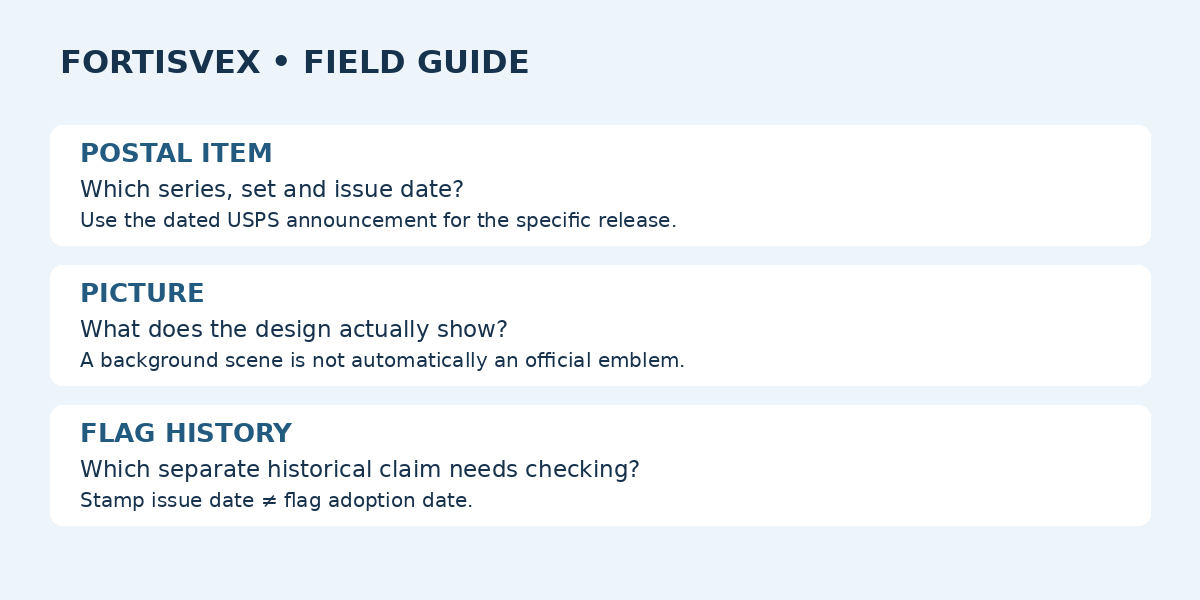
Try a compact worksheet with three rows. In the first, identify the postal item: series, set and documented issue date. In the second, describe what the image shows without adding a historical interpretation. In the third, record any separate flag-history fact with its own source. For example, “the image includes a state flag and a landscape” is a description; “this landscape is an official state symbol” requires additional evidence. Keep those rows separate until you write the caption. This method helps you see which statements are supported and which remain questions.
Official sources
Recent Posts
-
Charcoal Weber Kettle Pulled Pork with Mustard-Cider Dressing
Pork shoulder rewards a steady fire and a texture check. This version uses paprika and fennel in th …Nov 4th 2026 -
Chubbuck, Idaho: From a Fire-Station Chalkboard to Places for a Growing Community
Chubbuck's civic history includes an emergency address written on a fire-station chalkboard, expand …Nov 3rd 2026 -
Garden City, Idaho: Chinese Gardens, Creative Work and a Living Landscape
Garden City's name carries a history that can be easy to miss from the road. Before the studios and …Nov 3rd 2026