
Ordering a Flagpole Counterweight: Record Weight, Length and Eyebolts
The weight number is only one part of a replacement record. Keep the complete configuration tied to the existing internal-halyard system.
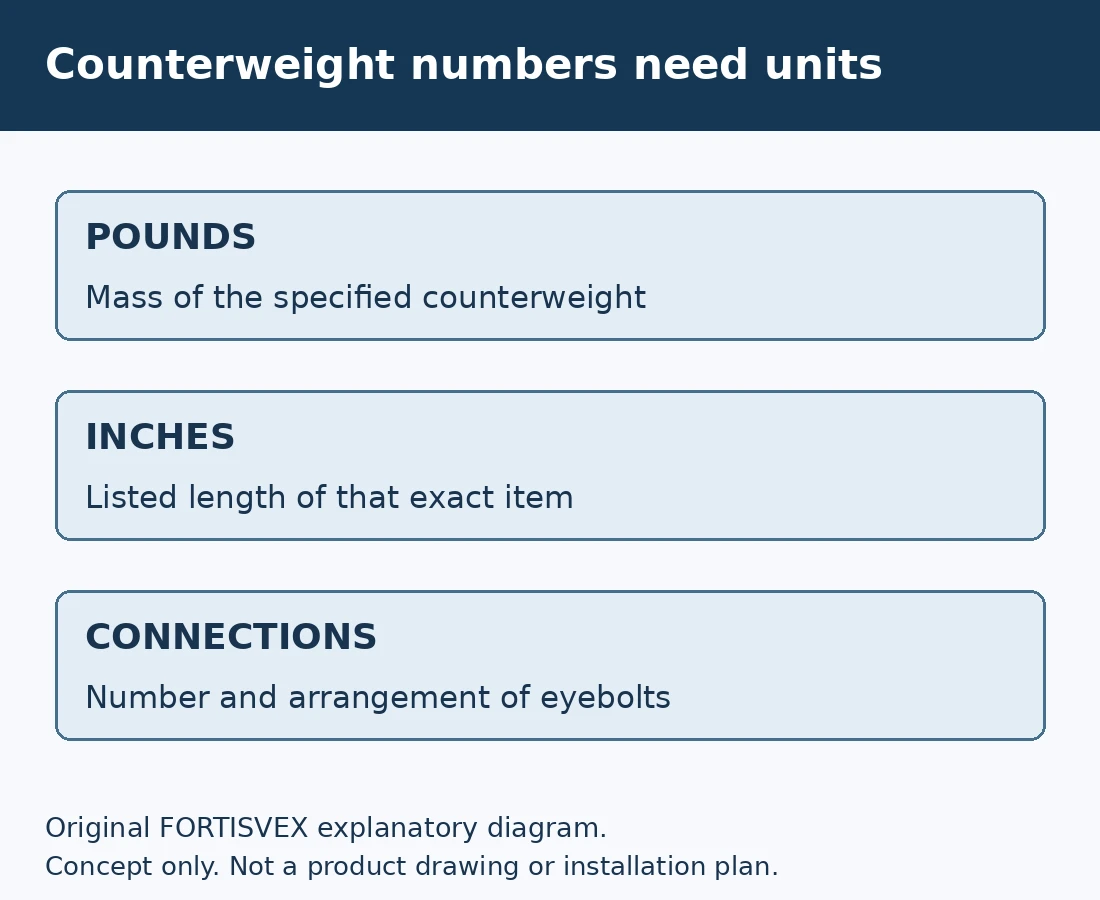
Treat this as a component-matching task
A counterweight listing can look straightforward: choose a weight and a color, then place the order. That approach skips the system the component belongs to. Begin with the pole and internal-halyard assembly identification already held in your maintenance records. Record the replacement requirement from the applicable documentation before shopping. This article is about preparing that purchasing record; it is not a procedure for releasing a loaded line, opening a mechanism or changing the tension of an installed system.
A real configuration comparison
The counterweight listings distinguish these specific examples. The table separates the consistent length and connection details. It deliberately does not supply an exact mass: the current titles and specification sections disagree for these three listings, so no disputed number is treated as a verified weight.
| Part | Listed length | Eyebolts |
|---|---|---|
| 360316, silver | 3.5 inches | One |
| 360317, silver | 7 inches | Two, one at each end |
| 360515, black | 14 inches | Two, one at each end |
A length in inches does not establish a weight in pounds, even when a product name uses a similar number. The two longer examples share an eyebolt count without sharing length. No single column is enough to identify a replacement. Confirm the exact required mass against the identified system, then obtain consistent product information before ordering. These are listed configurations, not a selection chart assigning weights to pole heights or flag sizes.
Resolve conflicting weight information before buying
When a product title and its specification section disagree, keep both source references and mark the mass unresolved. Do not assume that one figure is a shipping weight, a rounded value or a corrected specification unless the listing actually explains that distinction. A purchaser should not have to invent the reason for a discrepancy.
When requesting clarification from FORTISVEX, identify the exact part and ask which mass applies to the item being supplied. Keep the answer with the purchase record. Until that clarification is available, the table can help identify a candidate by length and connections, but it cannot confirm the complete replacement specification.
Use the system requirement to narrow the list
Start a comparison with the required component specification on the left and the candidate listing on the right. Include weight, body length, connection arrangement, finish and part number where documented. Put the pole or assembly model at the top of the page so the comparison cannot become detached from the system it serves.
A number printed on an old purchasing note may identify a part, a weight or an invoice line. Preserve its label. If the note simply says “3.5,” do not fill in missing units from memory. A product name can repeat a number used for a dimension without resolving the exact mass. Preserve the separate fields and their sources rather than completing one from the other.
A hypothetical record with one missing field
Suppose a facility record says: “Required replacement: 3.5 lb; one eyebolt; silver; original part number unconfirmed.” A candidate with those visible features may deserve further review, but the missing identity still matters. Record the candidate’s exact number and compare it with the approved system information before treating it as interchangeable.
If a second candidate has two eyebolts, do not call it an upgrade solely because it offers another connection point. Its arrangement may serve a different specification. This example is invented to illustrate a purchasing decision; it does not authorize a substitution in any installed system.
Avoid selecting by pole height or wind alone
A general impression that a pole is “tall” or that a site is “windy” is not a component specification. Do not invent a weight-selection chart from those descriptions, and do not infer that a heavier counterweight will improve an unfamiliar assembly. The correct requirement needs to come from the identified system and its applicable instructions.
Similarly, a product description mentioning more than one type of pole does not prove compatibility with every model in those categories. Keep a specific product claim narrow. If the required combination cannot be confirmed, preserve the question in the purchase record instead of replacing it with a confident assumption.
Distinguish a replacement from a proposed system change
A like-for-like purchase begins with a known approved configuration and seeks the corresponding component. A proposed change begins with a different requirement and needs its own technical basis. If the original requirement is unknown, the order is not yet a confirmed like-for-like replacement, even when a candidate resembles the old component.
This matters especially when comparing the category’s one-eyebolt and two-eyebolt arrangements. Record the connection layout as a separate field rather than assuming a second eye can simply remain unused. The page’s configuration descriptions help identify products; they do not provide a substitution procedure. Likewise, do not replace a documented component with a heavier one merely because it is available sooner.
A purchase-review question that preserves the missing information
Sample wording: “Our assembly record identifies the required counterweight configuration as 3.5 lb with one eyebolt. Candidate 360316 lists a 3.5-inch length and one eyebolt, but its title and weight specification disagree. Please clarify the exact mass and verify the complete configuration against the identified assembly before approving the replacement; we have not established interchangeability from appearance.”
If there is no assembly record, begin by identifying the equipment through the appropriate existing documentation or authorized inspection process. Do not detach a loaded component just to obtain a shopping measurement. If the problem involves abnormal movement or damaged parts, keep that maintenance concern separate from the order. A new counterweight is not, by itself, a diagnosis or a confirmed remedy for an operating problem.
Recent Posts
-
South Korea’s Taegeukgi: Check the Four Trigrams and Artwork Orientation
The South Korea flag, known as the Taegeukgi, is a good example of why artwork review should go beyo …Nov 2nd 2026 -
Brazil Flag Artwork: Check the Star Map Before Approving the Proof
The blue globe on a Brazil flag rewards a closer look. When buying a flag or reviewing a production …Nov 2nd 2026 -
Mexico Flag: The Eagle Is Part of the Design, Not an Optional Logo
A Mexico flag can look familiar at a glance while still needing a closer artwork check. When compari …Nov 2nd 2026