
Keep the Story with the Flag: A Family Provenance Record That Separates Facts from Memories
A family flag sometimes arrives with a clear story: a person, a ceremony and a date. Sometimes it comes with only a sentence repeated over the years. In both cases, the most useful first project may be a record rather than a display. Write down what came with the object, who supplied the information and which parts can be checked. A modest, traceable account can preserve more history than an elaborate label built on assumptions.
This article is about documenting association and custody. It does not authenticate a flag, establish a market value or replace conservation advice. For handling and storage questions, see our inherited-flag preservation guide. Here the task is to keep evidence and memory connected without pretending they are the same kind of source.
Give the object a neutral working name
Start with a name that describes what you know. 'Flag received from Aunt Maria in 2026' is a usable working title. A title declaring that it flew in a named battle is a historical claim that needs evidence. You can record the family account without promoting it into the object's official identity.
Assign a simple internal identifier and use it consistently on the record and digital files. The identifier belongs on an appropriate enclosure or record, not as an improvised mark on the textile. If you have several flags, distinguish them before gathering stories so that photographs, documents and recollections do not drift from one object to another. Keep a short explanation of the naming system for the next person who will manage the collection.
Build three columns before writing the story
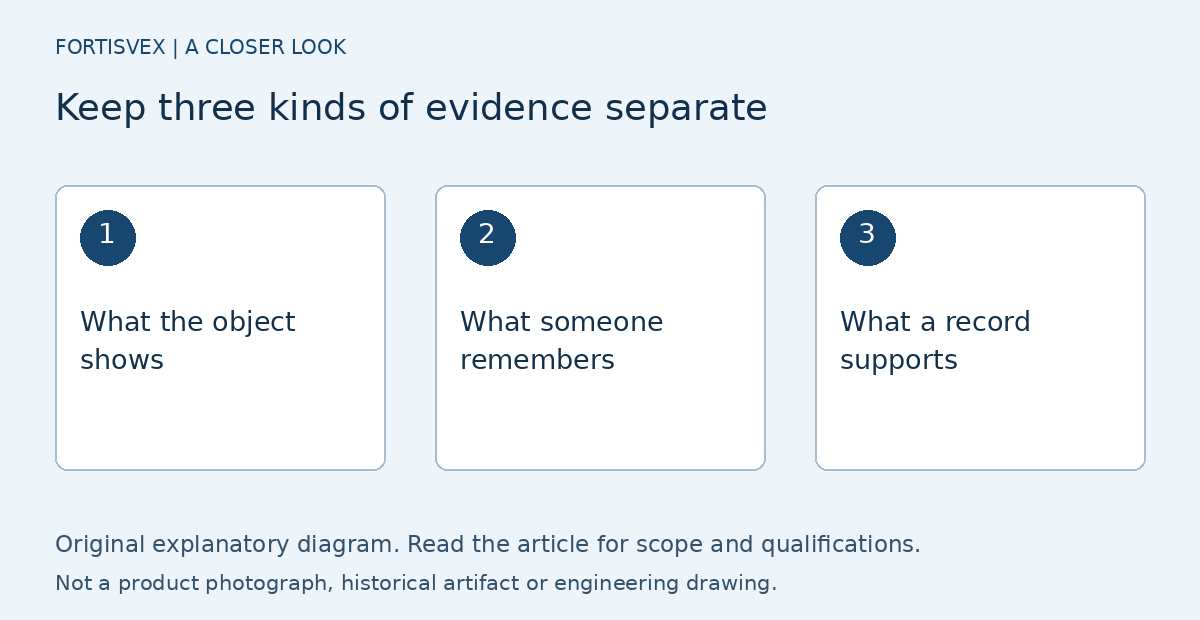
Use separate columns for observation, reported memory and documentary evidence. An observation records something visible, such as a label or repair, without explaining its origin. A reported memory records who said what and when. Documentary evidence identifies the letter, photograph, receipt or other record that supports a specific point.
Suppose a relative remembers the flag being displayed at a retirement ceremony. Write that statement with the relative's name and the date you recorded it. If you later find a dated photograph, add it as a new source. Do not erase the earlier note or silently rewrite it to match the photograph. The development of the research is useful history too. Differences can help distinguish two ceremonies or two similar-looking flags.
Record custody as a sequence
A simple custody timeline asks who had the flag, approximately when, and how it moved to the next person. It is acceptable to have gaps. A line such as 'location unknown between these dates' is more accurate than filling the interval with a plausible family narrative. Distinguish possession from original use: someone can own an object without having been present at the event associated with it.
For each transfer, record the basis of the information. Was the transfer documented in a letter, remembered by a participant or inferred from where the object was found? Include the date of your note, not just the date of the supposed event. A future researcher should be able to tell a contemporary statement from a recollection made decades later.
Keep related papers identifiable
Letters, presentation certificates and photographs can explain a flag's history, but an item found in the same box is not automatically proof that it belongs to that flag. Record the association as found and investigate it. If a caption names a person but not the flag, preserve that limited claim rather than expanding it.
National Archives family-archive guidance emphasizes preventing damage and keeping originals after digitization. Apply its paper-and-photograph guidance to the supporting records; do not assume a paper technique is suitable for a textile. Scan or photograph documents only when they can be handled safely. Keep the whole document, including identifying context, alongside any cropped detail used in a family story.
Name digital files for retrieval, not certainty
A practical filename can combine the object identifier, a view or document type and the date of photography. Avoid turning an uncertain historical date into a filename that looks definitive. If a date is approximate, say so in the metadata or accompanying note. Keep an untouched original file and make separately identified working copies for cropping or annotation.
The Library of Congress's catalog guidance is a useful reminder that the date assigned to an image and the period depicted are not necessarily the same. Apply that distinction to your own collection. Record when a scan was made, what it reproduces and what is known about the original. Do not let a new digital file's creation date become the supposed date of the historical scene.
Ask questions that invite detail rather than agreement
When speaking with relatives, begin with open questions: what do you remember about this object, where did you see it and who else was present? Then ask how they learned the information. Avoid leading with an exciting theory and asking them to confirm it. Record disagreements respectfully and identify each speaker.
If someone is comfortable being recorded, obtain their permission and explain how the recording will be used. A written summary can also work. Let the person distinguish a firsthand memory from a story received from someone else. Preserve names as supplied, and separately note possible spelling corrections rather than silently changing the account.
Create a short public caption and a fuller private record
A family display does not need to expose every private address, phone number or personal document. Write a concise caption supported by the evidence, and keep the more detailed research file in an appropriate private location. If an association remains uncertain, qualify it plainly. A caption can be meaningful without claiming more than you know.
A contemporary American flag may serve a separate everyday display role while the inherited object and its record are preserved. If you choose that approach, describe the new display honestly: it honors a person or story, but it is not the original object. The distinction protects both the family history and the reader's understanding.
Leave the next custodian a usable package
Finish with the object identifier, custody timeline, source list, photographs, unresolved questions and a clear location for the originals. Add a brief note explaining the folder structure and naming conventions. Make sure a trusted future custodian knows the record exists.
The goal is not to remove every uncertainty. It is to prevent uncertainty from being disguised as fact and to keep a recoverable trail. A flag's story becomes stronger when another person can see how you know it.
Sources and further reading
Recent Posts
-
South Korea’s Taegeukgi: Check the Four Trigrams and Artwork Orientation
The South Korea flag, known as the Taegeukgi, is a good example of why artwork review should go beyo …Nov 2nd 2026 -
Brazil Flag Artwork: Check the Star Map Before Approving the Proof
The blue globe on a Brazil flag rewards a closer look. When buying a flag or reviewing a production …Nov 2nd 2026 -
Mexico Flag: The Eagle Is Part of the Design, Not an Optional Logo
A Mexico flag can look familiar at a glance while still needing a closer artwork check. When compari …Nov 2nd 2026