
Can a Flag Date an Old Photograph? Build a Range Before Naming a Year
An old photograph shows a flag above a building. You count the stars, find a historical design period and feel close to an exact year. The flag may indeed be a useful clue. But the photograph could show an older flag still in use, a commemorative display or a reproduction. Part of the union may also be hidden by a fold. The safest next step is to build an evidence record, not to turn a partial count into a precise date.
The Library of Congress describes dating photographs as a process that uses multiple clues, including clothing, a photographer's life dates and the physical medium. Sometimes the defensible answer is a span of years. This guide applies that approach to photographs containing flags. It offers a research method, not an authentication service.
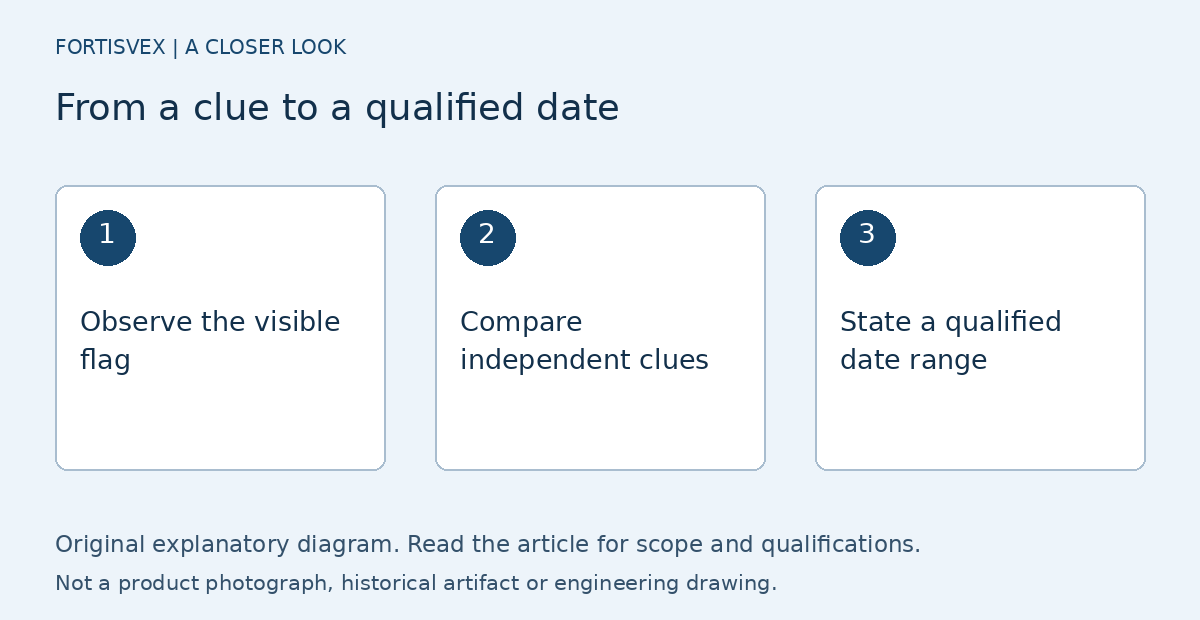
Record what you can actually see
Begin with an observation before an interpretation. Note whether the entire union is visible, whether a fold obscures a row, and whether the image has enough detail to distinguish a star from damage or grain. If the count is incomplete, write that down. 'At least this many visible stars' and 'this is a particular star-count design' are different claims.
Keep a copy of the whole image alongside any detail crop. The wider scene may contain a sign, building or event banner that proves more useful than the flag. A crop is a research aid; it should not quietly remove the context needed to understand the original. Record where the image came from and whether you are looking at an original print, a scan, a copy negative or a later reproduction.
Official design dates are not automatic manufacture dates
The National Park Service's Fort Sumter account explains that the United States had a 33-star flag when Kansas entered the Union in January 1861; the new star followed on July 4. That example shows why admission dates and flag-change dates must be distinguished. It also explains that star arrangements were not standardized in that early period.
An additional limit follows from ordinary object use: an official change does not establish that every older flag disappeared that day. For dating a photograph, a design period is therefore evidence to assess alongside other clues. It is not, by itself, proof of when a particular textile was made, acquired or photographed. Our 49-star flag history offers another specific transition to study, but it should not become a shortcut for dating every image that appears to show that design.
Separate the scene from the physical photograph
The Library of Congress's catalog guidance distinguishes the date of the image being cataloged from the time period depicted. It also explains qualifications such as approximate dates and ranges. A picture can show a historical scene without being a photograph made during that scene's original period. Reproductions and staged commemorations make that distinction important.
Create separate fields in your notes: the apparent event or scene, the estimated image date, and the date or format of the particular copy in your hands. If one field is unknown, leave it unknown. A later print of an earlier negative is still useful evidence, but it should not be described as though every part of its history occurred at the same moment.
Look for an independent boundary
A building addition can supply a useful before-or-after clue. So can a clearly identified sign or a documented event. Library of Congress examples demonstrate how architectural changes help narrow an image's date. The strongest clue may be a small feature unrelated to the flag.
Make a table with three columns: observation, supporting source and implication. One row might record that a particular addition is absent; another might identify the photographer's operating period. Do not force the clues to agree. If the flag seems inconsistent with the architecture, first reconsider the count, the identity of the building and the possibility of a later reproduction. A contradiction is a reason to investigate, not to discard the inconvenient evidence.
Use qualified captions that survive new information
A sound caption can say 'probably,' 'approximately' or 'between' when that is what the evidence supports. Those words are not signs of weak work. They tell a future reader how firmly the conclusion is established. Keep the reasoning in the research note so the caption can remain readable without losing its basis.
For a family collection, an honest description might identify a location and an estimated decade while noting that the exact year remains uncertain. Avoid inventing the name of an event simply because a flag is prominent. A decoration, ordinary daily display and ceremonial flag-raising can look similar in a still image. The picture needs additional evidence to distinguish them.
Do not use image editing as historical proof
Enlargement can make existing information easier to inspect, but a generated reconstruction can add details that were not recorded. Keep any adjusted research copy separate from the original scan and describe what was changed. If the star count remains unresolved, do not fill the missing area with a plausible pattern and then cite that pattern as evidence.
For a public article, use an unaltered source or a clearly identified crop wherever possible. If a diagram explains competing interpretations, label it as an illustration rather than a recovered view. Readers should be able to tell where the historical evidence ends and your explanation begins.
The useful result is a traceable conclusion
Finish with the best-supported range, the clues that produced it and the questions still open. Preserve the collection identifier or original location so someone else can revisit the image. A careful date range with a transparent basis is more valuable than an exact year built on one uncertain star count.
For related reading, compare our historical flag stories with the original institutional records. If you are choosing a contemporary historical-design flag for display, keep that buying decision separate from authenticating an old photograph. Similar appearance can be a starting point for research; it is never a substitute for provenance.
Sources and further reading
Recent Posts
-
South Korea’s Taegeukgi: Check the Four Trigrams and Artwork Orientation
The South Korea flag, known as the Taegeukgi, is a good example of why artwork review should go beyo …Nov 2nd 2026 -
Brazil Flag Artwork: Check the Star Map Before Approving the Proof
The blue globe on a Brazil flag rewards a closer look. When buying a flag or reviewing a production …Nov 2nd 2026 -
Mexico Flag: The Eagle Is Part of the Design, Not an Optional Logo
A Mexico flag can look familiar at a glance while still needing a closer artwork check. When compari …Nov 2nd 2026