
Cranberry-Orange Roasted Carrots
FORTISVEX · HOLIDAY RECIPES
Roasted carrots bring sweetness to a holiday plate, but they do not need a heavy coating of sugar. Here, fresh cranberries add tart little bursts, orange zest gives a bright citrus aroma, and a modest amount of maple syrup helps the juices cling to the vegetables. The carrots stay recognizable: tender in the middle, lightly browned at the edges and glossy rather than swimming in sauce.
This colorful side fits a Thanksgiving dinner, a Christmas roast or a smaller autumn supper. It uses one sheet pan and leaves the stovetop free. The main technique is simple: roast the carrots first, then add the cranberries and orange-maple mixture late enough that the fruit softens without turning the whole pan into cranberry sauce.
Jump to the recipe · What it pairs with · Make ahead and reheat
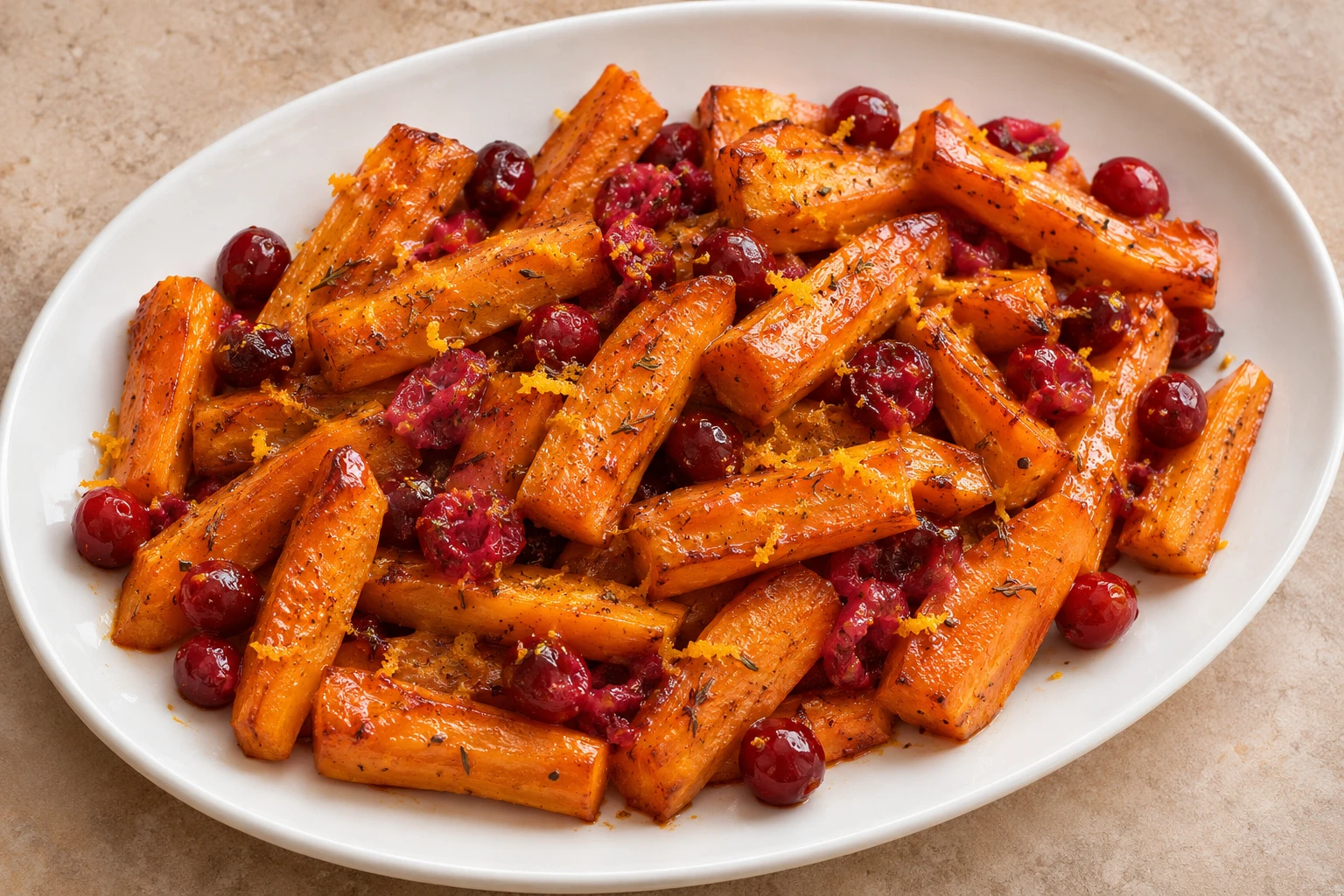
The flavor balance
Carrots become sweeter and more rounded as they roast. Cranberries pull the dish in the opposite direction: they stay noticeably tart, even with maple syrup in the pan. The recipe is meant to taste like a savory vegetable side with fruit, not a candied carrot dessert.
Orange contributes two different effects. Its juice helps make a light glaze, while zest added at the end supplies a fresher aroma. Thyme and black pepper keep the finish savory. There is no butter or cream in the base recipe, so it can sit comfortably beside richer potatoes, gravy or a creamy casserole.
Cut for even cooking and leave space
Use regular full-size carrots and cut them into batons about 2½ inches (6 centimeters) long and ½ inch (1.25 centimeters) thick. Split thick ends lengthwise more than once if needed. Similar thickness is more important than perfectly identical lengths: a very wide piece stays firm while a skinny tip can darken too quickly.
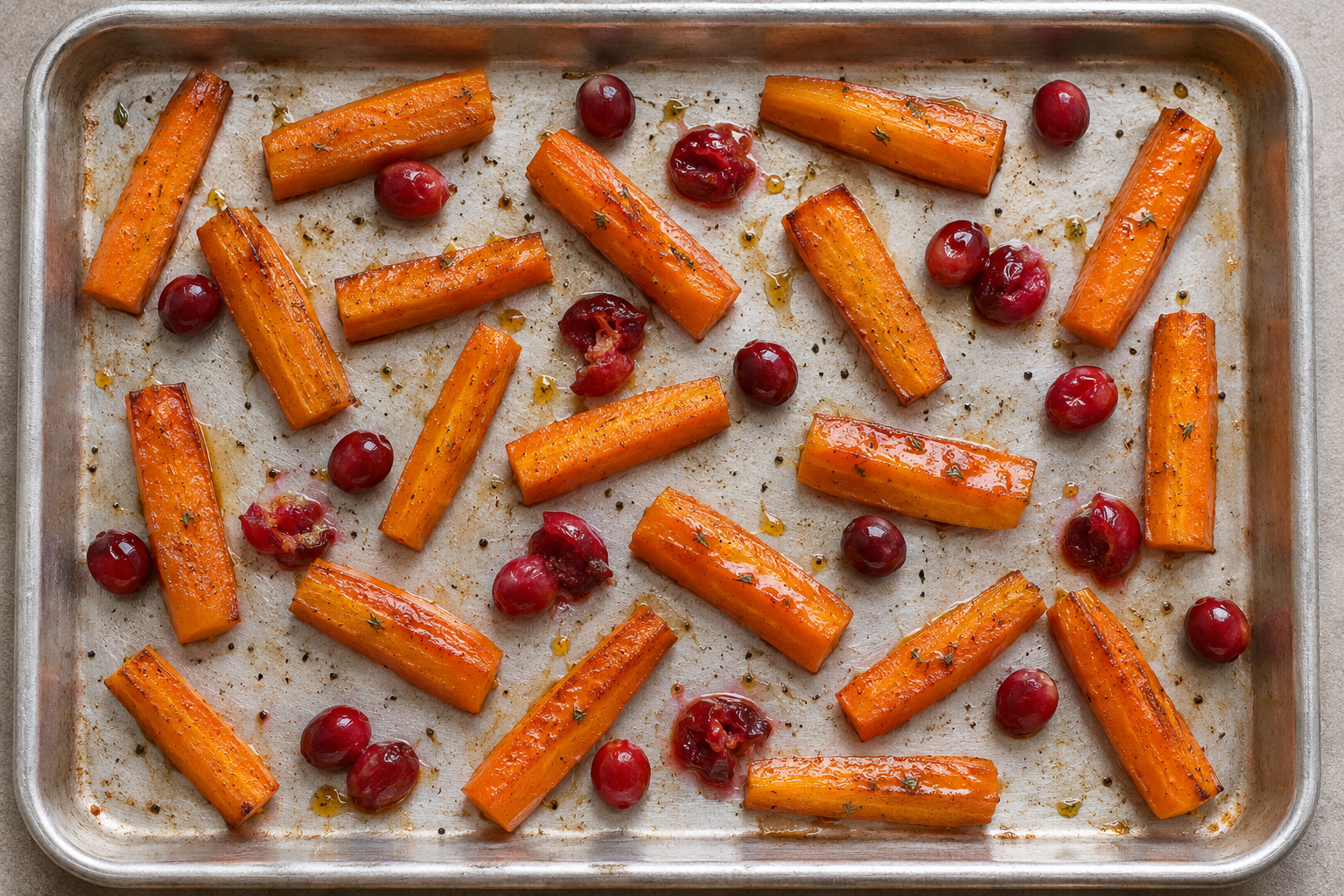
A large rimmed sheet pan gives the carrots room to roast. Spread them in one layer with small gaps rather than piling them into a deep casserole. If your pan is smaller than the one listed, divide the vegetables between two pans. A crowded pan traps moisture, which produces softer, paler carrots and a wetter glaze.
Cranberry-Orange Roasted Carrots
Yield: 6 side-dish servings, each one-sixth of the finished recipe
Prep: 15 minutes · Cook: about 35 minutes · Total: about 50 minutes
Oven: 425°F (220°C), conventional oven
The oven should be hot by the end of preparation. Cooking time varies with carrot thickness, pan crowding and the moisture in the fruit; use the tenderness and glaze cues below rather than the clock alone.
Equipment
- Large rimmed sheet pan, about 18 by 13 inches (46 by 33 centimeters), or two smaller pans
- Parchment paper rated by its manufacturer for 425°F (220°C), if lining the pan
- Cutting board, knife, vegetable peeler and fine grater or zester
- Large mixing bowl, small bowl, measuring cups and spoons, spatula or tongs, and oven mitts
- Kitchen scale if using weights; food thermometer for reheating leftovers
Ingredients
- 2 pounds (900 grams) carrots, weighed after trimming and peeling, cut into batons about 2½ inches (6 centimeters) long and ½ inch (1.25 centimeters) thick
- 2 tablespoons (30 milliliters) olive oil
- ½ teaspoon (3 grams) fine salt
- ¼ teaspoon (0.5 gram) ground black pepper
- ½ teaspoon (0.5 gram) dried thyme
- 1 cup (100 grams) fresh or frozen whole cranberries; do not thaw if frozen
- ¼ cup (60 milliliters) fresh orange juice, divided: 3 tablespoons (45 milliliters) for roasting and 1 tablespoon (15 milliliters) for finishing
- 2 tablespoons (30 milliliters / 40 grams) pure maple syrup
- 2 teaspoons (4 grams) finely grated orange zest, from about 1 medium orange
Shopping note: Buy a little more than 2 pounds of untrimmed carrots so you have the full prepared quantity. Zest the orange before juicing it. Grate only the colored outer peel, avoiding the bitter white layer underneath.
Instructions
- Heat the oven and prepare the ingredients. Heat a conventional oven to 425°F (220°C), with a rack in the middle. Line the sheet pan with appropriately rated parchment if desired. Rinse carrots and the orange under running water, then peel and cut the carrots. Rinse fresh cranberries and discard any spoiled or badly damaged berries. Measure the zest and juice separately.
- Season and spread. Toss the carrots in the large bowl with the olive oil, salt, pepper and thyme until lightly coated. Spread them on the sheet pan in a single layer with small gaps. Keep thick pieces from overlapping. If using two pans, divide evenly and place the racks in the upper and lower thirds of the oven.
- Roast the carrots first. Roast for 20 minutes. Carefully turn the carrots with a spatula or tongs. Their undersides should have some golden spots, but the centers can still be a little firm. If using two pans, swap their rack positions when you turn the vegetables.
- Add the cranberries and glaze. Stir together 3 tablespoons (45 milliliters) orange juice and the maple syrup in the small bowl. Scatter the cranberries around the carrots, drizzle the mixture over the pan, and gently turn the carrots to coat. Return to the oven for 10 to 15 minutes more, until a fork or small knife enters the thickest carrot pieces easily. The cranberries should soften and some should split; the pan juices should look glossy and lightly reduced, not like a deep pool. Frozen berries may need a few additional minutes.
- Check before the glaze burns. If the carrots are tender but the juices are still thin, stir and roast for another 2 to 3 minutes, watching closely. If the glaze is darkening before the carrots are tender, lower the oven to 400°F (200°C), loosely cover with foil and continue until tender. Do not use the broiler; the maple syrup can scorch quickly.
- Finish with fresh citrus. Remove the pan from the oven. Sprinkle on the orange zest and drizzle with the remaining 1 tablespoon (15 milliliters) orange juice. Toss gently so you do not crush all the berries. Transfer to a serving platter, including the light glaze, and serve promptly. Divide the finished dish into six portions.
Build a balanced holiday plate
With poultry: Serve alongside roast turkey or roast chicken with a savory herb seasoning. The cranberries and orange bring brightness without needing another fruit-heavy sauce. If cranberry sauce is already on the menu, offer modest portions of each so the plate does not become dominated by sweet-tart sides.
With pork: The fruit works well beside a savory pork roast. If the main dish already has a sweet glaze, keep these carrots as written rather than adding extra syrup.
With a meatless main: Pair with mushroom-and-lentil loaf, a bean-based main or a savory grain-and-mushroom stuffed squash. Something earthy and substantial gives the carrots’ citrus flavor a useful contrast.
Choose a quieter second side: Mashed potatoes, a simple wild rice pilaf or steamed green beans let the carrots keep their identity. Avoid making every side sweet or heavily glazed. Sparkling water with orange or unsweetened tea are easy drinks alongside the meal.
Substitutions that keep the recipe recognizable
- Frozen cranberries: Use the same weight straight from the freezer. Expect a little more moisture and possibly a longer final roasting stage. Do not add a frozen block of berries; separate them first.
- Dried cranberries: These are sweeter and less juicy, so they are not a direct swap. For a different version, omit the fresh berries, roast the carrots with the glaze, then fold in ½ cup (65 grams) dried cranberries at the end. The result will have a softer, sweeter fruit note rather than fresh cranberry tartness.
- Honey: The same 2-tablespoon volume can replace maple syrup, but the flavor changes and the recipe is no longer vegan. Watch the glaze closely for darkening.
- Fresh thyme: Replace the dried thyme with 1½ teaspoons (about 1.5 grams) chopped fresh thyme leaves. Strip out woody stems before measuring.
- Baby carrots: Their thickness varies, and some hold more surface moisture. Pat dry, split thick ones and cook to tenderness rather than assuming the same timing as the batons.
- Dietary needs: The base ingredients are plant-based and contain no added wheat, dairy, egg, soy, sesame or nuts. This is not a guarantee against allergens or cross-contact; check packaged ingredients and preparation surfaces for the people you are serving. No nutrition, allergy-free or certification claim is implied.
Make ahead without losing the finish
Prepare the day before: Wash, peel and cut the carrots, then refrigerate in a covered container. Measure the glaze ingredients separately and refrigerate the orange juice and zest. Keep the zest covered so it does not dry out. Roast on serving day for the best contrast between browned edges and tender centers.
Cook ahead if oven space is tight: Roast the dish up to one day ahead, but reserve the final tablespoon of orange juice and zest until after reheating. Promptly refrigerate the cooked carrots in shallow containers. The cranberries will soften further and may tint more of the glaze red; that is a texture change, not a reason to add extra sugar.
Reheat: Arrange refrigerated carrots and cranberries in a shallow oven-safe dish. Add 1 to 2 tablespoons (15 to 30 milliliters) water if the glaze has become sticky, cover with foil, and heat at 350°F (175°C). Begin checking after about 15 minutes, and continue until the center reaches 165°F (74°C), stirring or turning gently if needed for even heating. Uncover briefly at the end if there is excess moisture, then add the reserved fresh citrus. Follow the federal 165°F (74°C) target for reheated leftovers, rather than treating a warm serving dish as proof the food is hot throughout.
Store safely: Refrigerate before the food has spent 2 hours total outside safe hot or cold holding, or 1 hour total when the surrounding temperature is above 90°F (32°C). Serving the food does not restart that clock. Keep the refrigerator at 40°F (4°C) or below and divide leftovers into shallow containers. If holding for service instead, keep them at 140°F (60°C) or hotter. These limits follow FoodSafety.gov handling guidance. Use safely refrigerated leftovers within 3 to 4 days, following federal leftover-storage guidance.
Freezing: Roasted carrots can become softer and the cranberries more broken after freezing. If freezing leftovers, cool promptly, package airtight, and aim to use within 2 months for quality. Thaw in the refrigerator and reheat to 165°F (74°C). For a holiday presentation, preparing the raw carrots ahead is a better texture choice than freezing the finished platter.
Small adjustments for a better pan
Pale carrots: Check for overcrowding and excess surface moisture. Dry the prepared carrots before tossing with oil, and use a second pan if they overlap. More syrup will not solve a spacing problem.
Too tart for your table: Serve the cranberries distributed among the carrots rather than in concentrated spoonfuls. If you prefer a sweeter finish, taste the cooked dish and add a little maple syrup at the table; do not assume every batch of fruit needs a large increase.
Burned glaze at the edges: Turn the carrots as directed and check during the final stage. Thin metal pans and strong oven hot spots can darken the syrup before the largest pieces soften. Smaller, even pieces and the lower-temperature rescue in step 5 help keep that from happening.
Serve the platter while the glaze is loose and glossy. Its job is to add a bright, tart-sweet vegetable note to the meal, leaving room for the main dish and the rest of the holiday table.
Recent Posts
-
Standard vs. Deluxe Pulley-and-Eyebolt Assemblies: Threads and Rope Size
Standard and Deluxe pulley-and-eyebolt assemblies differ in more than their names. These two models …Nov 8th 2026 -
West Virginia Half-Staff Order Honors Jay Rockefeller Through November 13, 2026
Governor Patrick Morrisey issued a November 6, 2026 order lowering the U.S. and West Virginia flags …Nov 8th 2026 -
Replacing a Kansas Flag: Match Size and Attachment
A replacement Kansas flag should match more than the state design. Before ordering, record the flag …Nov 8th 2026