
Coeur d'Alene's Waterfront: Gathering Place, Military Post and College Campus
Coeur d'Alene's waterfront holds several histories in the same landscape. The Tribe's account describes an enduring homeland. A military post changed the use of part of that land. A town grew around transport and industry, and a college later moved to the former fort site. These stories connect, but they do not make the Tribe, municipality and college interchangeable.
Begin with the Schitsu'umsh
The Coeur d'Alene Tribe's official introduction identifies its people as Schitsu'umsh and explains that name as “Those who were found here” or “The discovered people.” It presents the homeland as a continuing connection, not a closed chapter before settlement. The same account attributes the French name Coeur d'Alene to fur-trade encounters and disciplined trading practices.
That self-description belongs beside, rather than underneath, a municipal history. The Tribe is a living sovereign community. When writing a caption, distinguish the city, lake and Tribe; a photograph of a municipal waterfront does not by itself establish that its subject is on the reservation. Nor does a shared place-name establish endorsement of a commercial display.
A post changes the use of the waterfront
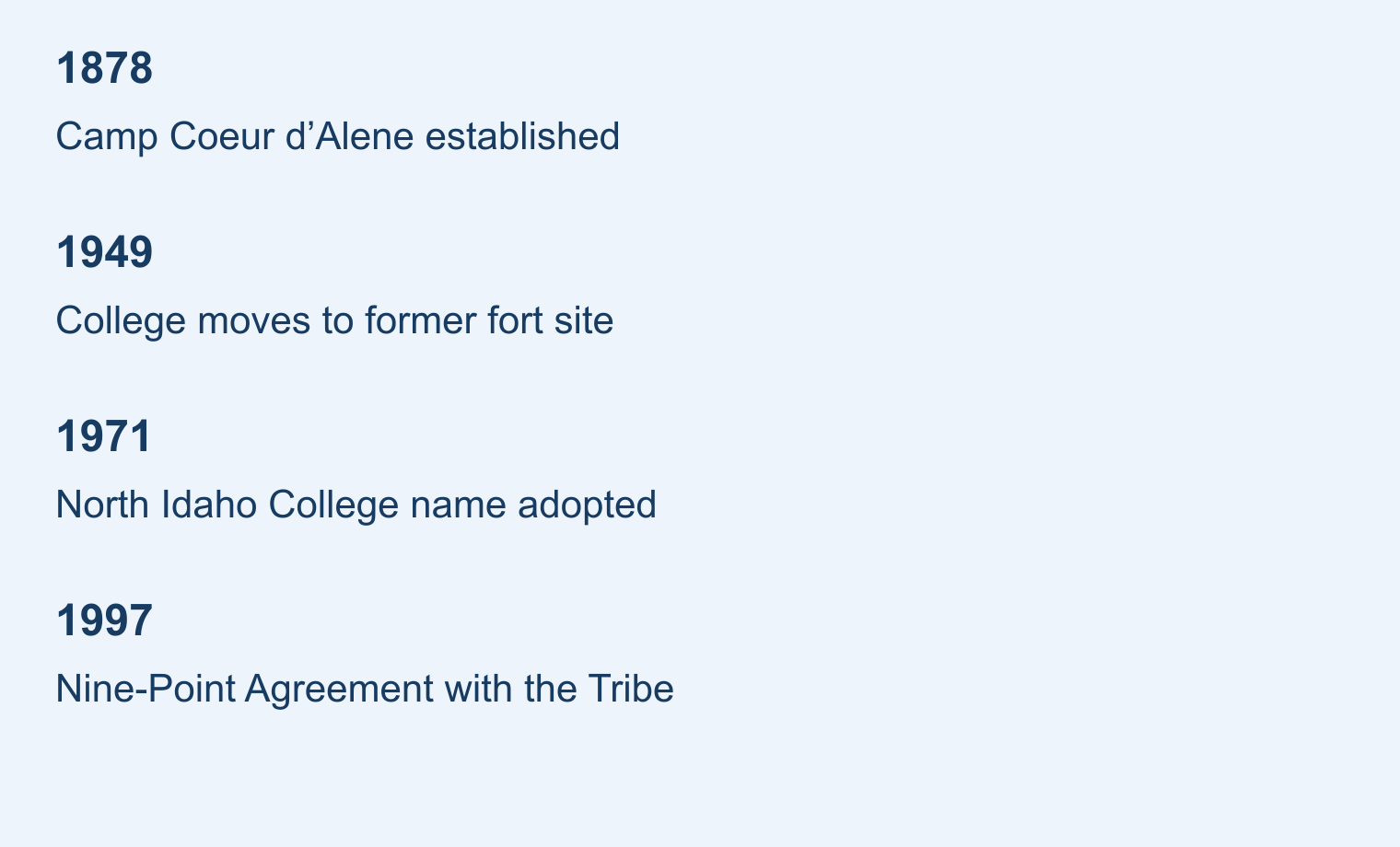
North Idaho College's history records Camp Coeur d'Alene's establishment in 1878 and identifies it as the post later known as Fort Sherman. The college account describes displacement of Tribal people from the gathering place. It also describes institutions associated with the post, including a hospital, school, chapel and library.
This gives the site's military chapter a human dimension beyond a sequence of official names. Changes in land use affected both the people already connected to the place and the institutions that developed there. This article uses the college's broad chronology; it does not claim an independently established day-by-day account of the fort's renaming or closure.
For a period-based display, first decide which chapter you are interpreting. Compare historical flag designs at FORTISVEX against that date, while treating any claim about the post's actual flag as a separate research question. A current product is not evidence of historic use.
The working town beyond the lake view
Kootenai County's history describes the town near the fort becoming a supply point and navigation center for mining and timber. Its 1910 snapshot lists six large lumber mills in or near the city and four railroads serving it. Banks, hotels, schools and telephone systems appear alongside those industrial connections.
These are dated observations, not today's business counts. They help explain why a waterfront photograph may show work as well as recreation. Look for an original caption identifying the activity before deciding that a boat, landing or railway connection represents tourism. The county account also establishes Coeur d'Alene's county-seat role, but gives inconsistent years for the move; this article does not select an unsupported exact year.
From former fort land to a college campus
The college dates its move to the former fort site to 1949 and credits the Winton family with donating the land. It records the adoption of the North Idaho College name in 1971. These milestones concern the institution's later development, not the beginning of the place's history.
Its account also dates the Nine-Point Agreement with the Coeur d'Alene Tribe to 1997, describing support for Native American students and cultural programming. This provides a concrete connection between the living Tribal community and the campus story. The agreement should not be described as undoing the earlier displacement or as an endorsement of this independent article.
A thoughtful display and a closer reading
For a modern home display, browse FORTISVEX American flags separately from historical reproductions. Check the chosen listing's size and attachment details against your setup. Keep the accompanying caption specific: name the subject and date, credit the source, and avoid presenting a reproduction as an artifact.
The sources linked here offer three complementary perspectives: Tribal self-description, the county's working-town history and the college's institutional account. Read them together to understand why the waterfront matters, without treating one voice as a substitute for all the others. This guide establishes no current opening hours, interior access or reserved walking route.
Recent Posts
-
Choosing a Historical Flag Reproduction: More Than Counting Stars
Before choosing a historical flag for a classroom or display, finish this sentence: “This flag will …Oct 29th 2026 -
The Flag, the Pledge and the Anthem: A Clear Ceremony Cue Sheet
A flag enters the room, a host invites the Pledge of Allegiance, and a musician begins the national …Oct 29th 2026 -
Welcoming International Guests: Plan a Multi-Nation Flag Display
A display for visiting international guests begins with a different question from a display of the …Oct 29th 2026