
Buhl, Idaho: Irrigation, Dairy Barns and a Working Landscape
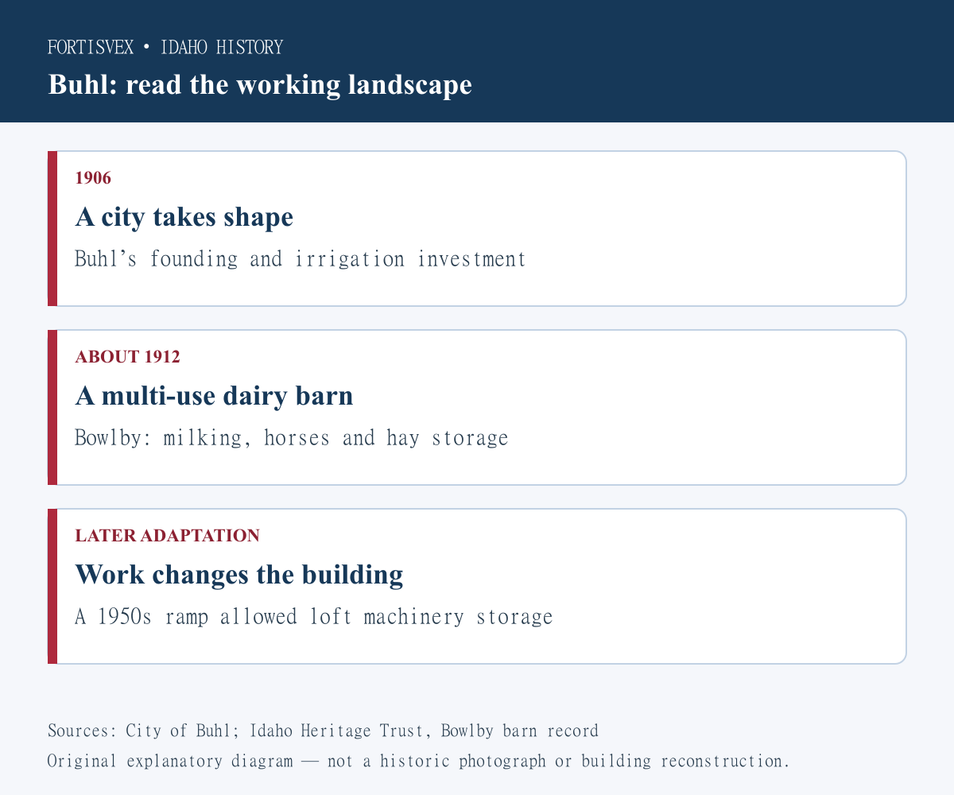
Buhl’s history is easier to understand when you look beyond the trout nickname. Irrigation investment, dairy farming and the buildings that served that work explain how this part of the Magic Valley took shape. Two surviving barns offer particularly concrete evidence: their walls, rooflines and working spaces tell a story that a founding date alone cannot.
Why the name Buhl belongs to the irrigation story
The City of Buhl’s historical introduction identifies Frank H. Buhl of Sharon, Pennsylvania, as a major investor in Carey Act irrigation development. That connection helps explain why a Pennsylvania name belongs to an Idaho community. Water development and investment were central to the settlement story described by the city.
Today the city describes itself as the Trout Capital of America. Its location along Highway 30 and the Thousand Springs Scenic Byway places it within a wider regional landscape. For a closer look at Buhl’s own history, however, the dairy barns are a more specific starting point than a broad tour of southern Idaho attractions.
The Bowlby barn: a building organized around work
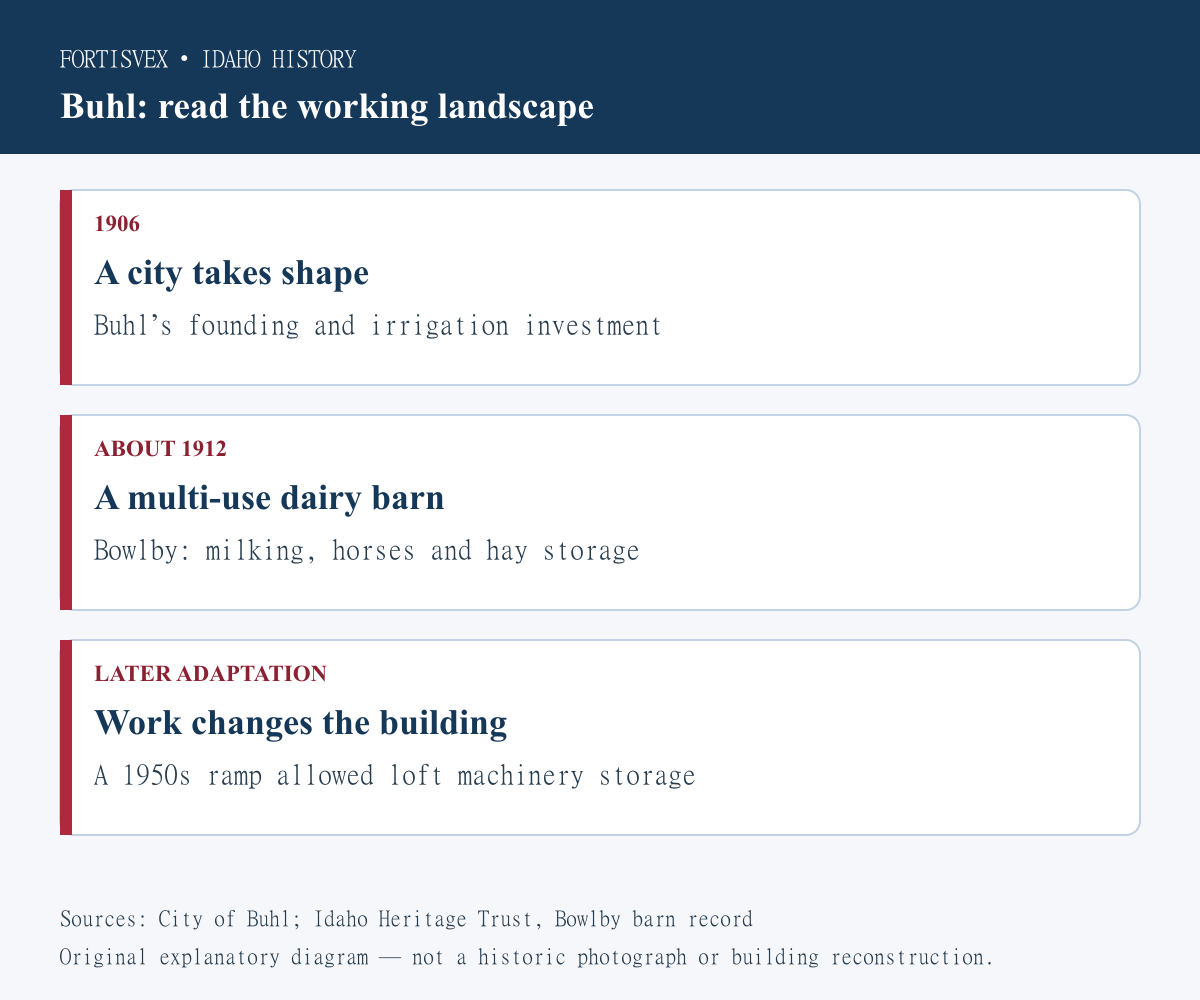
The Idaho Heritage Trust’s Bowlby barn project record dates the building to about 1912 and describes a two-story structure combining concrete walls with a gambrel roof. Its account identifies separate areas for milking, a milk room, horse stalls and hay storage. The arrangement makes the barn useful evidence of how several kinds of farm work shared one building.
The Trust also records a later adaptation: in the 1950s, a ramp was added so machinery could be stored in the loft. That detail changes how we read an old agricultural building. A surviving barn may preserve early construction while also showing adjustments made by later users. The record identifies a 2024 grant for work on the southern roof area; it does not establish public visiting hours.
The Schick barn: craftsmanship in concrete and metal
The Trust’s Henry Schick barn record describes another historic dairy building in the Buhl area. It attributes its construction to Henry Schick, a German/Russian immigrant skilled in concrete and metalwork. Cast-in-place concrete walls and milking stalls are part of that account, along with distinctive onion-shaped domes on the ventilators and silo.
These are different buildings, not interchangeable examples of a generic Idaho barn. Bowlby’s record emphasizes a large, multi-use arrangement and changes to storage; Schick’s highlights the builder’s materials and distinctive metalwork. Reading the two accounts together gives a visitor or student a useful comparison without pretending that every surviving feature dates from the same moment.
| Building | What the record helps explain |
|---|---|
| T. P. Bowlby barn | Dairy work, horse accommodation, hay storage and later machinery access. |
| Henry Schick barn | Concrete construction and distinctive metalwork associated with its builder. |
Continue the story at the library
The city’s library page lists local-history resources, reference assistance, interlibrary loan and a microfilm reader/printer. Those services provide a practical next step for readers who want to investigate a family, building or event. Start with a precise question: a street address, a person’s full name or an approximate date is more useful than simply asking for everything about early Buhl.
For a school or community display, pair a short sourced building history with an Idaho state flag. Keep the historical captions separate from the modern display materials: a newly purchased flag is not an artifact from the period being discussed. An American flag can serve a present-day civic display without implying a documented connection to either barn.
A local celebration, with current details checked separately
Buhl’s city introduction describes the Sagebrush Celebration as an annual Fourth of July tradition. For a future visit, consult the current organizers’ schedule rather than treating a general description as this year’s timetable. The lasting story is the community’s connection to agriculture and civic life; event times, routes and access arrangements require a separate current check.
Remember this: Buhl’s history becomes more tangible when a name, a farm task and a surviving building detail are connected. Begin with the city’s account, compare the two preservation records, and use the library to pursue the questions that remain.
Recent Posts
-
South Korea’s Taegeukgi: Check the Four Trigrams and Artwork Orientation
The South Korea flag, known as the Taegeukgi, is a good example of why artwork review should go beyo …Nov 2nd 2026 -
Brazil Flag Artwork: Check the Star Map Before Approving the Proof
The blue globe on a Brazil flag rewards a closer look. When buying a flag or reviewing a production …Nov 2nd 2026 -
Mexico Flag: The Eagle Is Part of the Design, Not an Optional Logo
A Mexico flag can look familiar at a glance while still needing a closer artwork check. When compari …Nov 2nd 2026