
Bovill, Idaho: Reading a Town’s History Through Family, Main Street and Celebration
Bovill, Idaho: Reading a Town’s History Through Family, Main Street and Celebration
A family standing beside a cabin, a block of businesses and a child waving a flag offer three different ways into Bovill’s history. None tells the whole story. Together, the University of Idaho Library’s catalog records let readers move between household life, the commercial street and a community occasion without turning a photograph into more evidence than it contains.
A Local Collection With Many Viewpoints
The library describes a collection of 153 images covering 1904–2000, gathered by the Latah County Historical Society to document Bovill. Schools, schoolchildren and graduation events appear prominently. That emphasis is useful: community history includes classrooms and families as well as businesses and public buildings. It also reminds us that a collection reflects what was gathered and preserved, not everything that happened. Explore the Bovill Historical Photograph Collection.
1905: A Family Record, Not a Founding Certificate
The record titled “Bovill Family” is cataloged to 1905. Its description identifies Charlotte and Hugh Bovill, Gwen and Dorothy, with their dog in front of a cabin. The source identifier is 02-01-001b. That gives a reader names, a setting and a way to return to the exact item. It does not establish when the cabin was built or when each person arrived. Read the family portrait’s catalog record.
The city’s own overview connects the Bovill family with a ranch and later a hotel serving visitors. That broader account provides context, but the portrait should not be used to supply missing dates in it. Keep a photograph’s catalog information and a later written history visibly separate. Read the City of Bovill’s overview.
1907: Looking Along Main Street
“Downtown Bovill,” source identifier 02-02-013, carries a 1907 catalog date. The library describes a view of Main Street containing a hotel and a block of stores, and identifies the original format as a postcard. Those details support a useful exercise: compare the street as an arrangement of businesses with the family portrait’s domestic setting. They are different views of a community, not interchangeable illustrations. Open the downtown postcard record.
Do not read the catalog description as a current walking-tour map. A historic hotel in a postcard does not establish today’s occupant, a surviving facade or permission to enter. If you plan to explore a location, verify its present identity and access separately.
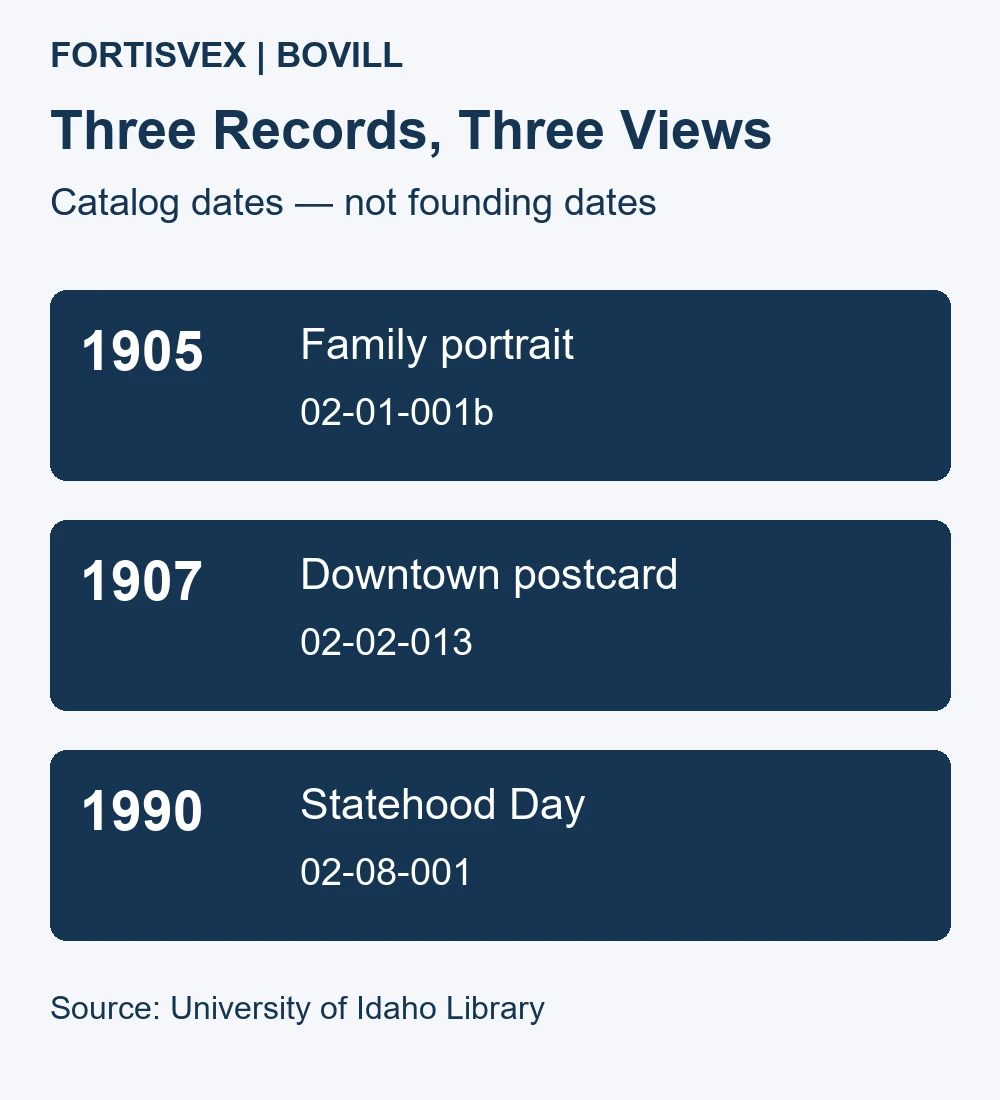
- 1905: Family
- Bovill Family, record 02-01-001b.
- 1907: Main Street
- Downtown Bovill, record 02-02-013.
- 1990: Celebration
- Statehood Day, record 02-08-001.
1990: A Civic Occasion, With Limits to What We Can Say
The library’s “Statehood Day” record is dated 1990 and describes a child waving a flag during Bovill’s celebration. The description does not identify the flag’s design or provide an exact calendar day. It supports a connection between flags and a documented community occasion, not a claim about every flag displayed in Bovill or a reconstruction of the entire event. Read the Statehood Day record.
Rights matter as much as dates when sharing local history. The library marks the family and downtown items as public domain based on publication date. The Statehood Day item instead carries an educational-use rights statement. This guide links to that photograph’s record; it does not reproduce the photograph or assume that educational permission covers a retailer’s website.
Bring the Same Care to Today’s Information
The city website identifies Bovill at the junction of Idaho Highways 3 and 8 and provides routes to municipal agendas, minutes, ordinances and community information. Use those current channels for present-day questions. An archive’s record of a celebration does not promise a recurring event, and an old photograph does not confirm opening hours.
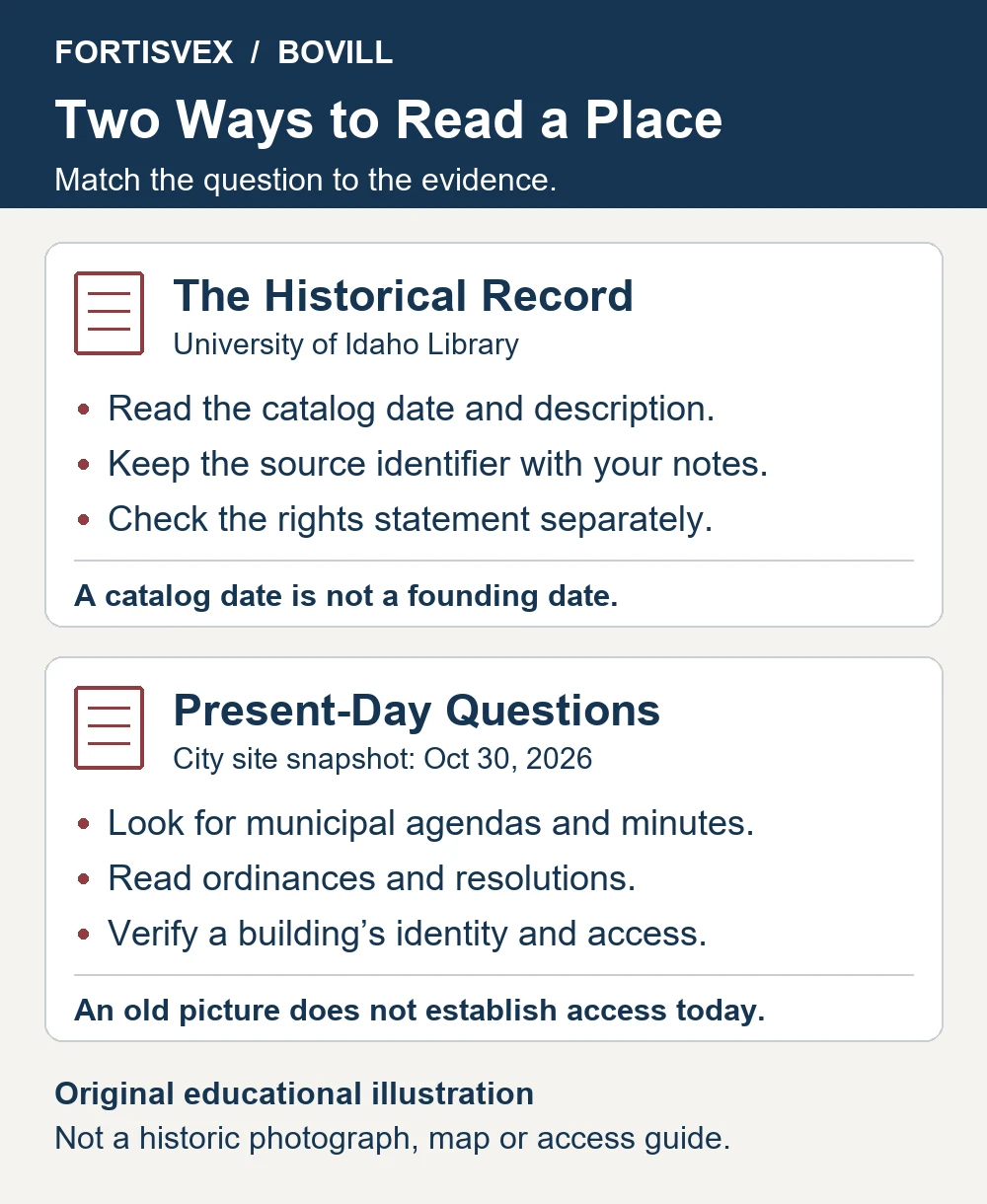
Historical record: read the catalog date and description, retain the source identifier, and check rights separately. A catalog date is not a founding date. Present-day questions: consult municipal agendas, minutes, ordinances and resolutions, and verify building identity and access. An old picture does not establish access today. Municipal navigation labels are based on the October 30, 2026 captured page; current navigation has not been verified.
For related reading, explore the FORTISVEX History & Reference guides. If you are planning your own modern display, compare Idaho flag sizes and attachment options with your equipment. That shopping reference is independent of the archive and city; it does not identify the flag in the 1990 photograph or imply institutional endorsement.
Keep the source identifier with any notes you make. It is the simplest way to let someone else find the same record, test your interpretation and distinguish what the archive documents from what remains unknown.
Recent Posts
-
Grace, Idaho: Understanding the Water Behind the Fields and the Powerhouse
Grace, Idaho: Understanding the Water Behind the Fields and the Powerhouse A canal and a hydroelect …Nov 4th 2026 -
Donnelly, Idaho: The Railroad Town and the Records Behind Its Story
Donnelly, Idaho: The Railroad Town and the Records Behind Its Story Donnelly's municipal history pl …Nov 4th 2026 -
Bovill, Idaho: Reading a Town’s History Through Family, Main Street and Celebration
Bovill, Idaho: Reading a Town’s History Through Family, Main Street and Celebration A family standi …Nov 4th 2026