
Boise Before Its Officials Took Office: The City's Contested Beginning
Boise Before Its Officials Took Office: The City's Contested Beginning
A founding date, a charter and a functioning city government are different milestones. Boise's early history makes that distinction unusually clear. The city's Department of Arts & History dates its founding to July 7, 1863, the territorial-capital designation to 1864 and incorporation to 1866. Yet its account of early government describes elected candidates refusing to take office. The question was not simply who would govern, but whether residents wanted the costs and machinery of municipal government at all.
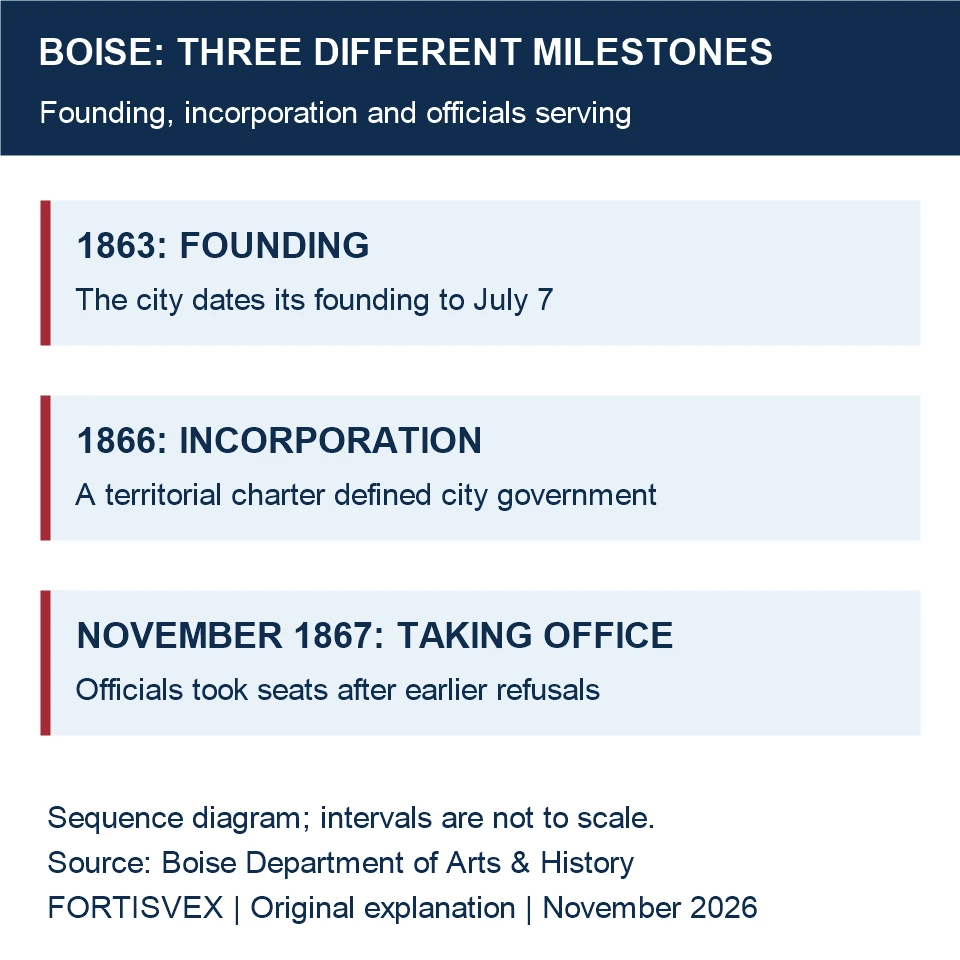
An election could delay government
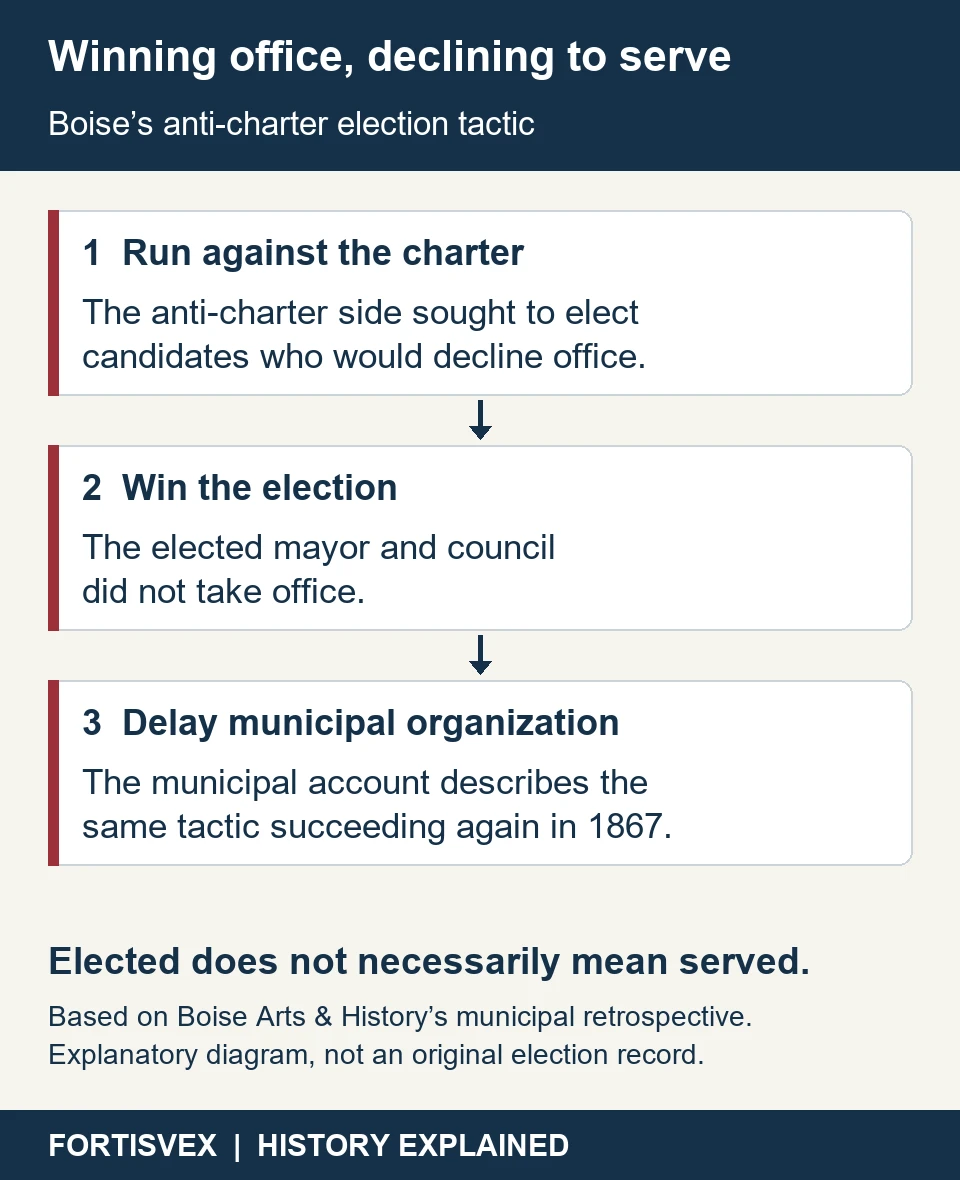
The department's early-government history describes rival pro-charter and anti-charter platforms. Following the January 11, 1866 incorporation, an election was scheduled for May. The anti-charter side sought to elect candidates who would decline office, postponing municipal organization. That side won, and the elected mayor and council did not take office. The account describes the same tactic succeeding in 1867.
This was opposition expressed through the election itself. Winning an office was the mechanism used to resist filling it. The city's historians connect the dispute to concerns about taxation and administrative expense, rather than reducing it to personal rivalry.
Property helped change the calculation
The municipal account identifies November 1867 as the turning point. A change in federal law allowed city governments to register townsites so that landowners could receive legal title. Officials then took their seats, replaced members who still refused and filed Boise's townsite patent. The city identifies H. E. Prickett as its first serving mayor, appointed that November.
The distinction between elected and serving is important. A list of election winners does not, by itself, establish who exercised the office. In a school project or historical exhibit, record the action beside the name: elected, declined, appointed or served. That small addition prevents an apparently contradictory chronology from becoming an error.
A charter with a long afterlife
The department's separate charter history describes municipal government operating under the 1866 charter, with amendments, for almost a century. In the 1950s, constraints on annexation complicated planning and public services as growth occurred outside city limits. The city dates the charter's repeal to 1961, after which Boise operated under Idaho's general laws for cities.
This later episode provides a useful comparison with the earlier dispute. In both, the legal form of government affected practical questions about property, boundaries and shared services. It does not follow that every resident held the same view or that a charter alone caused the city's growth. The municipal summary is a starting point for those questions, not a complete record of every debate.
Follow the records
The department's government-history hub points readers toward city-council minutes and the municipal archives. Those are appropriate next steps for checking a particular decision. Record the meeting date, the action and the source before turning an entry into a historical claim.
If you are arranging a modern Idaho-history display, the FORTISVEX Idaho state flag collection offers contemporary display options. Keep a modern flag clearly separate from reproductions of nineteenth-century records; it is not evidence of the flag used at an early Boise meeting.
For a present-day display that places Boise alongside other places, browse the state flag collections. If you also include an American flag, use the American flag material-selection page to compare fabric categories, then check the selected listing's size, attachments and intended use. These are modern display choices, not evidence of flags flown in early Boise.
Sources reviewed November 1, 2026. This article summarizes attributed municipal historical research and does not claim inspection of the original charter, federal enactment or townsite patent.
Recent Posts
-
Grace, Idaho: Understanding the Water Behind the Fields and the Powerhouse
Grace, Idaho: Understanding the Water Behind the Fields and the Powerhouse A canal and a hydroelect …Nov 4th 2026 -
Donnelly, Idaho: The Railroad Town and the Records Behind Its Story
Donnelly, Idaho: The Railroad Town and the Records Behind Its Story Donnelly's municipal history pl …Nov 4th 2026 -
Bovill, Idaho: Reading a Town’s History Through Family, Main Street and Celebration
Bovill, Idaho: Reading a Town’s History Through Family, Main Street and Celebration A family standi …Nov 4th 2026