
The Apollo Flag Was Also a Piece of Hardware: Reading the Lunar Flag Assembly
The American flag in an Apollo photograph is easy to recognize. The equipment holding it deserves a second look. On Earth, viewers are used to seeing fabric move in air or hang from a staff. The lunar display had to show a recognizable flag in a setting without that familiar breeze. A horizontal support made the fabric visible. The result was both a national symbol and a small, carefully arranged mechanical system.
This article focuses on how to read that system in NASA's historical record. It does not claim that a contemporary retail flag or pole duplicates flight equipment. A familiar rectangle in a photograph is not evidence that its attachments, preparation or operating conditions were ordinary. For a present-day terrestrial display, choose from American flags using the actual product dimensions and mounting details, rather than treating a lunar photograph as an installation guide.
Look for three parts, not one
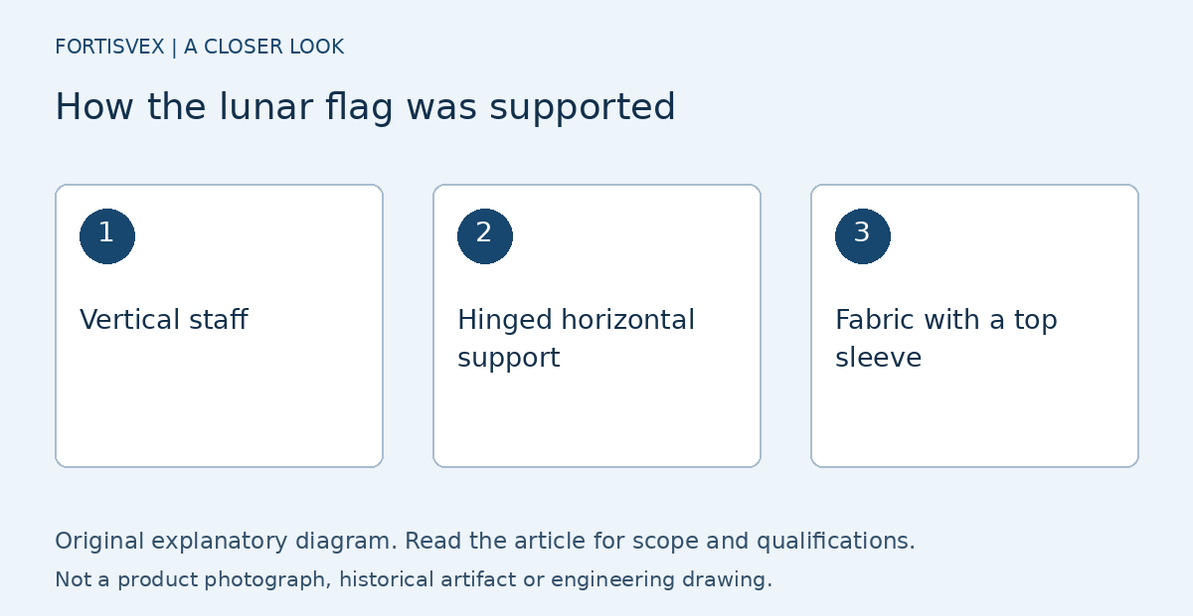
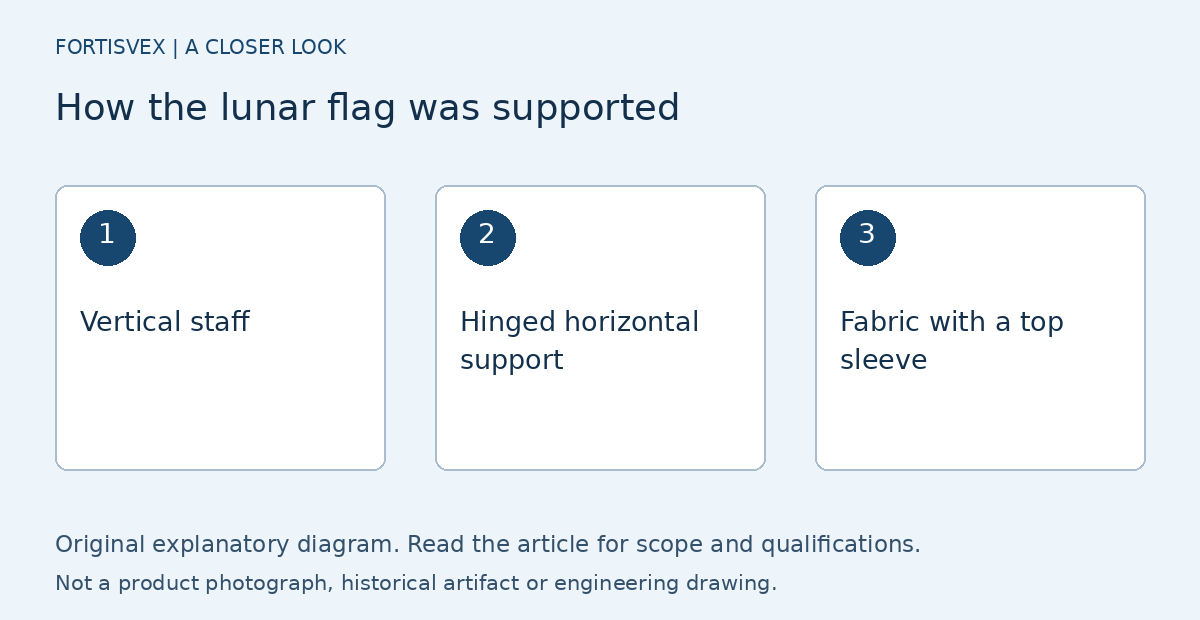
NASA's Apollo 11 Lunar Surface Journal describes a vertical staff connected to an extendable crossbar by a locking hinge. The fabric's top hem received the horizontal member. Those details explain why the image can show an extended upper edge even when the cloth below it is folded. A vertical pole alone would not explain that shape.
The three-part reading is useful: first identify the staff, then the crossbar, then the cloth. Ask which piece is bearing the load and which piece is simply responding to its support. A fold in the fabric and an angle in a metal member are different observations. Keeping them separate prevents a photograph from turning into a misleading story about wind, stiffness or construction. The diagram here is a simplified explanation of those relationships, not a dimensioned reconstruction of the flown assembly.
The crossbar did not fully extend on Apollo 11
The journal includes Armstrong's technical-debrief account that the astronauts could not fully extend the telescoping top rod. The resulting arrangement left the cloth partly folded. This is a particularly helpful example of an operational record explaining an appearance. You do not have to guess why the fabric looks gathered when the crew described the deployment problem.
That distinction also changes the questions a reader asks. Instead of asking whether a photograph looks like a flag on Earth, ask what the intended configuration was, what actually happened during deployment, and which record supports the answer. The planned design and the observed result belong beside one another. Neither should quietly replace the other.
Apollo 12 provides a useful comparison
NASA's Apollo 12 history records a different problem: the horizontal crossbar did not latch, and the flag looked limp unless an astronaut held a corner up. That account should not be pasted into the Apollo 11 story. The missions used related display ideas, but a shared concept does not make every setup event identical.
When comparing photographs, keep the mission name in the caption. A useful comparison names the crew or mission, describes the visible support, and points to the corresponding historical source. A weak comparison simply labels two photographs 'the Moon flag' and assumes their hardware behaved the same way. The practical research lesson is broader than spaceflight: similar-looking objects can have different histories.
Be cautious with measurements
NASA's photogrammetry discussion flags differing size descriptions in the literature and examines photographs to understand the geometry. That is a reason to preserve qualifications, not to select a convenient number and present it as uncontested. A quoted nominal size, a measurement of an altered textile and a dimension inferred from a photograph are not automatically equivalent.
Readers building a school display can label a schematic 'not to scale' and concentrate on the support mechanism. Readers studying the original hardware should follow the technical discussion and its underlying imagery. A retail comparison needs an additional boundary: matching a stated size does not establish matching fabric, assembly, provenance or flight history. Our historical-flags collection is a place to explore designs, not a source of claims that an item went to space.
A five-question checklist for an Apollo image
Start with the mission and image identifier. Then identify whether the source is a contemporary photograph, a transcript, a later technical analysis or an illustration. Third, locate the staff and crossbar before interpreting the fabric. Fourth, separate what the image visibly shows from what a transcript explains. Finally, record any unresolved measurement or identification rather than smoothing it away.
For example, a classroom caption might say that an extendable horizontal support held the flag's upper edge and that the Apollo 11 crew reported trouble extending it fully. That caption conveys the mechanism and the documented limitation without asserting an unsupported modern condition. It also gives viewers something concrete to look for in the photograph.
What this history does not establish
These deployment accounts do not by themselves establish the current color, condition or exact survival of a particular flag on the lunar surface. They also do not make a modern display product suitable for spaceflight. Those are separate claims requiring separate evidence.
The most interesting takeaway is already well supported: making a recognizable flag visible required attention to a pole, a hinge, a crossbar, fabric and human operation. The national symbol remained familiar while its support system changed. The next time you see an Apollo flag photograph, look above the folds. The horizontal member tells an important part of the story.
Sources and further reading
Recent Posts
-
Charcoal Weber Kettle Pulled Pork with Mustard-Cider Dressing
Pork shoulder rewards a steady fire and a texture check. This version uses paprika and fennel in th …Nov 4th 2026 -
Chubbuck, Idaho: From a Fire-Station Chalkboard to Places for a Growing Community
Chubbuck's civic history includes an emergency address written on a fire-station chalkboard, expand …Nov 3rd 2026 -
Garden City, Idaho: Chinese Gardens, Creative Work and a Living Landscape
Garden City's name carries a history that can be easy to miss from the road. Before the studios and …Nov 3rd 2026