
FORTISVEX
FORTISVEX Wisconsin State Flag 4x6 Feet Nylon - Made in USA with Brass Grommets

- MPN:
- FPAMSTWINYL4x6G
- Availability:
- Free Shipping* https://fortisvex.com/shipping-returns-terms/
- Shipping:
- Calculated at Checkout
Description
This is the first size that genuinely outgrows a house bracket and calls for a flagpole in the ground. The honest reason to buy a 4x6 foot flag is size, not looks.
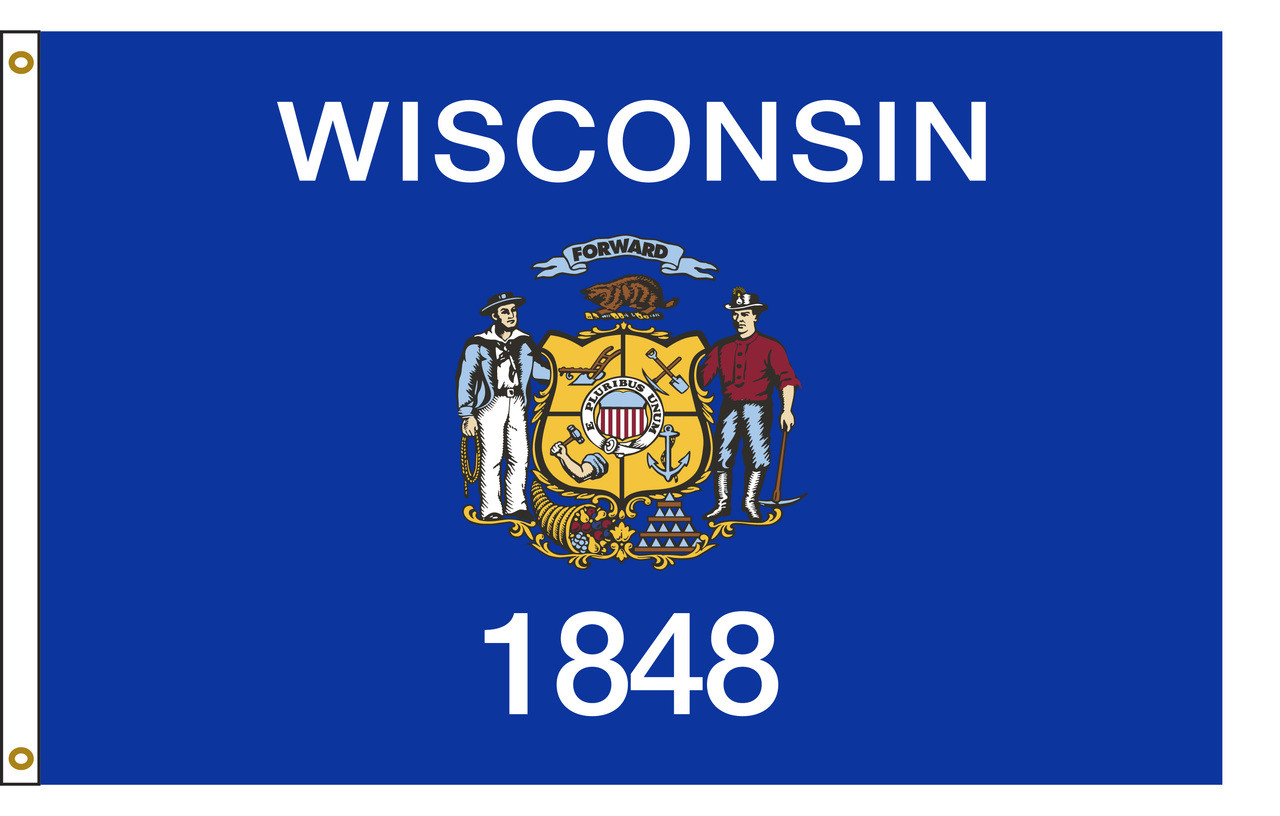
This is the Wisconsin state flag at 4x6 Feet (24 square feet) in nylon, made in the United States and finished with brass grommets.
Built to the Wisconsin flag specification
The Wisconsin flag is set out in Wisconsin Statutes Section 1.08, at a two to three proportion. It is the state coat of arms on royal blue, with the word Wisconsin above and the date 1848 below.
Originally 1863 and standardized in 1913; the word Wisconsin and the date 1848 were added by Chapter 286, Laws of 1979, mandatory for flags made on or after May 1, 1981.
The law governing this flag addresses design, colors and the seal or emblem, but leaves overall size unspecified for a modern outdoor flag. That is typical across most states, which is why the industry has converged on the same standard sizes.
We reproduce that design faithfully, in the standard outdoor flag sizes the whole industry uses and that the states themselves buy. What matters on an outdoor flag is that the colors, the seal and the emblems are right, and they are.
The law that defines it, in its own words
Wisconsin Statutes Section 1.08 reads:
(1) The Wisconsin state flag consists of the following features: (a) Relative dimensions of 2 to 3, hoist to fly. (b) A background of royal blue cloth. (c) The state coat of arms, as described under s. 1.07, in material of appropriate colors, applied on each side in the center of the field, of such size that, if placed in a circle whose diameter is equal to 50 percent of the hoist, those portions farthest from the center of the field would meet, but not cross, the boundary of the circle. (d) The word "WISCONSIN" in white, capital, condensed Gothic letters, one-eighth of the hoist in height, centered above the coat of arms, midway between the uppermost part of the coat of arms and the top edge of the flag. (e) The year "1848" in white, condensed Gothic numbers, one-eighth of the hoist in height, centered below the coat of arms, midway between the lowermost part of the coat of arms and the bottom edge of the flag. (f) Optional trim on the edges consisting of yellow knotted fringe. (2) The department of administration shall ensure that all official state flags that are manufactured on or after May 1, 1981 conform to the requirements of this section. State flags manufactured before May 1, 1981 may continue to be used as state flags.
The emblem itself is defined by reference to the coat of arms at Section 1.07, so these words are the frame and not the whole picture.
You do not have to take our word for any of that. Read Wisconsin Statutes Section 1.08 in full at the Wisconsin Legislature, and check what we sell against it.
It is the real flag we produce, not a simplified version.
What is on it and what it means
A sailor and a miner represent labor on water and on land. The shield quarters agriculture, mining, manufacturing and navigation. The crest is a badger and the motto is Forward.
Worth knowing about this flag
The lettering was added for a specific reason. Without it the flag was nearly indistinguishable from several other blue seal flags at a distance, and that is why the 1979 act required it.
Where the Wisconsin flag flies
The Acuity Insurance flagpole in Sheboygan is the tallest flagpole in the United States at four hundred feet, erected in 2014. It weighs approximately four hundred and twenty thousand pounds, uses three pendulum style tuned mass dampers to reduce movement and vibration, and is designed to withstand a low temperature of minus forty two degrees. The current flag is seventy by one hundred and forty feet. The original was sixty by one hundred and twenty. Flags fly about a hundred and twenty to a hundred and thirty days before retirement, and a heavier flag is used in harsh weather.
Fly it on Wisconsin’s birthday
Wisconsin became the 30th state on May 29, 1848. Under the United States Flag Code as amended July 7, 1976, a state flag flown on the state’s birthday takes its place beneath the United States flag, and that day is the one date every year the Wisconsin flag has an official reason to go up.
Buy it in time and it goes up on the day it matters. Every state’s date is on our state birthdays page.
Nylon or polyester in Wisconsin
Nylon inland at Madison. Polyester on the Lake Michigan shore at Milwaukee and Green Bay.
For scale, the National Weather Service ultraviolet index forecast for Milwaukee on July 23, 2026 was 9 at solar noon, in the very high band. That is the sun this flag has to survive.
Wind load becomes a real factor at twenty four square feet, and the verdict above matters more at this size than it does for a 3x5 Feet house flag.
The nylon is what you are looking at here — the right choice for the sheltered and moderate wind sites named above, for a house bracket, and for anywhere the flag comes down ahead of storms. Two things settle it. It is light enough to fly on an ordinary yard’s breeze rather than sag, and it dries fast, fighting mildew in humid conditions. What it gives up is resistance to ultraviolet — nylon’s amide bonds break under sun, costing strength and color faster than polyester, and it loses roughly a tenth of its strength while wet. If the site is one of the exposed ones above, the polyester version fits better.
Here is the part usually learned the hard way, after a second purchase: nylon catches wind on days polyester simply will not move. When the flag needs to be visibly flying — a quiet morning, a holiday, a funeral, a ceremony — that argues for nylon even on a site where polyester would technically last longer. A flag that just hangs there is not doing its job either.
The number most institutions rely on traces to the American Legion, which reports a roughly ninety-day expectation from the federal government for a flag flown daily sunrise to sunset, and about a quarter of that flown around the clock. Retailer experience puts nylon at three to six months daily, polyester at four to eight, and an occasionally flown flag at one to three years. These figures are practical guidance, not a warranty, and exposure will move them considerably.
How the 4x6 Feet is built
A 4x6 foot flag's larger area, over half again a 3x5 Feet's, catches more wind and stresses the fly end harder. That is why it carries four rows of lock stitching rather than fewer.
Work the numbers and you get 24 square feet of nylon at roughly two ounces a square yard. At thirty miles an hour, the fly end actually outpaces the wind, because the wave running to the tip accelerates along the way — the reason the tip fails first, and the reason fly-end stitching count is the number that matters.
Still a one person job, but you will notice the difference the first windy day you try to take it down alone. Do it before the weather, not during it.
A lock stitch ties into the stitch next to it, so one broken thread does not unzip the whole seam — it just stops. 4 rows is not 4 times the strength; it is 3 backups. The heading is reinforced heavy duty white, an inch and a half, with brass grommets and tooth washers taking a real load across twenty four square feet.
This is commercial grade nylon: light enough to fly in a light wind, quick to shed water instead of holding it, and fast to dry, which matters because a waterlogged flag is a heavier flag putting more strain on its seams. UV resistant, field tested ink is what fights the sun, which is the real driver of color loss over time.
Why this flag is harder to make than most
Two human figures, a quartered shield, a badger crest and two lines of added lettering. The lettering is what makes it identifiable and it is also more to print.
For what it is worth, the North American Vexillological Association surveyed 72 state, provincial and territorial flags in 2001 and rated them from zero to ten. The Wisconsin flag placed 65, at 3.16 out of 10.
Will it fit my flagpole?
Eighteen to twenty five feet of in-ground flagpole suits this size. A standard six foot house bracket will have it dragging and wrapping instead.
Questions about the 4x6 Feet
What flagpole does a 4x6 foot flag need? An in-ground flagpole of eighteen to twenty five feet. It is too large for a standard house bracket, which is the honest reason to choose it.
Is a 4x6 foot flag worth it over a 3x5 foot flag? Only if the flagpole is tall enough. On a twenty foot flagpole a 3x5 foot flag looks lost and a 4x6 foot flag fills it. On a six foot bracket the 4x6 foot flag will wrap.
Can I fly a 4x6 foot state flag with a 4x6 foot United States flag? Yes, and on two flagpoles of equal height that is the correct pairing, with the United States flag to the viewer’s left.
Where the step up starts to cost you
Going from a 3x5 foot flag to a 4x6 foot flag is where buying cheap begins to be expensive. The extra area means more force at the fly end and more load on the grommets, so a 4x6 Feet built to a budget fails faster than a 3x5 Feet built the same way. This is the size where construction stops being a nicety.
Specifications
- Size: 4x6 Feet
- Area: 24 square feet
- Material: 100 percent nylon
- Fly end: 4 rows of lock stitching
- Heading: heavy duty white, reinforced, 1-1/2 inch
- Finish: Brass Grommets
- Ink: UV resistant, field tested
- Made in the United States by FORTISVEX
Which size do I need?
Underneath both tables is a single ratio: a flag a quarter to a third the flagpole’s height. When you land between two rows, that is a real choice, not a rounding error — smaller flies more often, bigger reads further.
If you know your flagpole height, start here.
- 6 Feet house bracket: 2x3 Feet or 3x5 Feet
- 15 to 20 Feet flagpole: 3x5 Feet or 4x6 Feet
- 20 to 25 Feet flagpole: 4x6 Feet or 5x8 Feet
- 25 to 35 Feet flagpole: 5x8 Feet or 6x10 Feet
- 35 to 45 Feet flagpole: 6x10 Feet or 8x12 Feet
- 45 to 60 Feet flagpole: 8x12 Feet or 10x15 Feet
- 60 to 80 Feet flagpole: 10x15 Feet or 12x18 Feet
- 80 to 100 Feet flagpole: 12x18 Feet or 15x25 Feet
- 100 to 120 Feet flagpole: 15x25 Feet or 20x30 Feet
- 120 to 150 Feet flagpole: 20x30 Feet or 20x38 Feet
- 150 to 200 Feet flagpole: 20x38 Feet or 30x50 Feet
- 200 to 240 Feet flagpole: 30x50 Feet or 30x60 Feet
- 240 Feet and above: 30x60 Feet or 50x80 Feet, engineered to the flagpole
If you know your flag size, start here.
- 2x3 Feet: 4 to 8 Feet bracket or garden flagpole
- 3x5 Feet: 6 Feet bracket, or 15 to 20 Feet in-ground flagpole
- 4x6 Feet: 18 to 25 Feet in-ground flagpole
- 5x8 Feet: 25 to 35 Feet flagpole
- 6x10 Feet: 30 to 40 Feet flagpole
- 8x12 Feet: 40 to 50 Feet flagpole
- 10x15 Feet: 50 to 60 Feet flagpole
- 12x18 Feet: 60 to 80 Feet flagpole
- 15x25 Feet: 80 to 100 Feet flagpole
- 20x30 Feet: 100 to 120 Feet flagpole
- 20x38 Feet: 120 to 150 Feet flagpole. This is the garrison size under Executive Order 10834, at a one to one point nine ratio rather than the two to three of the commercial sizes, and it is the size flown at the White House and the Capitol
- 30x50 Feet: 150 to 200 Feet flagpole
- 30x60 Feet: 200 to 240 Feet flagpole. This is the largest standard commercial size
- 50x80 Feet: 240 Feet and above, engineered to the flagpole
The ratio does not fail at a hundred feet, but the transaction does change: past that height the flag, the flagpole, the truck, the halyard and the foundation have to be engineered together, and a flag ordered without checking the flagpole rating tends to cost the flagpole first. A few of the country’s best known flags deliberately exceed the rule, on the strength of an engineer’s calculation rather than a chart.
If a size in either table is missing from the website, it does not mean we do not carry it. The full range is available to order regardless of what is currently listed.
About the back of the flag
A single sided printed flag shows its design correctly on one face and reversed on the other. That is expected, and it describes almost every flag flying in the United States. A flag readable on both sides is built as two layers sewn around a liner, roughly double the cost and double the weight of a single sided flag. Unless a state’s law requires double sided, single sided remains the standard choice.
Flying it with the United States flag
Section 7 of Title 4, the United States Flag Code, addresses this directly: the United States flag is never outranked in position, staying above every other flag and to the right at the same level, which reads as the viewer’s left. Same-height flagpoles put the United States flag on the viewer’s left with matching flag sizes; different heights put it on the taller pole; one flagpole with two flags puts it at the top. There is no legal penalty for civilians under the Flag Code, but it is what every institution follows anyway.
Buy two and they both last longer
Alternate two flags on a monthly schedule and you will get more life from both than from three flags flown until they wear out, because resting fabric recovers and the fly end stops absorbing the same repeated stress. A severe storm is the one condition worth taking the flag down for; it can do more damage in a night than six calm months. The fly end frays first, not the center, and stitching it early adds a season.
For cities, counties, schools and agencies
State flags go out to municipalities, school districts, fire and police departments, courthouses and state agencies as a matter of course. Tax exempt purchasing runs through the tax exempt page, and anything involving quantity, a replacement schedule or a size we do not list goes through the contact page.
Why buy it from us
We are a small, American-based company that stocks what it lists. Every flag is made in the United States, uses UV resistant ink, and is finished to the standard described above rather than cut down to hit a price. One flag that lasts is worth more to us than three that do not. Free shipping applies over twenty five dollars.
Additional Information
Material Type: |
Commercial Nylon |
Flag Size: |
4x6 Feet |
Made in: |
USA |
Finish: |
Brass Grommets |
Related Products
Related Products

FORTISVEX Wisconsin State Flag 5x8 Feet Nylon - Made in USA with Brass Grommets
FORTISVEX

FORTISVEX Kentucky State Flag 4x6 Feet Nylon - Made in USA with Brass Grommets
FORTISVEX

FORTISVEX Hawaii State Flag 4x6 Feet Nylon - Made in USA with Brass Grommets
FORTISVEX

FORTISVEX Arkansas State Flag 4x6 Feet Nylon - Made in USA with Brass Grommets
FORTISVEX


FORTISVEX Maryland State Flag 4x6 Feet Nylon - Made in USA with Brass Grommets
FORTISVEX