
FORTISVEX
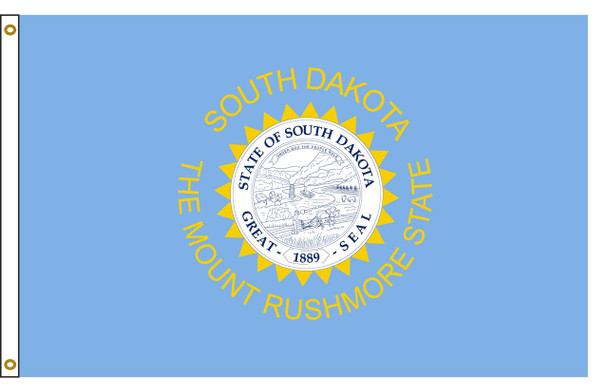
FORTISVEX South Dakota State Flag 4x6 Feet Nylon - Made in USA with Brass Grommets
- MPN:
- FPAMSTSDNYL4x6G
- Availability:
- Free Shipping* https://fortisvex.com/shipping-returns-terms/
- Shipping:
- Calculated at Checkout

Description
A 4x6 foot flag is too big for a house bracket and needs ground-mounted hardware. That practical fact, not appearance, is the real reason to choose this size over a 3x5 Feet.
This is the South Dakota state flag at 4x6 Feet (24 square feet) in nylon, made in the United States and finished with brass grommets.
Built to the South Dakota flag specification
The South Dakota flag is set out in South Dakota Codified Laws Section 1-6-4, at a ratio of about three to five. It is a sky blue field with the state seal on a serrated gold sun, and the words South Dakota and The Mount Rushmore State.
Originally adopted in 1909 as The Sunshine State, redesigned in 1963, with the current nickname version adopted in 1992.
South Dakota specifies a ratio. Section 1-6-4 gives a field one and two thirds as long as it is wide, which is three to five, and defines the seal, the sun and the lettering as fractions of the width. A 3x5 foot flag matches the ratio.
We reproduce that design faithfully, in the standard outdoor flag sizes the whole industry uses and that the states themselves buy. What matters on an outdoor flag is that the colors, the seal and the emblems are right, and they are.
The law that defines it, in its own words
South Dakota Codified Laws Section 1-6-4 reads:
The state flag or banner shall consist of a field of sky-blue one and two-thirds as long as it is wide. Centered on such field shall be the great seal of South Dakota made in conformity with the terms of the Constitution, which shall be four-ninths the width of the flag in diameter. The seal shall be on a white background with the seal outlined in dark blue or, in the alternative, shall be on a sky-blue background with the seal outlined in dark blue thereon. Surrounding the seal in gold shall be a serrated sun whose extreme width shall be five-ninths the width of the flag. The words "South Dakota" symmetrically arranged to conform to the circle of the sun and seal shall appear in gold letters one-eighteenth the width of the field above the sun and seal and the words "The Mount Rushmore State" in like-sized gold letters and in like arrangement shall appear below the sun and seal. Flags designed of such material as may be provident for outdoor use need have no fringe but flags for indoor and display usage shall have a golden fringe one-eighteenth the width of the flag on the three sides other than the hoist.
The emblem itself is defined by reference to the great seal, so these words are the frame and not the whole picture.
You do not have to take our word for any of that. Read South Dakota Codified Laws Section 1-6-4 in full at the South Dakota Legislature, and check what we sell against it.
That is the flag as we build it. Nothing about it is approximate.
What is on it and what it means
The seal sits on a serrated gold sun, which carries over from the original 1909 design when the flag was called the Sunshine State flag.
What most listings get wrong
The nickname on the flag changed. Before 1992 it read The Sunshine State. Flags reading Sunshine State are pre-1992 and are no longer current.
Where the South Dakota flag flies
A genuine state capitol program. Requests to have a flag flown over the State Capitol are handled by the Bureau of Administration's Property Management division in Pierre, with about three weeks' notice requested and the requester covering the cost of the flag plus mailing. Exact price, sizes, materials and any residency limit were not published in the sources found. The Bureau's Central Supply separately sells United States, South Dakota and prisoner of war flags. A distinctive history: one of the two original 1909 handmade state flags, linked to the Old West lawman Seth Bullock and designed by Ida Anding, was displayed for decades in the Secretary of State's office at the Capitol, went missing in January 2015, and was recovered in Washington later that year. A separate Memorial Flag Program running since 1987 flies flags for deceased veterans in Hilgers Gulch Park.
Fly it on South Dakota’s birthday
South Dakota became the 40th state on November 2, 1889. Under the United States Flag Code as amended July 7, 1976, a state flag flown on the state’s birthday takes its place beneath the United States flag, and that day is the one date every year the South Dakota flag has an official reason to go up.
Order ahead and this flag is ready for the day. The complete list of state birthdays lives on our state birthdays page.
Nylon or polyester in South Dakota
Polyester statewide at Sioux Falls and Rapid City.
Twenty four square feet is where wind load starts to matter in earnest, and the verdict above carries more weight here than on a standard house flag.
You are looking at the nylon here, the right pick for the sheltered and moderate wind sites named above, for any house bracket, and for anywhere the flag gets brought in during storms. Two things make that case. It is light enough to move on the breeze most yards actually get rather than hang limp, and it dries fast, which keeps mildew away in a humid climate. What it trades away is ultraviolet durability — nylon’s amide bonds break down under ultraviolet light, losing strength and color faster than polyester, and it loses roughly a tenth of its strength while wet. For one of the exposed sites named above, the polyester version is the better fit.
There is one more factor, and most people only discover it after buying the wrong material once: a nylon flag moves on days a polyester flag stays limp. If it matters to you that the flag is actually flying on a still morning, a holiday, at a funeral, at a ceremony, that favors nylon even where polyester would outlast it. A flag hanging motionless has failed at its job too.
The number most institutions rely on traces to the American Legion, which reports a roughly ninety-day expectation from the federal government for a flag flown daily sunrise to sunset, and about a quarter of that flown around the clock. Retailer experience puts nylon at three to six months daily, polyester at four to eight, and an occasionally flown flag at one to three years. These figures are practical guidance, not a warranty, and exposure will move them considerably.
How the 4x6 Feet is built
The extra area on a 4x6 foot flag — more than half again a 3x5 Feet's — means more wind caught and a harder-working fly end. Four rows of lock stitching, all four earning their place.
Here is the arithmetic: 24 square feet of nylon at roughly two ounces a square yard. A thirty mile an hour wind sends the fly end moving faster than the wind itself, since the wave traveling toward the tip picks up speed as it goes — which is why the tip wears out first, and why the fly end's stitching count is the figure to check on any listing.
A one person job, technically, but the first windy day taking it down alone will make the size difference clear. Bring it in ahead of weather, not during it.
With lock stitching, every stitch knots into its neighbor, so damage stays contained at the break instead of running down the seam. Read 4 rows not as 4 times the strength but as 3 backups. The heading is reinforced heavy duty white, an inch and a half, with brass grommets and tooth washers taking a real load across twenty four square feet.
The flag material is commercial grade nylon. It is light enough to fly in a gentle breeze, it sheds water rather than holding it, and it dries fast, which matters because a flag that stays wet stays heavy and works its seams harder. The ink is UV resistant and field tested; sun is what takes a flag’s color, and the ink decides how long it holds.
Why this flag is harder to make than most
A busy seal, a serrated sun and two lines of lettering, one of them long. Among the most crowded designs in the country.
For what it is worth, the North American Vexillological Association surveyed 72 state, provincial and territorial flags in 2001 and rated them from zero to ten. The South Dakota flag placed 68, at 3.12 out of 10.
Will it fit my flagpole?
Eighteen to twenty five feet of in-ground flagpole suits this size. A standard six foot house bracket will have it dragging and wrapping instead.
Questions about the 4x6 Feet
What flagpole does a 4x6 foot flag need? An in-ground flagpole of eighteen to twenty five feet. It is too large for a standard house bracket, which is the honest reason to choose it.
Is a 4x6 foot flag worth it over a 3x5 foot flag? Only if the flagpole is tall enough. On a twenty foot flagpole a 3x5 foot flag looks lost and a 4x6 foot flag fills it. On a six foot bracket the 4x6 foot flag will wrap.
Can I fly a 4x6 foot state flag with a 4x6 foot United States flag? Yes, and on two flagpoles of equal height that is the correct pairing, with the United States flag to the viewer’s left.
Where the step up starts to cost you
Stepping up from a 3x5 Feet to a 4x6 Feet is where a cheap build starts costing real money. The extra area means more force at the fly end and more load on the grommets, so a budget 4x6 Feet fails faster than a budget 3x5 Feet ever would. Construction stops being optional at this size.
Specifications
- Size: 4x6 Feet
- Area: 24 square feet
- Material: 100 percent nylon
- Fly end: 4 rows of lock stitching
- Heading: heavy duty white, reinforced, 1-1/2 inch
- Finish: Brass Grommets
- Ink: UV resistant, field tested
- Made in the United States by FORTISVEX
Which size do I need?
Underneath both tables is a single ratio: a flag a quarter to a third the flagpole’s height. When you land between two rows, that is a real choice, not a rounding error — smaller flies more often, bigger reads further.
If you know your flagpole height, start here.
- 6 Feet house bracket: 2x3 Feet or 3x5 Feet
- 15 to 20 Feet flagpole: 3x5 Feet or 4x6 Feet
- 20 to 25 Feet flagpole: 4x6 Feet or 5x8 Feet
- 25 to 35 Feet flagpole: 5x8 Feet or 6x10 Feet
- 35 to 45 Feet flagpole: 6x10 Feet or 8x12 Feet
- 45 to 60 Feet flagpole: 8x12 Feet or 10x15 Feet
- 60 to 80 Feet flagpole: 10x15 Feet or 12x18 Feet
- 80 to 100 Feet flagpole: 12x18 Feet or 15x25 Feet
- 100 to 120 Feet flagpole: 15x25 Feet or 20x30 Feet
- 120 to 150 Feet flagpole: 20x30 Feet or 20x38 Feet
- 150 to 200 Feet flagpole: 20x38 Feet or 30x50 Feet
- 200 to 240 Feet flagpole: 30x50 Feet or 30x60 Feet
- 240 Feet and above: 30x60 Feet or 50x80 Feet, engineered to the flagpole
If you know your flag size, start here.
- 2x3 Feet: 4 to 8 Feet bracket or garden flagpole
- 3x5 Feet: 6 Feet bracket, or 15 to 20 Feet in-ground flagpole
- 4x6 Feet: 18 to 25 Feet in-ground flagpole
- 5x8 Feet: 25 to 35 Feet flagpole
- 6x10 Feet: 30 to 40 Feet flagpole
- 8x12 Feet: 40 to 50 Feet flagpole
- 10x15 Feet: 50 to 60 Feet flagpole
- 12x18 Feet: 60 to 80 Feet flagpole
- 15x25 Feet: 80 to 100 Feet flagpole
- 20x30 Feet: 100 to 120 Feet flagpole
- 20x38 Feet: 120 to 150 Feet flagpole. This is the garrison size under Executive Order 10834, at a one to one point nine ratio rather than the two to three of the commercial sizes, and it is the size flown at the White House and the Capitol
- 30x50 Feet: 150 to 200 Feet flagpole
- 30x60 Feet: 200 to 240 Feet flagpole. This is the largest standard commercial size
- 50x80 Feet: 240 Feet and above, engineered to the flagpole
Above roughly a hundred feet of flagpole, the quarter to a third guide keeps its accuracy but loses its simplicity: the flag now has to be specified alongside the truck, the halyard, the foundation and the wind load as a single system, and skipping that step is how a flagpole gets damaged rather than the flag. Several famous installations fly flags larger than the rule on purpose, with an engineer deciding it rather than a table.
What is on the website is not the limit of what we carry. Any size in the tables above can be ordered, listed or not.
About the back of the flag
It is normal for a printed flag to read backward from behind — almost every flag flown in America works this way. A flag that reads correctly from both sides is double sided: two flags sewn together with a liner, at roughly double the weight and cost. Single sided stays the standard and the right choice except where a state’s own law requires the double sided build.
Flying it with the United States flag
Section 7 of Title 4, the United States Flag Code, addresses this directly: the United States flag is never outranked in position, staying above every other flag and to the right at the same level, which reads as the viewer’s left. Same-height flagpoles put the United States flag on the viewer’s left with matching flag sizes; different heights put it on the taller pole; one flagpole with two flags puts it at the top. There is no legal penalty for civilians under the Flag Code, but it is what every institution follows anyway.
Buy two and they both last longer
Keep two flags and swap them monthly. That single habit will outlast three flags run to destruction, since resting fabric recovers and the fly end is spared the repeated wear of constant flying. Take the flag down ahead of severe weather, since one bad storm night can outdo six calm months. Watch the fly end rather than the center; a little stitching early saves a whole season.
For cities, counties, schools and agencies
We supply state flags to municipalities, school districts, fire and police departments, courthouses and state agencies. Tax exempt accounts are handled through the tax exempt page. For quantities, replacement schedules or sizes not listed, use the contact page.
Why buy it from us
We are a small, American-based company that stocks what it lists. Every flag is made in the United States, uses UV resistant ink, and is finished to the standard described above rather than cut down to hit a price. One flag that lasts is worth more to us than three that do not. Free shipping applies over twenty five dollars.
Additional Information
Material Type: |
Commercial Nylon |
Flag Size: |
4x6 Feet |
Made in: |
USA |
Finish: |
Brass Grommets |
Related Products
Related Products

FORTISVEX North Dakota State Flag 4x6 Feet Nylon - Made in USA with Brass Grommets
FORTISVEX
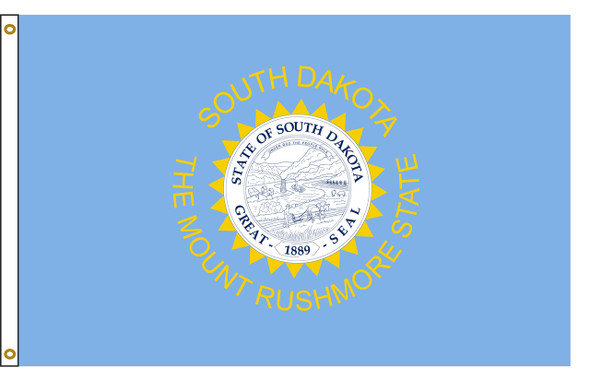
FORTISVEX South Dakota State Flag 6x10 Feet Nylon - Made in USA with Brass Grommets
FORTISVEX

FORTISVEX South Dakota State Flag 3x5 Feet Nylon - Made in USA with Brass Grommets
FORTISVEX
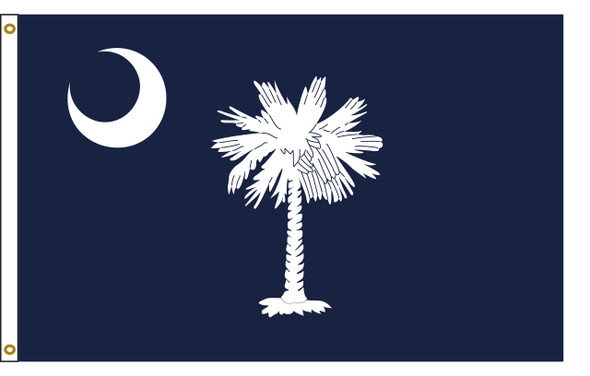
FORTISVEX South Carolina State Flag 4x6 Feet Nylon - Made in USA with Brass Grommets
FORTISVEX

FORTISVEX South Dakota State Flag 5x8 Feet Nylon - Made in USA with Brass Grommets
FORTISVEX