
FORTISVEX
North Carolina 5x8 Feet Nylon State Flag Made in USA

- MPN:
- FPAMSTNCNYL5x8G
- Availability:
- Free Shipping* https://fortisvex.com/shipping-returns-terms/
- Shipping:
- Calculated at Checkout





Description
Businesses fly this size on thirty foot flagpoles: dealerships, banks, fire stations, churches, schools. A homeowner with a tall flagpole reaches for it too, once a 4x6 foot flag starts looking small up there.
This is the North Carolina state flag at 5x8 Feet (40 square feet) in nylon, made in the United States and finished with brass grommets.
Built to the North Carolina flag specification
The North Carolina flag is set out in North Carolina General Statutes Section 144-1. It is a blue union with a white star flanked by gilt letters N and C, red over white bars in the fly, and two date scrolls, May 20th 1775 above and April 12th 1776 below.
Adopted March 9, 1885 from a design by William G. Browne, and modified in 1991.
Design, colors and the seal or emblem are what this state's statute defines; a fixed size for an outdoor flag is not among them. Most of the country works the same way, and that is why manufacturers all build to the same standard sizes.
We build a faithful reproduction of that design at the standard outdoor sizes the industry uses, the same sizes states order for themselves. Correct colors, seal and emblems are what an outdoor flag has to get right, and that is what this one gets right.
The law that defines it, in its own words
North Carolina General Statutes Section 144-1 reads:
The flag of North Carolina shall consist of a blue union, containing in the center thereof a white star with the letter "N" in gilt on the left and the letter "C" in gilt on the right of said star, the circle containing the same to be one third the width of said union. The fly of the flag shall consist of two equally proportioned bars, the upper bar to be red, the lower bar to be white; the length of the bars horizontally shall be equal to the perpendicular length of the union, and the total length of the flag shall be one half more than its width. Above the star in the center of the union there shall be a gilt scroll in semicircular form, containing in black letters this inscription: "May 20th 1775" and below the star there shall be a similar scroll containing in black letters the inscription: "April 12th 1776".
You do not have to take our word for any of that. Read North Carolina General Statutes Section 144-1 in full at the North Carolina General Assembly, and check what we sell against it.
This is what we actually make, not a stand-in for it.
What is on it and what it means
The two dates commemorate early independence actions, the Mecklenburg Declaration and the Halifax Resolves.
What most listings get wrong
The May 20, 1775 Mecklenburg Declaration date is historically contested. No original document survives. It is on the flag regardless, which is part of what makes it interesting.
Where the North Carolina flag flies
The AMVETS Post 920 flag in Gastonia, erected in 1999, measures sixty five by one hundred and fourteen feet, seven thousand four hundred and ten square feet, on a two hundred and twenty five foot flagpole, and is visible about thirty miles. It has long been billed as the largest flying United States flag on a flagpole.
Fly it on North Carolina’s birthday
North Carolina became the 12th state on November 21, 1789. Under the United States Flag Code as amended July 7, 1976, a state flag flown on the state’s birthday takes its place beneath the United States flag, and that day is the one date every year the North Carolina flag has an official reason to go up.
Get it now so it is flying on the day itself. See every state’s birthday on our state birthdays page.
Nylon or polyester in North Carolina
Nylon in the Piedmont at Charlotte, Raleigh and Greensboro. Polyester on the coast and Outer Banks.
The heading takes real load at forty square feet in any gust, and the exposed sites above will reveal the difference between nylon and polyester within a season.
You are looking at the nylon here, the right pick for the sheltered and moderate wind sites named above, for any house bracket, and for anywhere the flag gets brought in during storms. Two things make that case. It is light enough to move on the breeze most yards actually get rather than hang limp, and it dries fast, which keeps mildew away in a humid climate. What it trades away is ultraviolet durability — nylon’s amide bonds break down under ultraviolet light, losing strength and color faster than polyester, and it loses roughly a tenth of its strength while wet. For one of the exposed sites named above, the polyester version is the better fit.
The part most buyers learn only the second time around: nylon flies in wind too light to move polyester. When it matters that the flag is actually moving — a still morning, a holiday, a funeral, a ceremony — that favors nylon even somewhere polyester would last longer. A flag that hangs motionless is not doing its job either, however durable it is.
Institutions commonly cite the American Legion’s figure: the federal government expects about ninety days from a flag flown daily sunrise to sunset, and roughly a quarter of that flown around the clock. On the ground, retailers report three to six months for nylon flown daily, four to eight for polyester, and one to three years for occasional flying. Take these as working estimates, not warranties — exposure can move them a long way in either direction.
How the 5x8 Feet is built
Forty square feet is real work for a flag, and this one fails where everyone can see it. A frayed tip on a business flagpole shows from the road — which is exactly why the flag is flying.
The arithmetic behind that: 40 square feet of nylon at roughly two ounces a square yard. In a thirty mile an hour wind the fly end of a flag this size travels faster than the wind itself, because the wave running out to the tip accelerates as it goes. That is why the tip wears out first and why the stitching count at that end is the number worth reading on any listing.
Two people handle this more easily than one, especially on a windy site, since forty square feet of unsecured fabric catches wind during folding.
A lock stitch ties into the stitch next to it, so one broken thread does not unzip the whole seam — it just stops. 4 rows is not 4 times the strength; it is 3 backups. The heading widens to two inches here, heavy duty white and reinforced, with two solid brass grommets and tooth washers. Forty square feet in a gust is a serious pull on a heading, and the extra half inch is not decoration.
Commercial grade nylon is the material in this flag. Light enough to catch a gentle breeze, it sheds water rather than holding onto it and dries fast, which keeps a flag from staying heavy and stressing its seams. The ink is UV resistant and field tested, since sun exposure is what determines how long the color lasts.
A design that reproduces cleanly
Letters, a star and two dated scrolls, but no seal. The dates are small and are the first thing to blur on a cheap print.
For what it is worth, the North American Vexillological Association surveyed 72 state, provincial and territorial flags in 2001 and rated them from zero to ten. The North Carolina flag placed 33, at 5.34 out of 10.
Will it fit my flagpole?
This size belongs on an in-ground flagpole between twenty five and thirty five feet — the standard commercial setup.
Questions about the 5x8 Feet
What size flagpole for a 5x8 foot flag? Twenty five to thirty five feet in the ground, which is the standard commercial flagpole. This is the size on most dealerships, banks and fire stations.
Should a business choose nylon or polyester at 5x8 Feet? Nylon flies more often and looks better on a calm day. Polyester lasts longer on an open, windy or coastal site. The section above names which your state is.
How often does a 5x8 foot commercial flag need replacing? A flag flown daily on an exposed commercial flagpole is typically replaced two to four times a year. A rotation of two flags swapped monthly stretches that.
What the condition of it says
People see the flag before they see the building it stands in front of. A worn, faded flag on a business flagpole sends a message, and that message costs something different from the price of a replacement.
Specifications
- Size: 5x8 Feet
- Area: 40 square feet
- Material: 100 percent nylon
- Fly end: 4 rows of lock stitching
- Heading: heavy duty white, reinforced, 2 inch
- Finish: Brass Grommets
- Ink: UV resistant, field tested
- Made in the United States by FORTISVEX
Which size do I need?
Underneath both tables is a single ratio: a flag a quarter to a third the flagpole’s height. When you land between two rows, that is a real choice, not a rounding error — smaller flies more often, bigger reads further.
If you know your flagpole height, start here.
- 6 Feet house bracket: 2x3 Feet or 3x5 Feet
- 15 to 20 Feet flagpole: 3x5 Feet or 4x6 Feet
- 20 to 25 Feet flagpole: 4x6 Feet or 5x8 Feet
- 25 to 35 Feet flagpole: 5x8 Feet or 6x10 Feet
- 35 to 45 Feet flagpole: 6x10 Feet or 8x12 Feet
- 45 to 60 Feet flagpole: 8x12 Feet or 10x15 Feet
- 60 to 80 Feet flagpole: 10x15 Feet or 12x18 Feet
- 80 to 100 Feet flagpole: 12x18 Feet or 15x25 Feet
- 100 to 120 Feet flagpole: 15x25 Feet or 20x30 Feet
- 120 to 150 Feet flagpole: 20x30 Feet or 20x38 Feet
- 150 to 200 Feet flagpole: 20x38 Feet or 30x50 Feet
- 200 to 240 Feet flagpole: 30x50 Feet or 30x60 Feet
- 240 Feet and above: 30x60 Feet or 50x80 Feet, engineered to the flagpole
If you know your flag size, start here.
- 2x3 Feet: 4 to 8 Feet bracket or garden flagpole
- 3x5 Feet: 6 Feet bracket, or 15 to 20 Feet in-ground flagpole
- 4x6 Feet: 18 to 25 Feet in-ground flagpole
- 5x8 Feet: 25 to 35 Feet flagpole
- 6x10 Feet: 30 to 40 Feet flagpole
- 8x12 Feet: 40 to 50 Feet flagpole
- 10x15 Feet: 50 to 60 Feet flagpole
- 12x18 Feet: 60 to 80 Feet flagpole
- 15x25 Feet: 80 to 100 Feet flagpole
- 20x30 Feet: 100 to 120 Feet flagpole
- 20x38 Feet: 120 to 150 Feet flagpole. This is the garrison size under Executive Order 10834, at a one to one point nine ratio rather than the two to three of the commercial sizes, and it is the size flown at the White House and the Capitol
- 30x50 Feet: 150 to 200 Feet flagpole
- 30x60 Feet: 200 to 240 Feet flagpole. This is the largest standard commercial size
- 50x80 Feet: 240 Feet and above, engineered to the flagpole
The quarter to a third rule holds all the way up, but above about a hundred feet the flag and the flagpole stop being two purchases and become one engineered system: the truck, the halyard, the foundation and the wind load all have to be specified together, and a flag bought without checking the flagpole rating damages the flagpole first. Several famous installations deliberately fly longer than the rule, which is a choice made with an engineer rather than from a chart.
The full range is available to order even where a size is not shown on the site. If what you need is not listed here, ask and we can still get it made.
About the back of the flag
It is normal for a printed flag to read backward from behind — almost every flag flown in America works this way. A flag that reads correctly from both sides is double sided: two flags sewn together with a liner, at roughly double the weight and cost. Single sided stays the standard and the right choice except where a state’s own law requires the double sided build.
Flying it with the United States flag
Section 7 of Title 4, the United States Flag Code, addresses this directly: the United States flag is never outranked in position, staying above every other flag and to the right at the same level, which reads as the viewer’s left. Same-height flagpoles put the United States flag on the viewer’s left with matching flag sizes; different heights put it on the taller pole; one flagpole with two flags puts it at the top. There is no legal penalty for civilians under the Flag Code, but it is what every institution follows anyway.
Buy two and they both last longer
Fly one for a month, then swap. Two flags rotated monthly will outlast three flags flown to destruction, because the fabric recovers when it rests and the fly end stops taking the same abuse in the same place. Take it down in severe weather; a flag left up through a real windstorm can take more damage in one night than in six normal months. And watch the fly end rather than the middle, because a few minutes with a needle when the fraying starts buys another season.
For cities, counties, schools and agencies
This is a flag we sell to municipalities, school districts, fire and police departments, courthouses and state agencies as standard business. Use the tax exempt page for a tax exempt account, and the contact page for quantity orders, a replacement schedule, or a size not shown on this listing.
Why buy it from us
This is a small American company, and what you see listed is what we actually stock. Every flag is made in the United States, printed with UV resistant ink, and built to the construction described above, not to whatever a price point demands. Selling one flag that lasts beats selling three that fail. Orders over twenty five dollars ship free.
Videos
View AllClose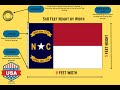
Additional Information
Material Type: |
Commercial Nylon |
Flag Size: |
5x8 Feet |
Made in: |
USA |
Finish: |
Grommets |
Related Products
Related Products
FORTISVEX South Carolina State Flag 5x8 Feet Nylon - Made in USA with Brass Grommets
FORTISVEX

FORTISVEX North Dakota State Flag 5x8 Feet Nylon - Made in USA with Brass Grommets
FORTISVEX

North Carolina 10x15 Feet Nylon State Flag Made in USA
FORTISVEX

North Carolina 2x3 Feet Nylon State Flag Made in USA
FORTISVEX


North Carolina 12x18 Feet Nylon State Flag Made in USA
FORTISVEX