
FORTISVEX
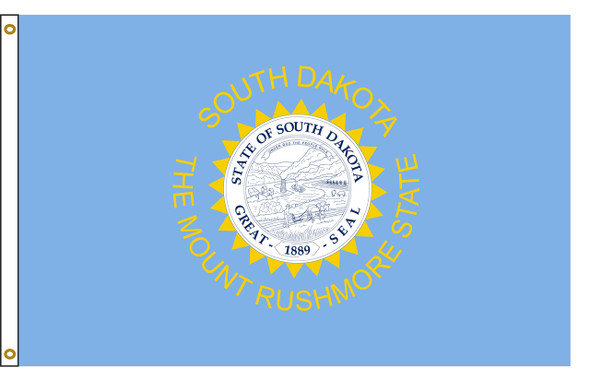
FORTISVEX South Dakota State Flag 3x5 Feet Nylon - Made in USA with Brass Grommets

- MPN:
- FPAMSTSDNYL3x5G
- Availability:
- Free Shipping*
- Shipping:
- Calculated at Checkout

Description
Ask someone to picture a flag and this is usually the size in their head. It matches the bracket most houses already have, and no other size gets replaced as often across the country.
This is the South Dakota state flag at 3x5 Feet (15 square feet) in nylon, made in the United States and finished with brass grommets.
Built to the South Dakota flag specification
The South Dakota flag is set out in South Dakota Codified Laws Section 1-6-4, at a ratio of about three to five. It is a sky blue field with the state seal on a serrated gold sun, and the words South Dakota and The Mount Rushmore State.
Originally adopted in 1909 as The Sunshine State, redesigned in 1963, with the current nickname version adopted in 1992.
South Dakota specifies a ratio. Section 1-6-4 gives a field one and two thirds as long as it is wide, which is three to five, and defines the seal, the sun and the lettering as fractions of the width. A 3x5 foot flag matches the ratio.
Faithfully reproduced, that is the standard we hold this design to, at the outdoor sizes the whole industry uses and states themselves order. What an outdoor flag needs right is the color, the seal and the emblems, and this one has them right.
The law that defines it, in its own words
South Dakota Codified Laws Section 1-6-4 reads:
The state flag or banner shall consist of a field of sky-blue one and two-thirds as long as it is wide. Centered on such field shall be the great seal of South Dakota made in conformity with the terms of the Constitution, which shall be four-ninths the width of the flag in diameter. The seal shall be on a white background with the seal outlined in dark blue or, in the alternative, shall be on a sky-blue background with the seal outlined in dark blue thereon. Surrounding the seal in gold shall be a serrated sun whose extreme width shall be five-ninths the width of the flag. The words "South Dakota" symmetrically arranged to conform to the circle of the sun and seal shall appear in gold letters one-eighteenth the width of the field above the sun and seal and the words "The Mount Rushmore State" in like-sized gold letters and in like arrangement shall appear below the sun and seal. Flags designed of such material as may be provident for outdoor use need have no fringe but flags for indoor and display usage shall have a golden fringe one-eighteenth the width of the flag on the three sides other than the hoist.
The emblem itself is defined by reference to the great seal, so these words are the frame and not the whole picture.
You do not have to take our word for any of that. Read South Dakota Codified Laws Section 1-6-4 in full at the South Dakota Legislature, and check what we sell against it.
It is the real flag we produce, not a simplified version.
What is on it and what it means
The seal sits on a serrated gold sun, which carries over from the original 1909 design when the flag was called the Sunshine State flag.
What most listings get wrong
The nickname on the flag changed. Before 1992 it read The Sunshine State. Flags reading Sunshine State are pre-1992 and are no longer current.
Where the South Dakota flag flies
A genuine state capitol program. Requests to have a flag flown over the State Capitol are handled by the Bureau of Administration's Property Management division in Pierre, with about three weeks' notice requested and the requester covering the cost of the flag plus mailing. Exact price, sizes, materials and any residency limit were not published in the sources found. The Bureau's Central Supply separately sells United States, South Dakota and prisoner of war flags. A distinctive history: one of the two original 1909 handmade state flags, linked to the Old West lawman Seth Bullock and designed by Ida Anding, was displayed for decades in the Secretary of State's office at the Capitol, went missing in January 2015, and was recovered in Washington later that year. A separate Memorial Flag Program running since 1987 flies flags for deceased veterans in Hilgers Gulch Park.
Fly it on South Dakota’s birthday
South Dakota became the 40th state on November 2, 1889. Under the United States Flag Code as amended July 7, 1976, a state flag flown on the state’s birthday takes its place beneath the United States flag, and that day is the one date every year the South Dakota flag has an official reason to go up.
Buy it in time and it goes up on the day it matters. Every state’s date is on our state birthdays page.
Nylon or polyester in South Dakota
Polyester statewide at Sioux Falls and Rapid City.
This is a house flag, fifteen square feet, where the material determines whether it flies in a light breeze and how fast it dries once it rains.
The nylon is what you are looking at here — the right choice for the sheltered and moderate wind sites named above, for a house bracket, and for anywhere the flag comes down ahead of storms. Two things settle it. It is light enough to fly on an ordinary yard’s breeze rather than sag, and it dries fast, fighting mildew in humid conditions. What it gives up is resistance to ultraviolet — nylon’s amide bonds break under sun, costing strength and color faster than polyester, and it loses roughly a tenth of its strength while wet. If the site is one of the exposed ones above, the polyester version fits better.
The part most buyers learn only the second time around: nylon flies in wind too light to move polyester. When it matters that the flag is actually moving — a still morning, a holiday, a funeral, a ceremony — that favors nylon even somewhere polyester would last longer. A flag that hangs motionless is not doing its job either, however durable it is.
The figure most institutions use is from the American Legion, citing the United States government's expectation of about ninety days for a flag flown daily from sunrise to sunset, and roughly a quarter of that around the clock. Retailers see three to six months in practice for nylon flown daily, four to eight for polyester, and one to three years when flown occasionally. These are practical figures, not a guarantee, and real-world exposure shifts them considerably.
How the 3x5 Feet is built
This size fails at the fly end first, and sooner than it should on most 3x5 foot flags, because this size gets bought on price more than any other. Four rows of lock stitching at the fly end is what separates one season from three.
The arithmetic behind that: 15 square feet of nylon at roughly two ounces a square yard. In a thirty mile an hour wind the fly end of a flag this size travels faster than the wind itself, because the wave running out to the tip accelerates as it goes. That is why the tip wears out first and why the stitching count at that end is the number worth reading on any listing.
Raising or lowering this size is a one person task, and it folds to fit a drawer. Rotating two flags monthly is a minute of effort, no more, at 3x5 Feet.
A lock stitch ties into the stitch next to it, so one broken thread does not unzip the whole seam — it just stops. 4 rows is not 4 times the strength; it is 3 backups. Two solid brass grommets sit in a reinforced, inch and a half heading. At fifteen square feet, there is enough sail area to put real strain on them whenever the site sees wind.
Commercial grade nylon is the material in this flag. Light enough to catch a gentle breeze, it sheds water rather than holding onto it and dries fast, which keeps a flag from staying heavy and stressing its seams. The ink is UV resistant and field tested, since sun exposure is what determines how long the color lasts.
Why this flag is harder to make than most
A busy seal, a serrated sun and two lines of lettering, one of them long. Among the most crowded designs in the country.
For what it is worth, the North American Vexillological Association surveyed 72 state, provincial and territorial flags in 2001 and rated them from zero to ten. The South Dakota flag placed 68, at 3.12 out of 10.
Will it fit my flagpole?
This is the size for a five or six foot house bracket or a fifteen to twenty foot flagpole, the most common residential setup nationwide.
Questions about the 3x5 Feet
What size flagpole does a 3x5 foot flag need? A six foot house bracket, or an in-ground flagpole of fifteen to twenty feet. It is the most common residential pairing in the country.
How long does a 3x5 foot nylon flag last outside? The federal working figure is about ninety days for a flag flown daily from sunrise to sunset, and about a quarter of that flown around the clock. Retailers commonly see three to six months in daily use and one to three years flown on occasions only.
Is this flag printed or sewn? The design is printed in UV resistant ink on one side and reads through in reverse on the back, which is how nearly every state flag sold in the country is made. The construction, the heading, the stitching and the grommets are sewn.
Why this size gets replaced most
The 3x5 foot flag is not weaker by design — it is simply the size most often sold on price, which means most of them are built down to a price. A cheap one, with just one or two rows of fly-end stitching, frays within a season and is six inches shorter by the next one. Construction is the whole story here.
Specifications
- Size: 3x5 Feet
- Area: 15 square feet
- Material: 100 percent nylon
- Fly end: 4 rows of lock stitching
- Heading: heavy duty white, reinforced, 1-1/2 inch
- Finish: Brass Grommets
- Ink: UV resistant, field tested
- Made in the United States by FORTISVEX
Which size do I need?
Both tables follow the same logic. A flagpole reads best with a flag whose length falls between a quarter and a third of its height. Where a size could go either way, smaller means more flying days and a longer life, bigger means more visibility at range.
If you know your flagpole height, start here.
- 6 Feet house bracket: 2x3 Feet or 3x5 Feet
- 15 to 20 Feet flagpole: 3x5 Feet or 4x6 Feet
- 20 to 25 Feet flagpole: 4x6 Feet or 5x8 Feet
- 25 to 35 Feet flagpole: 5x8 Feet or 6x10 Feet
- 35 to 45 Feet flagpole: 6x10 Feet or 8x12 Feet
- 45 to 60 Feet flagpole: 8x12 Feet or 10x15 Feet
- 60 to 80 Feet flagpole: 10x15 Feet or 12x18 Feet
- 80 to 100 Feet flagpole: 12x18 Feet or 15x25 Feet
- 100 to 120 Feet flagpole: 15x25 Feet or 20x30 Feet
- 120 to 150 Feet flagpole: 20x30 Feet or 20x38 Feet
- 150 to 200 Feet flagpole: 20x38 Feet or 30x50 Feet
- 200 to 240 Feet flagpole: 30x50 Feet or 30x60 Feet
- 240 Feet and above: 30x60 Feet or 50x80 Feet, engineered to the flagpole
If you know your flag size, start here.
- 2x3 Feet: 4 to 8 Feet bracket or garden flagpole
- 3x5 Feet: 6 Feet bracket, or 15 to 20 Feet in-ground flagpole
- 4x6 Feet: 18 to 25 Feet in-ground flagpole
- 5x8 Feet: 25 to 35 Feet flagpole
- 6x10 Feet: 30 to 40 Feet flagpole
- 8x12 Feet: 40 to 50 Feet flagpole
- 10x15 Feet: 50 to 60 Feet flagpole
- 12x18 Feet: 60 to 80 Feet flagpole
- 15x25 Feet: 80 to 100 Feet flagpole
- 20x30 Feet: 100 to 120 Feet flagpole
- 20x38 Feet: 120 to 150 Feet flagpole. This is the garrison size under Executive Order 10834, at a one to one point nine ratio rather than the two to three of the commercial sizes, and it is the size flown at the White House and the Capitol
- 30x50 Feet: 150 to 200 Feet flagpole
- 30x60 Feet: 200 to 240 Feet flagpole. This is the largest standard commercial size
- 50x80 Feet: 240 Feet and above, engineered to the flagpole
Nothing about the ratio breaks above a hundred feet, but the purchase does: the flag, the flagpole, the truck, the halyard and the foundation become one system that has to be specified together, and skipping that check risks the flagpole before it risks the flag. Some of the largest flags flown in the country are deliberately oversized for their rule-of-thumb flagpole, always on an engineer’s sign-off.
We do not limit ourselves to what is listed on the site. The full range above is available to order, and an unlisted size can still be supplied.
About the back of the flag
Every printed flag looks right from one side and mirrored from the other, and that is simply how the overwhelming majority of American flags are built. Making both sides read correctly means building what is really two flags stitched together over a liner, at roughly twice the price and twice the weight. Single sided is the standard, and it is the right choice unless a state’s statute specifically requires otherwise.
Flying it with the United States flag
Title 4, Section 7 of the Flag Code is the source for this. The United States flag is never subordinate in position — nothing flies above it, and nothing takes its place at the viewer’s left when flags are level with each other. On matched flagpoles, the United States flag takes the viewer’s left and the flags should be sized the same; on unequal flagpoles, it goes on the taller one; and on a single pole flying two flags, it goes at the top. There is no penalty for civilians who do not follow the Code, but institutions treat it as the standard regardless.
Buy two and they both last longer
Alternate two flags on a monthly schedule and you will get more life from both than from three flags flown until they wear out, because resting fabric recovers and the fly end stops absorbing the same repeated stress. A severe storm is the one condition worth taking the flag down for; it can do more damage in a night than six calm months. The fly end frays first, not the center, and stitching it early adds a season.
For cities, counties, schools and agencies
We supply state flags to municipalities, school districts, fire and police departments, courthouses and state agencies. Tax exempt accounts are handled through the tax exempt page. For quantities, replacement schedules or sizes not listed, use the contact page.
Why buy it from us
We run a small American company and stock the flags we sell. Each one is made in the United States, printed in UV resistant ink, and built to the construction described above instead of built to hit a lower price. One durable flag beats three that fail, in our view. Free shipping applies to orders over twenty five dollars.
Additional Information
Material Type: |
Commercial Nylon |
Flag Size: |
3x5 Feet |
Made in: |
USA |
Finish: |
Brass Grommets |
Related Products
Related Products

FORTISVEX North Dakota State Flag 3x5 Feet Nylon - Made in USA with Brass Grommets
FORTISVEX

FORTISVEX South Carolina State Flag 3x5 Feet Nylon - Made in USA with Brass Grommets
FORTISVEX

FORTISVEX South Dakota State Flag 4x6 Feet Nylon - Made in USA with Brass Grommets
FORTISVEX

FORTISVEX South Dakota State Flag 5x8 Feet Nylon - Made in USA with Brass Grommets
FORTISVEX
FORTISVEX South Dakota State Flag 6x10 Feet Nylon - Made in USA with Brass Grommets
FORTISVEX