
FORTISVEX
FORTISVEX South Carolina State Flag 3x5 Feet Nylon - Made in USA with Brass Grommets

- MPN:
- FPAMSTSCNYL3x5G
- Availability:
- Free Shipping*
- Shipping:
- Calculated at Checkout

Description
This is the default: the size that fits the bracket already on the house, and the size Americans replace more than any other. When someone says flag without qualifying it, this is what they mean.
This is the South Carolina state flag at 3x5 Feet (15 square feet) in nylon, made in the United States and finished with brass grommets.
Built to the South Carolina flag specification
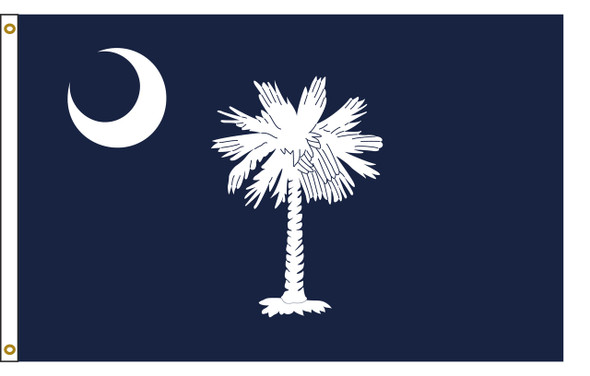
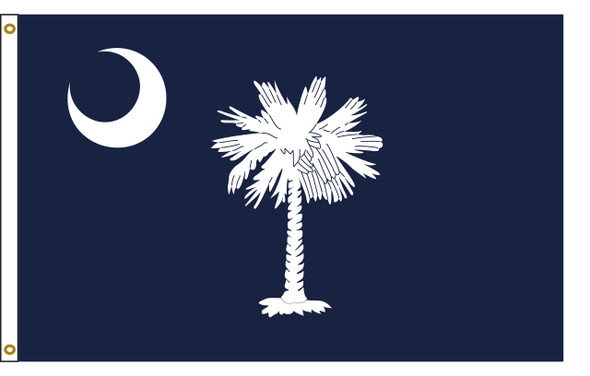
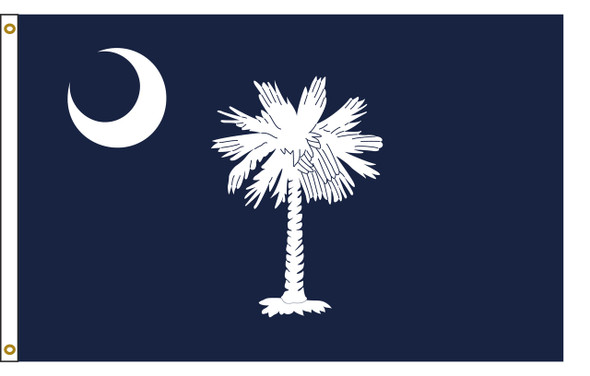
The South Carolina flag is set out in no detailed statutory design since 1940, which leaves the shape, the size and the shade of blue formally unspecified. It is a blue field with a white palmetto tree and a white crescent in the upper hoist.
Roots in Moultrie’s Revolutionary flag of 1775, with the current palmetto and crescent design adopted January 28, 1861 after a gold palmetto version that lasted two days.
The law governing this flag addresses design, colors and the seal or emblem, but leaves overall size unspecified for a modern outdoor flag. That is typical across most states, which is why the industry has converged on the same standard sizes.
The design here is reproduced faithfully, at the standard outdoor sizes the whole industry works in and that states buy for themselves. What actually matters on a flag flown outdoors is that the colors, the seal and the emblems are correct, and they are.
The law that defines it, in its own words
South Carolina Code Section 1-1-710 reads:
The color indigo blue worn on the uniform of Colonel William Moultrie's soldiers and adopted as the background of the South Carolina State flag, is designated as the official color of the State of South Carolina.
The South Carolina Code contains no design specification for the flag; this color provision is the only statutory statement about its appearance. A 2021 bill proposing one did not become law, which is why palmetto and crescent shapes vary between manufacturers.
You do not have to take our word for any of that. Read South Carolina Code Section 1-1-710 in full at the South Carolina Legislature, and check what we sell against it.
It is the real flag we produce, not a simplified version.
What is on it and what it means
The palmetto is Fort Moultrie’s palmetto log walls, which absorbed British cannon fire in 1776 rather than splintering. The crescent is the silver gorget worn on Revolutionary soldiers’ caps.
What most listings get wrong
Because the law says almost nothing, manufacturers’ palmettos and crescents vary widely and no two brands match. A standardization effort between 2018 and 2021 stalled and nothing is settled. This is the one state where asking what the official design is has no clean answer.
It is the only state whose flag has no statutory design specification, which is why versions differ between suppliers.
Where the South Carolina flag flies
Fort Sumter and Fort Moultrie National Historical Park holds the Fort Sumter garrison flag, a thirty three star flag wind damaged the night of April 11, 1861, the Fort Sumter storm flag that flew during the thirty four hour bombardment opening the Civil War on April 12, 1861, and the Palmetto Guard flag, the first Confederate aligned flag over the fort on April 14, 1861. All three were removed from display in September 2023 for long term conservation. The Revolutionary War Fort Moultrie flag is referenced by the South Carolina State Museum in Columbia.
Fly it on South Carolina’s birthday
South Carolina became the 8th state on May 23, 1788. Under the United States Flag Code as amended July 7, 1976, a state flag flown on the state’s birthday takes its place beneath the United States flag, and that day is the one date every year the South Carolina flag has an official reason to go up.
Buy it in time and it goes up on the day it matters. Every state’s date is on our state birthdays page.
Nylon or polyester in South Carolina
Nylon in the Midlands and Upstate at Columbia and Greenville. Polyester on the coast at Charleston and Myrtle Beach.
This is a house flag, fifteen square feet, where the material determines whether it flies in a light breeze and how fast it dries once it rains.
You are looking at the nylon here, the right pick for the sheltered and moderate wind sites named above, for any house bracket, and for anywhere the flag gets brought in during storms. Two things make that case. It is light enough to move on the breeze most yards actually get rather than hang limp, and it dries fast, which keeps mildew away in a humid climate. What it trades away is ultraviolet durability — nylon’s amide bonds break down under ultraviolet light, losing strength and color faster than polyester, and it loses roughly a tenth of its strength while wet. For one of the exposed sites named above, the polyester version is the better fit.
One more thing that decides it, and it is the part people only learn after buying twice: a nylon flag flies on days a polyester flag will not. If the flag matters to you on a still morning, on a holiday, at a funeral, at a ceremony, that is an argument for this one even on a site where the polyester would last longer. A flag that hangs is not doing its job either.
The working benchmark most institutions use comes from the American Legion, which reports that the United States government expects a flag flown daily from sunrise to sunset to last about ninety days, and one flown around the clock about a quarter of that. Retailer experience runs three to six months for nylon and four to eight for polyester flown daily, and one to three years for a flag flown only on occasions. Those are working figures, not a warranty, and exposure moves them a long way in either direction.
How the 3x5 Feet is built
The fly end is where this size gives out, and it gives out sooner than it should on most flags people buy, because the 3x5 foot flag is bought on price more than any other size. Four rows of lock stitching on the fly end is the difference between one season and three.
The math comes to 15 square feet of nylon at roughly two ounces a square yard. In a thirty mile an hour wind, the fly end moves faster than the wind that is driving it, since the wave headed for the tip speeds up as it travels — which explains why the tip wears out first and why fly-end stitching count is worth checking on any listing.
Raising or lowering this size is a one person task, and it folds to fit a drawer. Rotating two flags monthly is a minute of effort, no more, at 3x5 Feet.
A lock stitch ties into the stitch next to it, so one broken thread does not unzip the whole seam — it just stops. 4 rows is not 4 times the strength; it is 3 backups. The heading is an inch and a half of reinforced heavy duty white material, holding two solid brass grommets. Fifteen square feet of sail area works those grommets hard on a windy site.
The material here is commercial grade nylon. Its lightness lets it fly on a gentle breeze, it sheds rather than absorbs water, and it dries quickly, sparing the seams the extra weight and strain of staying wet. Field tested UV resistant ink handles the part that actually determines fade life: sun exposure.
A design that reproduces cleanly
A palmetto silhouette and a crescent, with no seal. The variation between suppliers is a legal gap rather than a manufacturing one.
For what it is worth, the North American Vexillological Association surveyed 72 state, provincial and territorial flags in 2001 and rated them from zero to ten. The South Carolina flag placed 10, at 7.16 out of 10.
Will it fit my flagpole?
This is the size for a five or six foot house bracket or a fifteen to twenty foot flagpole, the most common residential setup nationwide.
Questions about the 3x5 Feet
What size flagpole does a 3x5 foot flag need? A six foot house bracket, or an in-ground flagpole of fifteen to twenty feet. It is the most common residential pairing in the country.
How long does a 3x5 foot nylon flag last outside? The federal working figure is about ninety days for a flag flown daily from sunrise to sunset, and about a quarter of that flown around the clock. Retailers commonly see three to six months in daily use and one to three years flown on occasions only.
Is this flag printed or sewn? The design is printed in UV resistant ink on one side and reads through in reverse on the back, which is how nearly every state flag sold in the country is made. The construction, the heading, the stitching and the grommets are sewn.
Why this size gets replaced most
It is not that the 3x5 foot flag is weaker. It is that it is the size sold on price, which means most of them are built to a price. A cheap 3x5 foot flag with one or two rows of stitching on the fly end will fray inside a season and be six inches shorter by the end of the next one. The construction is the whole difference.
Specifications
- Size: 3x5 Feet
- Area: 15 square feet
- Material: 100 percent nylon
- Fly end: 4 rows of lock stitching
- Heading: heavy duty white, reinforced, 1-1/2 inch
- Finish: Brass Grommets
- Ink: UV resistant, field tested
- Made in the United States by FORTISVEX
Which size do I need?
There is one number behind both tables. A flag reads right when its length is somewhere between a quarter and a third of the flagpole it is on. If your flagpole puts you between two sizes, go smaller for a flag that flies more and lasts longer, or bigger for one that carries further.
If you know your flagpole height, start here.
- 6 Feet house bracket: 2x3 Feet or 3x5 Feet
- 15 to 20 Feet flagpole: 3x5 Feet or 4x6 Feet
- 20 to 25 Feet flagpole: 4x6 Feet or 5x8 Feet
- 25 to 35 Feet flagpole: 5x8 Feet or 6x10 Feet
- 35 to 45 Feet flagpole: 6x10 Feet or 8x12 Feet
- 45 to 60 Feet flagpole: 8x12 Feet or 10x15 Feet
- 60 to 80 Feet flagpole: 10x15 Feet or 12x18 Feet
- 80 to 100 Feet flagpole: 12x18 Feet or 15x25 Feet
- 100 to 120 Feet flagpole: 15x25 Feet or 20x30 Feet
- 120 to 150 Feet flagpole: 20x30 Feet or 20x38 Feet
- 150 to 200 Feet flagpole: 20x38 Feet or 30x50 Feet
- 200 to 240 Feet flagpole: 30x50 Feet or 30x60 Feet
- 240 Feet and above: 30x60 Feet or 50x80 Feet, engineered to the flagpole
If you know your flag size, start here.
- 2x3 Feet: 4 to 8 Feet bracket or garden flagpole
- 3x5 Feet: 6 Feet bracket, or 15 to 20 Feet in-ground flagpole
- 4x6 Feet: 18 to 25 Feet in-ground flagpole
- 5x8 Feet: 25 to 35 Feet flagpole
- 6x10 Feet: 30 to 40 Feet flagpole
- 8x12 Feet: 40 to 50 Feet flagpole
- 10x15 Feet: 50 to 60 Feet flagpole
- 12x18 Feet: 60 to 80 Feet flagpole
- 15x25 Feet: 80 to 100 Feet flagpole
- 20x30 Feet: 100 to 120 Feet flagpole
- 20x38 Feet: 120 to 150 Feet flagpole. This is the garrison size under Executive Order 10834, at a one to one point nine ratio rather than the two to three of the commercial sizes, and it is the size flown at the White House and the Capitol
- 30x50 Feet: 150 to 200 Feet flagpole
- 30x60 Feet: 200 to 240 Feet flagpole. This is the largest standard commercial size
- 50x80 Feet: 240 Feet and above, engineered to the flagpole
Nothing about the ratio breaks above a hundred feet, but the purchase does: the flag, the flagpole, the truck, the halyard and the foundation become one system that has to be specified together, and skipping that check risks the flagpole before it risks the flag. Some of the largest flags flown in the country are deliberately oversized for their rule-of-thumb flagpole, always on an engineer’s sign-off.
We carry the full range whether or not every size appears on this website. If the size you need is not listed, we can still supply it.
About the back of the flag
The reverse of a printed flag mirrors the front, which is ordinary and true of nearly every flag in the country. To have both faces read correctly requires a double sided construction: two flags joined with a liner in between, at about twice the material and twice the price. Single sided is the industry standard, and the sensible pick unless a state’s statute says otherwise.
Flying it with the United States flag
This is governed by the United States Flag Code, Title 4, Section 7: the United States flag always outranks every other flag in position, never displayed below it or to its right at the same level — right from the viewer’s side, that is. Two flagpoles of equal height place the United States flag at the viewer’s left with both flags the same size; if the poles differ in height, it goes on the taller pole; on one pole flying two flags, it sits at the top. The Flag Code carries no penalty for private citizens, but institutions treat it as the standard.
Buy two and they both last longer
Buy two flags and swap them every month. That habit alone outlasts three flags flown into the ground, since the material recovers while resting and the fly end is not repeatedly stressed in the same place. Take the flag down for real storms; overnight wind damage can exceed six months of ordinary wear. Inspect the fly end rather than the middle, and a few minutes of repair stitching when fraying starts buys another season.
For cities, counties, schools and agencies
Our state flags go to municipalities, school districts, fire and police departments, courthouses and state agencies regularly. Tax exempt purchasing is handled on the tax exempt page. For quantity, a replacement schedule, or a size outside this listing, use the contact page.
Why buy it from us
We run a small American company and stock the flags we sell. Each one is made in the United States, printed in UV resistant ink, and built to the construction described above instead of built to hit a lower price. One durable flag beats three that fail, in our view. Free shipping applies to orders over twenty five dollars.
Additional Information
Material Type: |
Commercial Nylon |
Flag Size: |
3x5 Feet |
Made in: |
USA |
Finish: |
Brass Grommets |
2 Reviews
-
Vivid colors
Beautiful flag. Vivid colors.
-
Working excellent
The product works great for now. I'm not sure how it will look after some time in the sun. When you have a flagpole with 2 flags you only really deal with it about once a year but if I get to the point where I need to buy more I will come back
Related Products
Related Products


FORTISVEX North Carolina State Flag 3x5 Feet Nylon - Made in USA with Brass Grommets
FORTISVEX

FORTISVEX South Dakota State Flag 3x5 Feet Nylon - Made in USA with Brass Grommets
FORTISVEX
FORTISVEX South Carolina State Flag 5x8 Feet Nylon - Made in USA with Brass Grommets
FORTISVEX
FORTISVEX South Carolina State Flag 4x6 Feet Nylon - Made in USA with Brass Grommets
FORTISVEX
FORTISVEX South Carolina State Flag 6x10 Feet Nylon - Made in USA with Brass Grommets
FORTISVEX