
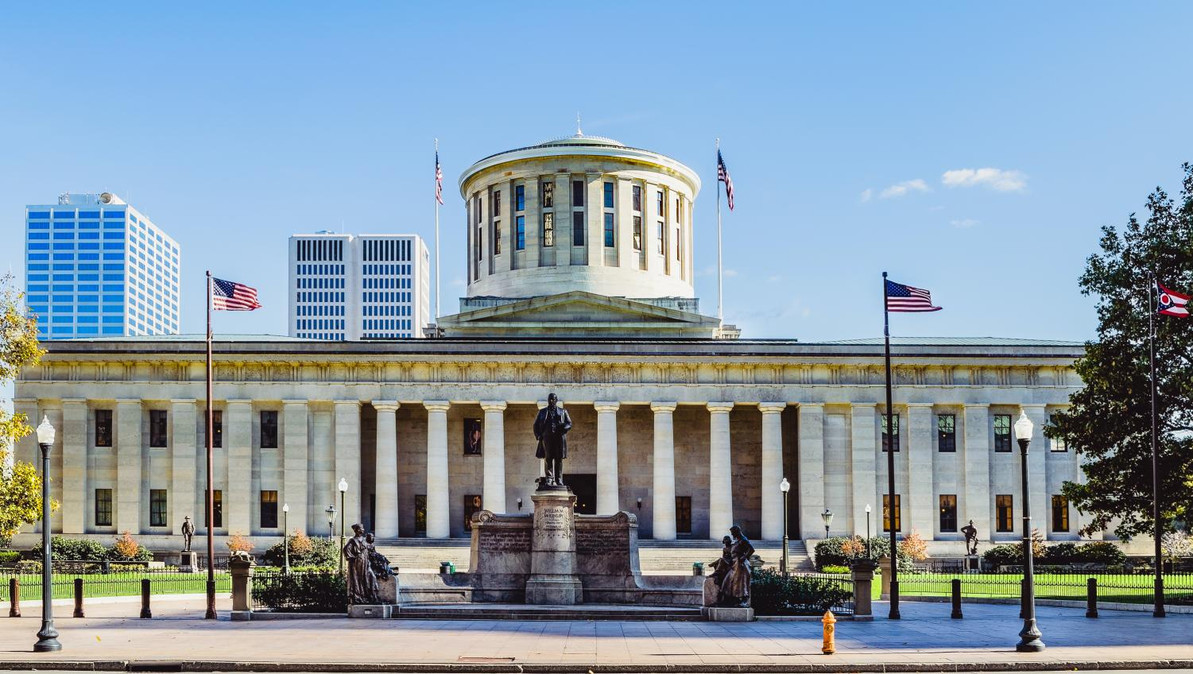
Ohio History: March 1, 1803, Statehood and Its Flag
Ohio celebrates statehood on March 1, 1803, when its first General Assembly met. The seventeenth state’s admission involved several steps: an enabling act, a constitutional convention, federal recognition, and the start of state government. Congress confirmed March 1 as the effective date in 1953. That later action clarified the historical record; it does not mean Ohio spent its first 150 years outside the Union. (National Archives: Ohio statehood)
The Buckeye State’s story reaches far beyond its birthday. Indigenous earthworks, the Ohio River, Lake Erie, canals, factories, flight experiments, and campaigns for equal rights all help explain its place in American life. Its red, white, and blue swallowtail flag makes that identity unusually visible. Understanding the history behind the flag turns an attractive display into a reminder of work, service, invention, and the continuing responsibility to protect liberty.
Ohio before statehood: Indigenous homelands
Nearly two thousand years ago, Indigenous builders created enormous geometric earthworks in the valleys of southern Ohio. Around present-day Chillicothe, circles, squares, embankments, and mounds formed ceremonial landscapes requiring careful planning and sustained cooperation. The name Hopewell is an archaeological label, taken from a later landowner, rather than the name these builders are known to have used for themselves. The surviving earthworks are evidence of sophisticated communities, not traces of an empty wilderness waiting for settlement. Their design makes ancient Ohio part of a much larger history of human knowledge and artistic accomplishment. (National Park Service: Hopewell earthworks)
Eight sites now make up the Hopewell Ceremonial Earthworks World Heritage property, inscribed in 2023. They include earthworks around Chillicothe, Newark, and Oregonia. Materials found in these landscapes show connections stretching as far as the Yellowstone region and Florida. The designation recognizes the extraordinary scale and precision of the monuments, while preservation keeps attention on the people who built them. For anyone exploring Ohio history, these places are an essential starting point: the state’s written constitutions occupy only a small portion of the region’s human timeline. (National Park Service: Hopewell World Heritage)
Later Native nations had their own histories, alliances, languages, and claims to the Ohio Country. The Wyandotte Nation describes its ancestors’ movement through the Great Lakes region and into Ohio, where the spelling Wyandot developed. Its account also records forced removal from Ohio in 1843, followed by further upheaval west of the Mississippi. Today the federally recognized Wyandotte Nation is headquartered in Oklahoma. Reading its history in its own words helps keep removal from becoming a misleading ending: the community continued, and its relationship with Ohio remains part of the state’s history. (Wyandotte Nation: our history)
The Northwest Territory: a promise of equal statehood
The Northwest Ordinance of July 13, 1787, established a territorial government and a path toward admission for new states north and west of the Ohio River. Its lasting importance was the principle that western communities could enter the Union on equal terms with the original states rather than remain permanent dependencies. Government would develop in stages, from appointed officers to representative institutions and ultimately a state constitution. For a young republic defining its future, that framework offered a practical way to connect expansion with self-government. (National Archives: Northwest Ordinance)
The ordinance protected religious liberty and trial by jury, encouraged education, and prohibited slavery while allowing the return of fugitives from slavery. It also promised respect for Native lands and rights. These provisions reveal both ambition and contradiction. Territorial liberty had limits, and federal promises did not prevent the displacement that accompanied settlement. Ohio’s later struggles over racial equality and Native dispossession make more sense when the ordinance is read as a governing document with competing commitments, not as a guarantee that freedom had already been secured for everyone. (National Archives: Northwest Ordinance)
Control of the Ohio Country was contested on the ground. Native confederacies resisted American expansion, and the defeat of Arthur St. Clair’s army in 1791 demonstrated the strength of that resistance. In 1794, Anthony Wayne’s forces defeated a Native coalition at Fallen Timbers near present-day Maumee. The Treaty of Greenville followed in 1795, opening extensive lands to American settlement. The sequence helped make later statehood possible, but it did so through military defeat and dispossession. A complete account recognizes the stakes for the Native nations defending their homelands as well as the settlers seeking new opportunities. (National Park Service: Fallen Timbers)
Why Ohio celebrates March 1, 1803
Congress approved Ohio’s enabling act on April 30, 1802. Delegates met at Chillicothe and adopted the state constitution on November 29, 1802. On February 19, 1803, Congress recognized that Ohio had formed a constitution and become a state. The first state legislature assembled on March 1. The National Archives distinguishes the February recognition from the March anniversary, which Congress made retroactive in 1953. Keeping these steps separate avoids a common mistake: there was no October 27, 1802 popular ratification of the constitution. Ohio’s birthday marks a constitutional process, not a single ceremony that accomplished every part of admission. (National Archives: Ohio statehood)
The War of 1812 and Lake Erie
Statehood did not immediately remove the danger of war along the northern frontier. During the War of 1812, Lake Erie was an important supply route and a contested military space. On September 10, 1813, Oliver Hazard Perry’s American squadron defeated the British fleet near Put-in-Bay. Perry transferred from the badly damaged Lawrence to Niagara before renewing the attack. The victory disrupted British supply lines and became a major source of national pride. The memorial on South Bass Island honors those who died while also commemorating the later peace among the United States, Britain, and Canada. (National Park Service: Perry’s Victory)
Canals connected farms, towns, and national markets
Ohio’s rivers and Great Lakes shoreline gave it access to trade, but moving goods between them required major investment. Construction of the Ohio & Erie Canal began in 1825. Its Cleveland-to-Akron section opened in 1827, and the route to Portsmouth on the Ohio River was completed in 1832. Workers, including many Irish and German immigrants, dug the waterway largely by hand. The canal gave farmers and merchants a cheaper route to eastern markets and helped turn scattered local economies into parts of a national commercial system. (National Park Service: Ohio & Erie Canal)
The change was visible in daily life as well as freight totals. Mills, stores, and taverns grew along the route, while agricultural products, coal, iron ore, and timber moved outward and manufactured goods moved inland. News and ideas traveled with the boats. Canal history is therefore a history of workers and neighborhoods as much as engineering. The surviving towpath and canal sites allow modern visitors to follow a transportation corridor that once shaped where people worked, what they could sell, and how closely they were connected to the rest of the country. (National Park Service: Ohio & Erie Canal)
Freedom seekers and service to the Union
Ohio’s location across the river from slaveholding states made it important to people escaping slavery. The Underground Railroad was a network of individuals and routes, not a single organization or a literal railway. Freedom seekers took the greatest personal risks, sometimes receiving help from free Black communities and white abolitionists. The National Park Service identifies the Ohio & Erie Canal as a likely corridor, but carefully separates documented journeys from possibilities. That distinction matters: a persuasive story about a hidden route should not be presented as a proven event without evidence. (National Park Service: Underground Railroad)
Ohio also had discriminatory Black Laws and segregated institutions, so arriving in a free state did not ensure equality or safety. Black activists petitioned for change, pursued education, and challenged exclusion. Federal fugitive-slave enforcement added another danger to life north of the Ohio River. These facts give greater meaning to the courage of abolitionists and those they assisted. Their work tested whether American commitments to liberty would apply in practice, and it demonstrated that progress often depended on people confronting unjust customs and laws rather than simply trusting that geography had made them free. (National Park Service: Underground Railroad)
During the Civil War, nearly 320,000 Ohioans served in the United States military, according to Ohio History Connection, and more than 35,000 died. Individual records make that scale comprehensible. Colwell Porter, a young soldier from Trumbull County, served with the 171st Ohio Volunteer Infantry, guarded prisoners at Johnson’s Island, and was captured during fighting in Kentucky. He returned to Ohio after parole and died in Cleveland in July 1864. His preserved cap and letter connect the national struggle to one family’s loss. Remembering military service means attending to these lives, not only to famous commanders. (Ohio History Connection: Colwell Porter)
An industrial state built by working communities
The Youngstown Historical Center of Industry & Labor preserves a particularly important part of Ohio’s manufacturing story. Its collections examine the steel industry that dominated the Mahoning Valley during much of the twentieth century, including the final batches produced before mills closed. Industrial history includes technical skill, physical danger, company decisions, and the families whose lives depended on factory work. The museum’s focus on labor helps keep the people behind production in view. A mill’s closing changed more than a business balance sheet; it altered the community built around that work. (Ohio History Connection: industry and labor)
Migration changed Ohio’s cities as people searched for employment, security, and a fuller share of American opportunity. Ohio History Connection’s account of Columbus describes the growth of Black neighborhoods during the Great Migration, including businesses, churches, and social organizations on the Near East Side. Segregation restricted housing choices even as those communities flourished. Completed in 1940, Poindexter Village became an important public-housing community and home to residents who shaped the city’s cultural life. Its history connects the promise of a better future with the obstacles that residents worked to overcome together. (Ohio History Connection: Poindexter Village)
Flight, invention, and the widening right to vote
Dayton’s role in aviation grew from repeated experiment rather than a single lucky moment. After their first powered flights in North Carolina in December 1903, Wilbur and Orville Wright returned to Ohio and continued testing at Huffman Prairie. In 1904 and 1905 they improved control and endurance until they had a practical airplane. The field later supported a flying school and exhibition work. Ohio can take pride in that achievement without relocating the first flight from North Carolina: the distinctive Dayton contribution was the sustained development that made controlled flight increasingly useful and repeatable. (National Park Service: Huffman Prairie)
Political rights also developed through persistent work. Ohio hosted an important women’s rights convention in 1850, followed by the 1851 Akron convention at which Sojourner Truth spoke. Later campaigners, including Harriet Taylor Upton, organized for voting rights at state and national levels. Ohio ratified the Nineteenth Amendment on June 16, 1919. The amendment reached the necessary national threshold in 1920, barring denial of the vote on account of sex. This history belongs beside military and industrial achievements because self-government depends on who is permitted to participate in it. (National Park Service: Ohio and suffrage)
Modern Ohio: research, public responsibility, and renewal
Ohio’s aviation legacy continued in federal research. The laboratory now known as NASA’s Glenn Research Center was established in Cleveland in 1941 by the National Advisory Committee for Aeronautics to investigate aircraft propulsion. It became part of NASA in 1958 and expanded into work involving space propulsion, power, communications, and materials. Its history links wartime technical demands with later exploration and civilian innovation. The center’s continuing research illustrates a durable Ohio strength: bringing specialized tools, practical experimentation, and skilled people together to solve difficult problems. (NASA: Glenn Research Center history)
Industrial growth also left environmental costs. The Cuyahoga River fire of June 22, 1969, became an international symbol of polluted waterways, although it was neither the river’s first fire nor the sole cause of national environmental reform. Cleveland had already approved a major sewer and treatment investment in 1968. Mayor Carl Stokes and environmental journalists helped draw attention to the problem. The National Park Service cautions against reducing the later Clean Water Act and other changes to one dramatic incident. The more useful lesson is that public awareness, local investment, and sustained organizing reinforced one another. (National Park Service: 1969 river fire)
Another event placed Ohio at the center of national debate over authority and dissent. On May 4, 1970, Ohio National Guard members fired at Kent State University, killing four students and wounding nine. The shootings occurred amid protests over the Vietnam War and its expansion into Cambodia and triggered strikes across American campuses. Kent State’s historical account emphasizes careful reconstruction of what happened rather than easy assumptions about every person present. Remembering the deaths requires seriousness about civil liberties, public responsibility, and the consequences of using force in a deeply divided society. (Kent State University: May 4 historical accuracy)
Ohio’s present includes the work of repairing earlier damage. Along the Cuyahoga, reduced pollution, wastewater improvements, habitat projects, and removal of obsolete dams have supported recovery and recreation. The National Park Service describes progress rather than a claim that every problem has disappeared. That measured view is worth keeping. Civic pride can include a restored river, preserved earthworks, and a research laboratory as readily as a battlefield monument. Each reflects choices about what a community values and what it is willing to maintain for the next generation. (National Park Service: river recovery)
Ohio’s flag: a 1901 design adopted in 1902
Ohio did not adopt its familiar state flag at admission. Architect John Eisenmann designed it for the Ohio building at the 1901 Pan-American Exposition in Buffalo, New York, and the legislature adopted it on May 9, 1902. Its swallowtail outline, with a V-shaped cut at the free end, sets it apart from rectangular state flags. The design is commonly called the Ohio burgee. Its origin in an exhibition building also explains its emphasis on recognition: it needed to represent Ohio clearly in a setting where visitors were comparing states and their accomplishments. (Ohio Memory: history of Ohio’s flag)
The flag uses three red stripes and two white stripes, a blue triangular field, seventeen white stars, and a red disc within a white ring. Eisenmann associated the triangles with hills and valleys and the stripes with roads and waterways. Thirteen stars recall the original states, while four additional stars bring the total to Ohio’s admission number. The circular design suggests both the letter O and the buckeye. There is no state motto or ribbon on this flag. Its symbols can be read without adding a state seal or words that the design does not contain. (Ohio Secretary of State: flag guide)
Choosing and displaying an Ohio flag
For a home, office, classroom, or civic display, start with the correct swallowtail shape and a clearly printed star arrangement. Then choose a size and attachment style that fit the setting. A flag intended for a pole with clips needs a different heading from one intended to slide onto an indoor presentation staff. Check the product’s stated construction and intended use rather than assuming every Ohio flag is interchangeable. FORTISVEX’s Ohio state flag category provides a place to compare listings; current availability, dimensions, and mounting details should be confirmed on the individual product page. (FORTISVEX Ohio state flags)
When Ohio and United States flags share one halyard, the national flag belongs above the state flag. On adjacent staffs, the Ohio Secretary of State’s guide says to raise the United States flag first and lower it last. The same guide provides illustrations for display and a folding method suited to Ohio’s unusual shape. Consult those diagrams when planning a formal arrangement, and check current official instructions for any half-staff observance. A thoughtful display respects both the state’s distinctive identity and its place within the Union. (Ohio Secretary of State: flag guide)
March 1 offers a natural occasion to revisit that relationship. Ohio’s history includes the promise of equal statehood, the labor that connected farms and cities, the defense of the Union, and the long effort to make freedom more complete. Flying its flag can honor all of those experiences. The strongest pride is informed pride: knowing what the symbols mean, remembering who helped build the state, and accepting the responsibility to carry its best commitments forward.
Recent Posts
-
Maryland Flag Half-Staff for Dennis C. McCoy on November 12, 2026
The Maryland flag is to be flown at half-staff from sunrise to sunset on Thursday, November 12, 2026 …Nov 12th 2026 -
Cord-and-Tassel Rings: Wood or Aluminum Pole, Same Outside Diameter
Two cord-and-tassel rings can share the same listed outside diameter without being the same replacem …Nov 9th 2026 -
Pressure-Cooker Lemon Chicken and Rice
Lemon belongs at the end of this pot of chicken and rice. Stirring in the zest and juice after press …Nov 9th 2026