
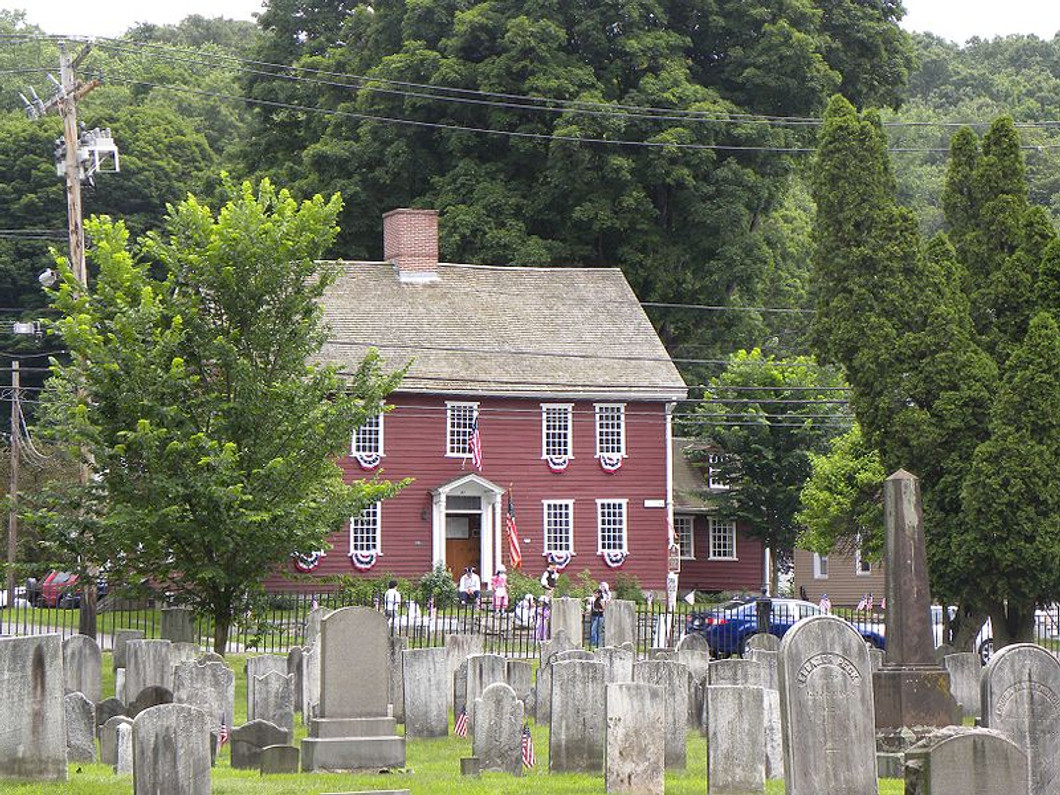
Connecticut History: January 9, 1788, Statehood and Its Flag
Connecticut ratified the United States Constitution on January 9, 1788, becoming the fifth state in the ratification sequence. The vote was 128 to 40. Its familiar statehood anniversary celebrates that decision, not the admission of a newly organized territory. Connecticut was already an independent state helping decide the shape of the American Union. (National Archives: ratification dates)
The Constitution State’s story reaches from Indigenous homelands and river settlements to manufacturing cities, submarine shipyards, and modern research industries. Its flag brings together three fruit-bearing grapevines, a white shield, a blue field, and a motto about transplantation and endurance. Understanding the people and institutions behind those symbols gives Connecticut pride a firmer foundation than a list of famous firsts.
Indigenous Connecticut: communities, diplomacy, and survival
Before Dutch traders or English settlers arrived, Native peoples already had their own communities, leaders, political relationships, and homelands. The Mohegan Tribe’s account of Uncas describes the seventeenth century as a period of competing strategies under the pressure of disease and expanding European settlement. Uncas and his followers established a distinct Mohegan community and pursued an alliance with the English. That choice was a political calculation, not evidence that all Native nations shared one position. Reading tribal history alongside colonial records helps replace a simplistic settlers-against-wilderness story with an account of people acting to protect their futures. (The Mohegan Tribe: Uncas)
The Mashantucket Pequot Museum presents Native life before European contact through language, family, work, and social organization. Its account continues through reservation life and the rebuilding of the Mashantucket Pequot Tribal Nation, which achieved federal recognition in 1983. That continuity matters. Pequot history does not end with the violence of the colonial period, and modern tribal communities are not merely reminders of the past. They are part of Connecticut’s present, preserving memory while making decisions about their own institutions, culture, and economic life. (Mashantucket Pequot Museum: history)
River settlements and the Pequot War
In 1633 the Dutch established the House of Hope at the future site of Hartford, while English traders established a post at Windsor. Wethersfield developed in the following years, and Thomas Hooker’s group came from Massachusetts to Hartford in 1636. Saybrook guarded the river’s mouth, and a separate New Haven Colony began in 1638. These were distinct settlements and jurisdictions, not a single state founded in one stroke. The Connecticut River and coastal harbors made trade possible while increasing competition over land and access. (Connecticut General Assembly: historical dates)
The Pequot War exposed the destructive potential of that competition. On May 26, 1637, English forces and their Native allies attacked the Pequot fort at Mistick, or Mystic. The violence killed hundreds of Pequot people, including women and children, and the subsequent fighting severely damaged the nation’s ability to resist further attacks. The Mashantucket Pequot Museum’s battlefield research gives this history a material record as well as a written one. An honest colonial history must recognize the massacre and its consequences rather than presenting the war only as a heroic colonial victory. (Mashantucket Pequot Museum: Pequot War)
1639 and 1662: the roots of the Constitution State
The Fundamental Orders of 1639 provided a framework of government for Hartford, Windsor, and Wethersfield. They established elected officers and a General Court, making Connecticut an important early example of written constitutional government. They were not a charter of universal democracy: participation belonged to admitted freemen, and the document explicitly joined civil order to the protection of Christian religious life. Calling the Orders an important constitutional milestone is more useful than insisting on an unqualified world-first claim. Their achievement was to put enduring rules for public authority into a written framework. (Connecticut Secretary of the State: Fundamental Orders)
The royal charter of 1662 confirmed substantial local self-government. Its later defense became the subject of Connecticut’s best-known patriotic legend. According to the Charter Oak tradition, when royal governor-general Edmund Andros tried to take control of the charter in 1687, it was hidden inside an oak tree. The state library identifies the hiding story as a legend, a distinction worth preserving. Its enduring importance lies in what the tree came to represent: a community’s attachment to its governing rights and its resistance to arbitrary outside power. (Connecticut State Library: Charter Oak)
The Revolution and the Provisions State
Connecticut supported the Revolution with men, supplies, and productive capacity. Soldiers served far beyond the state’s boundaries, while farmers and manufacturers helped feed and equip the Continental Army and militia. That contribution earned Connecticut the name Provisions State. It is a useful corrective to a history told only through commanding generals. Independence depended on food, clothing, tools, transportation, and repeated decisions by ordinary households to keep supporting an uncertain cause. Military courage and the practical labor of sustaining an army belonged to the same national effort. (State of Connecticut: early history)
War also came directly to Connecticut’s coast. On September 6, 1781, British forces attacked the New London–Groton area, and Fort Griswold fell after a costly defense by American militia. The surviving earthworks and memorial landscape at Groton preserve the memory of those losses. The episode came near the end of the war, a reminder that eventual American victory did not make the final months safe. Remembering Fort Griswold adds a specific place and human cost to the broader celebration of independence. (Connecticut State Parks: Fort Griswold)
The Connecticut Compromise and January 9, 1788
At the Constitutional Convention in Philadelphia, representation threatened to divide large and small states. Connecticut’s Roger Sherman and Oliver Ellsworth helped shape the compromise associated with their state. Under the arrangement adopted on July 16, 1787, the House of Representatives would reflect population, while the Senate would give states equal representation. The result did not eliminate disagreement. It built disagreement into a workable structure in which different kinds of majorities would have to cooperate. Connecticut’s influence therefore reached beyond securing its own position: it helped make a national legislature possible. (U.S. Senate: the Great Compromise)
Ratification was a separate decision from drafting. Connecticut’s convention approved the Constitution on January 9, 1788, by 128 votes to 40. The opposition matters because it shows that the choice was debated, not automatic. Becoming fifth in the sequence placed Connecticut among the early supporters, but five approvals were not enough to activate the new arrangement. The state’s anniversary is best understood as a deliberate endorsement of a new federal framework by an existing member of the revolutionary Union. (National Archives: ratification dates)
The Constitution required nine state ratifications before taking effect among the states that accepted it. Arguments over federal power, representation, and individual rights continued throughout the process, and the Bill of Rights followed. Connecticut’s constitutional pride need not imply that every founding decision was just or complete. The Constitution also accommodated slavery. The more durable patriotic lesson is that written limits, divided authority, and mechanisms for change created a structure that later Americans could use to demand a fuller measure of liberty. (National Archives: Constitution history)
A new state constitution and unfinished freedom
Connecticut continued using its adapted colonial charter after independence rather than immediately replacing it. A new state constitution finally arrived in 1818. It ended the system of an established church and created a more explicit constitutional order for the state. That transition is important to the history of religious freedom. The colony’s commitment to its own religious community was not the same thing as equal religious liberty, and the expansion of freedom required changing institutions inherited from the colonial era. (Connecticut General Assembly: historical dates)
Slavery persisted in Connecticut well after the Revolution. The Gradual Abolition Act of 1784 applied prospectively to children born into slavery, promising freedom only after a prescribed period rather than immediately emancipating everyone already enslaved. Connecticut did not abolish slavery completely until 1848. This history challenges a comfortable division between a wholly free North and an enslaving South. Connecticut could contribute to independence and still deny fundamental liberty within its own borders. Recognizing that contradiction clarifies why abolition was necessary, not merely inevitable. (CT Humanities: slavery and abolition)
The struggle for equal education also brought conflict. Sarah Harris, a young Black woman, asked to attend Prudence Crandall’s Canterbury school in 1832. After local opposition to integration, Crandall reopened it in 1833 for Black students. Connecticut responded with a discriminatory law restricting out-of-state Black students’ access to education without local approval. Prosecution and harassment followed, and a mob attack forced the school to close in 1834. The students were participants in this struggle, not simply beneficiaries of a teacher’s courage; several became educators and reformers themselves. (Prudence Crandall Museum)
Connecticut became central to another fight for freedom when Africans from the schooner Amistad were brought into the federal legal system in 1839. They had resisted captivity after being kidnapped and illegally trafficked. The litigation reached the U.S. Supreme Court, where former president John Quincy Adams helped argue their case. In 1841 the Court upheld their freedom. The ruling did not abolish American slavery, but the case exposed the conflict between human liberty, claims of property, and the obligations of courts. Its importance lies in the captives’ resistance as much as in the lawyers’ arguments. (National Archives: the Amistad case)
Manufacturing skill and service to the Union
Connecticut’s nineteenth-century manufacturing reputation rested on skilled workers as well as inventors. At Hartford’s Colt Armory, precision machining and interchangeable parts helped develop production methods that could turn out complex goods consistently. Coltsville also became a community of factories, housing, and institutions. After Samuel Colt’s death, Elizabeth Colt continued the enterprise and shaped its legacy. The history of firearms manufacturing here is best understood through that larger industrial story: design, workmanship, business organization, and the people whose daily labor made large-scale production possible. (National Park Service: Coltsville)
Factories drew people into growing towns and cities, creating new opportunities and new conflicts over wages, hours, and working conditions. Connecticut’s labor history includes successive arrivals of immigrants and migrants whose skills sustained manufacturing. Workers’ organizations challenged employers and influenced the conditions under which industrial wealth was produced. This belongs beside the familiar stories of entrepreneurial invention. A factory was not simply a building with a celebrated name above its door. It was a workplace in which families negotiated the meaning of a decent living and a fair share of economic progress. (Connecticut Department of Education: labor history)
During the Civil War, Connecticut supported the Union, including through the service of Black soldiers. The 29th Connecticut Infantry organized at New Haven and mustered into federal service in March 1864. It served in Virginia and took part in the occupation of Richmond in April 1865. The regiment’s history gives concrete form to the connection between military service and the struggle for citizenship. These men were not waiting on the sidelines for freedom to arrive; they helped defeat the Confederacy while the nation debated what equal membership in the republic would require. (National Park Service: 29th Connecticut)
A broader democracy and a changing industrial economy
The campaign for women’s suffrage continued the argument over who could participate in self-government. Connecticut ratified the Nineteenth Amendment in September 1920, but only after enough other states had already secured its adoption nationally. That timing is worth remembering: a state’s constitutional tradition does not mean it always led every expansion of rights. The suffrage movement depended on sustained organizing by women who challenged laws that excluded them from the ballot. Its achievement widened the electorate and changed what representative government could mean. (National Park Service: women’s suffrage)
World War II brought new workers into Connecticut’s defense factories, including African Americans migrating from the South and Puerto Rican workers. Women filled jobs as production expanded and men entered the armed forces. Unionization also spread across major industries during the war. These changes connected military production to the everyday meaning of opportunity: who could get a skilled job, what workers earned, and how families built a future around industrial employment. Connecticut’s wartime transformation was therefore both an engineering story and a social one. (Connecticut Department of Education: labor history)
A major technological milestone arrived at Groton on January 21, 1954, when USS Nautilus launched at the Electric Boat shipyard. Commissioned that September, it became the world’s first nuclear-powered submarine. The vessel’s construction brought together naval planning, engineering research, and industrial skill. Nuclear propulsion changed what submarines could do by allowing much longer submerged operations. For Connecticut, Nautilus connected a long maritime tradition to the nuclear age, while giving the state a prominent place in the history of the U.S. Navy. (U.S. Navy: USS Nautilus)
Constitutional development continued too. Connecticut adopted a new constitution in 1965, with legislative reapportionment a central purpose of the convention. The debate concerned how a representative government should reflect its people as population patterns changed. That issue connects the modern state to its earlier constitutional story without pretending that the institutions remained unchanged. Written government must be preserved, but it also must be examined when inherited arrangements no longer provide adequate representation. Connecticut’s history contains both impulses: continuity and reform. (CT Humanities: the 1965 Constitution)
In the twenty-first century, the state’s economic development programs identify advanced manufacturing, aerospace and defense, insurance, financial services, life sciences, and technology among important sectors. These are not disconnected replacements for Connecticut’s past. They draw on established traditions of precision work, risk management, research, and maritime production. The modern challenge is to carry those strengths into new industries while maintaining opportunities for the communities that support them. Connecticut is more than either a colonial museum or a collection of corporate offices; its history continues through work, civic institutions, and local initiative. (Connecticut economic development: industries)
Connecticut flag history and symbolism
Connecticut’s official state flag dates to 1897, not the Revolution. The adoption effort followed a memorial from the Anna Warner Bailey Chapter of the Daughters of the American Revolution and Governor O. Vincent Coffin’s 1895 proposal. The legislature described a blue flag bearing the state’s arms. A separate 1931 action standardized the official armorial design; it should not be mistaken for the original flag adoption. Older symbols and a later official flag can coexist in the same history. (Connecticut Secretary of the State: symbols)
The current statutory description specifies an azure-blue field with a white, rococo-style shield. Three supported grapevines bear fruit in natural colors. Gold and silver edging and white-oak leaves with acorns ornament the shield, with a white motto streamer below. The original specified size is five feet six inches long by four feet four inches wide. The composition places an ornamental emblem at the center of a broad blue field. Its fruit-bearing vines suggest growth and continuity, while the scroll preserves the state motto. (Connecticut General Statutes: state flag)
The grapevines came through Connecticut’s seal tradition. The Saybrook seal reached Connecticut in the seventeenth century; a replacement ordered in 1711 reduced the vines to three. The Secretary of the State says they may represent the colonies of Connecticut, New Haven, and Saybrook, so that identification should remain an interpretation rather than a proven original intention. The motto, “Qui Transtulit Sustinet,” is translated as “He Who Transplanted Still Sustains.” Its exact origin is uncertain, but its association with transplantation and continued protection is longstanding. (Connecticut Secretary of the State: symbols)
For a modern display, those vines offer a fitting image of endurance: roots established, work continued, and fruit produced over time. That is a present-day reading, not a claim that every generation assigned the same meaning to the flag. It can inspire pride without turning an uncertain symbol into a fabricated historical fact. The flag’s dignity comes from the relationship between its longstanding emblem and the communities that carry it forward.
Connecticut statehood and flag FAQs
Why is January 9, 1788, Connecticut’s statehood date?
It is the date Connecticut ratified the federal Constitution, fifth among the states. It was not a territorial admission act. (National Archives: ratification dates)
Does the Connecticut flag show the state seal?
More precisely, it displays the state’s armorial bearings: the grapevine shield and motto. Calling it simply a seal can obscure the actual design, and describing it as a battle scene is incorrect. (Connecticut General Statutes: state flag)
Was the 1897 flag used at the 1788 ratifying convention?
No. The official flag came more than a century later. A modern state flag is appropriate for celebrating the anniversary today, but it should not be presented as a period-correct artifact from the convention.
Display Connecticut’s history with care
Browse Connecticut state flags at FORTISVEX when planning a home, school, office, or community display. Check each listing’s dimensions, fabric, mounting details, and intended use rather than assuming every flag serves the same setting. For a historical exhibit, identify the period and distinguish a modern reproduction from an original artifact. Connecticut’s contribution to America deserves both pride and precision: the courage to defend liberty, the discipline to build useful institutions, and the honesty to keep widening the circle of people those institutions serve.
Recent Posts
-
Maryland Flag Half-Staff for Dennis C. McCoy on November 12, 2026
The Maryland flag is to be flown at half-staff from sunrise to sunset on Thursday, November 12, 2026 …Nov 12th 2026 -
Cord-and-Tassel Rings: Wood or Aluminum Pole, Same Outside Diameter
Two cord-and-tassel rings can share the same listed outside diameter without being the same replacem …Nov 9th 2026 -
Pressure-Cooker Lemon Chicken and Rice
Lemon belongs at the end of this pot of chicken and rice. Stirring in the zest and juice after press …Nov 9th 2026