
Massachusetts History: Statehood, Liberty and the State Flag
Massachusetts: liberty, statehood and a flag with a long memory
On February 6, 1788, Massachusetts became the sixth state to ratify the United States Constitution. That is the anniversary used when the Bay State takes its place in the familiar list of fifty state birthdays. It celebrates an important national decision, not the first appearance of a Massachusetts government or the beginning of the region’s history.
Massachusetts helped turn resistance to distant authority into an American republic. Its story also includes Indigenous nations, religious settlements, Atlantic commerce, industrial workers, reform movements and scientific enterprise. The state flag gathers only a small portion of that experience into a white field and an elaborate coat of arms. Understanding the history behind it makes the display more meaningful than memorizing a date or recognizing a familiar outline.
Sources: U.S. Senate: Massachusetts.
Before Plymouth: homelands, communities and continuity
Long before English colonies, the region supported Native communities with their own languages, political relationships and knowledge of land and water. The Massachusett, Wampanoag, Nipmuck, Pocumtuck and other peoples were not interchangeable groups. Farms, fishing places, seasonal movement and trade connected communities across boundaries that would later become state lines. Massachusetts itself preserves a Native place-name associated with the Great Blue Hill region.
The Mashpee Wampanoag Tribe’s history makes another essential point: Native history did not end with European settlement. Its account follows communal landholding, struggles against outside overseers, military service and survival into the present. The tribe gained federal recognition in 2007. Its citizens and cultural institutions remain part of Massachusetts today.
A state history should therefore begin with living peoples rather than a suggestion that the landscape was waiting to be discovered. Colonial records tell one part of the story; tribal accounts supply perspectives and continuity that colonial officials often excluded.
Sources: Massachusetts historical sketch, Mashpee Wampanoag history, State symbols.
Plymouth and Massachusetts Bay were different colonies
The settlement established at Plymouth in 1620 and the Massachusetts Bay colony associated with John Winthrop’s arrival in 1630 began separately. Their later inclusion in a single provincial government can make them seem like one founding event, but the settlers, governing arrangements and early experiences were different. The 1691 royal charter joined Plymouth with Massachusetts Bay in a new province.
Religious purpose helped motivate English migration, but seeking freedom for a particular religious community did not automatically mean granting equal freedom to every dissenter. The colonial experience contains both determined self-government and narrow boundaries around belonging. That tension is important to the later American story: liberty became a principle people repeatedly challenged their own governments to honor more fully.
The consequences for Native peoples were devastating. King Philip’s War in the 1670s brought death, displacement and enslavement. The Mashpee account records both that catastrophe and continued tribal life afterward. Neither an uncomplicated settlement celebration nor a story of disappearance adequately describes the region.
Sources: Massachusetts historical sketch, Mashpee Wampanoag history.
Boston’s resistance and the argument over authority
The Boston Tea Party was not simply an objection to expensive tea. The 1773 crisis concerned Parliament’s authority, taxation and the advantages given to the East India Company. When tea ships arrived, opponents resisted unloading while Governor Thomas Hutchinson refused to let the vessels depart without resolving the customs obligations. On December 16, participants destroyed 342 chests of tea in Boston Harbor.
Public meetings were part of the political machinery behind the confrontation. Old South Meeting House became a gathering place for large crowds debating what to do. The building’s survival, including its rescue from destruction in 1876, allows visitors to connect the famous harbor scene with the discussion and organizing that preceded it.
The larger question was who possessed the legitimate power to govern. Colonial protesters were not all seeking independence from the beginning. Positions changed as imperial enforcement, local resistance and failed compromises made reconciliation increasingly difficult.
Sources: Boston Tea Party timeline, Old South Meeting House.
Lexington and Concord: citizens become soldiers
On April 19, 1775, British regulars marched into the Massachusetts countryside to seize military supplies. The confrontation at Lexington, the fighting at Concord’s North Bridge and the long return along the Battle Road transformed a political crisis into war. Local militia and minutemen responded through community networks that had prepared for an emergency.
These events remain central to the American citizen-soldier tradition. The participants were not interchangeable figures in a painting: they were people with families, trades, obligations and differing levels of military experience. Their willingness to turn out under dangerous circumstances is one reason the landscape still carries such emotional power.
It is worth keeping the chronology straight. The fighting came more than a year before the Declaration of Independence. The present Massachusetts state flag was not flying over that day’s events. A modern flag honors the state’s connection to the Revolution; it is not evidence that its current design existed in 1775.
Sources: Minute Man National Historical Park.
A constitution before federal ratification
Massachusetts adopted its own constitution in 1780. John Adams prepared the principal draft, and a specially elected convention helped distinguish fundamental constitutional law from ordinary legislation. The document was ratified on June 15 and took effect on October 25. It remains the foundation of the Commonwealth’s government, amended over time rather than replaced wholesale.
The framework paired a declaration of rights with a structure of government, including an executive branch and a bicameral legislature. That combination matters: a promise of liberty needs institutions capable of protecting it, and institutions need limits that prevent their power from becoming arbitrary. The Massachusetts example influenced the federal Constitution that followed.
Calling Massachusetts a commonwealth does not place it outside the Union or give it a different constitutional rank from other states. The name expresses a tradition of government for the public good. It is a historic designation, not a separate category of American membership.
Sources: John Adams and the Massachusetts Constitution.
The sixth ratification and the difficult work of republican government
February 6, 1788 marks Massachusetts’ ratification of the federal Constitution. That decision belongs to a different stage from the state constitution of 1780. Using both dates accurately preserves the distinction between organizing a state government and accepting the new national constitutional framework.
The years between independence and ratification were not a calm victory celebration. Shays’ Rebellion exposed serious conflict over debt, taxation and the treatment of people struggling in the postwar economy. On January 25, 1787, armed protesters attempted to take the arsenal at Springfield. The confrontation became part of the national argument about the strength and legitimacy of republican government.
The episode resists a one-line moral. People who had fought for independence could disagree intensely about what a free government owed its citizens and what citizens owed lawful institutions. Remembering that dispute adds depth to the founding story rather than diminishing the achievement of constitutional government.
Sources: U.S. Senate: Massachusetts, Shays’ Rebellion at Springfield.
Liberty tested in the courts
The words of the Massachusetts Constitution had consequences for enslaved people who demanded that its principles apply to them. Freedom litigation associated with Elizabeth Freeman and Quock Walker helped expose the incompatibility of slavery with the new constitution’s declaration of human equality. In the Walker proceedings, Chief Justice William Cushing explained that slavery could not be reconciled with those constitutional principles.
This was not freedom arriving automatically because a document had been printed. Enslaved people acted, lawyers brought cases and judges made decisions. The distinction matters in any patriotic account: the country’s stated ideals supplied tools that people used to challenge practices that violated them.
Abolition in Massachusetts also did not erase racial discrimination or the state’s economic connections to slavery elsewhere. The achievement was important precisely because it was a real change within an unfinished struggle, not proof that every injustice had disappeared.
Sources: Constitution and abolition.
Waterpower, mill towns and the dignity of work
Lowell became one of the great landscapes of American industrialization. Textile mills drew young women from rural New England into wage work, company boardinghouses and a new rhythm governed by machinery and factory schedules. The women commonly called mill girls were workers with ambitions and opinions, not merely supporting characters in a story about inventors.
Industrial opportunity could bring earnings and independence while also imposing long hours and difficult conditions. Workers organized to defend their interests. Sarah Bagley became a prominent labor reformer, challenging the assumption that young female employees should accept management decisions without a political voice. Later immigrant workers and families helped reshape Lowell’s communities and workforce.
The preserved mills make the industrial revolution tangible. A canal, loom or boardinghouse shows how business, engineering and daily life fit together. The nation’s manufacturing strength depended on investment and invention, but also on the skill and endurance of people whose names rarely appeared on factory buildings.
Sources: The mill girls of Lowell, Sarah Bagley.
The Union, the 54th Massachusetts and a wider claim to citizenship
Massachusetts raised the 54th Volunteer Infantry in 1863, one of the early Black regiments organized for Union service during the Civil War. Men came from beyond the state as well as from its own communities. Their assault on Fort Wagner in South Carolina demonstrated extraordinary courage and became an enduring part of the history of Black military service.
The regiment’s significance reaches beyond a single battlefield. Its soldiers fought to preserve the United States and destroy slavery while confronting unequal treatment themselves. Their service made the claim to citizenship and equal recognition impossible to separate from the sacrifices already being made for the country.
The memorial to Robert Gould Shaw and the 54th in Boston offers a powerful place to consider that story. It honors military courage while inviting closer attention to the individual soldiers. A state flag displayed at a veterans’ event can open that conversation, but it should never substitute for learning whose service is being remembered.
Sources: The 54th Massachusetts.
The Revolution’s language in later reform
The struggle over representation did not end in the eighteenth century. In 1873, women’s-rights advocates marked the Boston Tea Party’s centennial with a gathering that turned Revolutionary language toward their own exclusion from political power. The New England Woman’s Tea Party connected a familiar patriotic anniversary to the continuing question of who had a voice in government.
That connection is a useful way to read Massachusetts history. Later generations did not simply inherit a completed definition of liberty. They argued over its reach, appealed to founding principles and sought changes through organizing, persuasion and law. Agreement on every reform was never universal, but the ability to debate and petition belonged to the constitutional inheritance itself.
For families exploring the state, placing revolutionary sites alongside labor and civil-rights sites produces a fuller picture. The same landscape contains resistance to empire, arguments over wages and campaigns for political equality.
Sources: New England Woman’s Tea Party.
From industrial reinvention to the present
Massachusetts did not remain the same textile-and-shipping economy forever. Its twentieth-century history included industrial decline in some places and the growth of technology and research-based work in others. The contemporary state’s official economic materials emphasize life sciences, advanced manufacturing, technology, defense and emerging fields such as applied artificial intelligence.
Those industries connect the modern Commonwealth with older habits of engineering, education and enterprise without making the transition effortless. A prosperous laboratory district does not tell the entire story of a former mill town, fishing port or rural community. State history is more useful when it notices different regional experiences rather than treating the economy as one unbroken success.
The present also includes the institutions that preserve the past: tribal museums, local historical societies, national parks, archives and conserved military colors. They make it possible to test inherited stories against evidence and to introduce a new generation to the people behind familiar place-names.
Sources: Massachusetts economic sectors, Hall of Flags.
Reading the Massachusetts flag
The familiar Commonwealth flag places the state’s arms on a white field. Within the blue shield stands a Native figure holding a bow and a downward-pointing arrow; a star appears near the figure. Above the shield is an arm holding a sword, and a ribbon carries the Latin motto. The design is heraldic, meaning that its elements belong to a formal language of arms rather than a naturalistic scene.
The motto connects peace with liberty. Its traditional English rendering is “By the sword we seek peace, but peace only under liberty.” The Provincial Congress adopted the motto in 1775. The star connects Massachusetts with its place among the original states, while the downward arrow is conventionally read as peaceful.
Do not assign an invented explanation to every color. The Secretary of the Commonwealth specifically cautions that the original reasons for the flag’s color choices are not known. Attractive internet explanations are not a substitute for documentation.
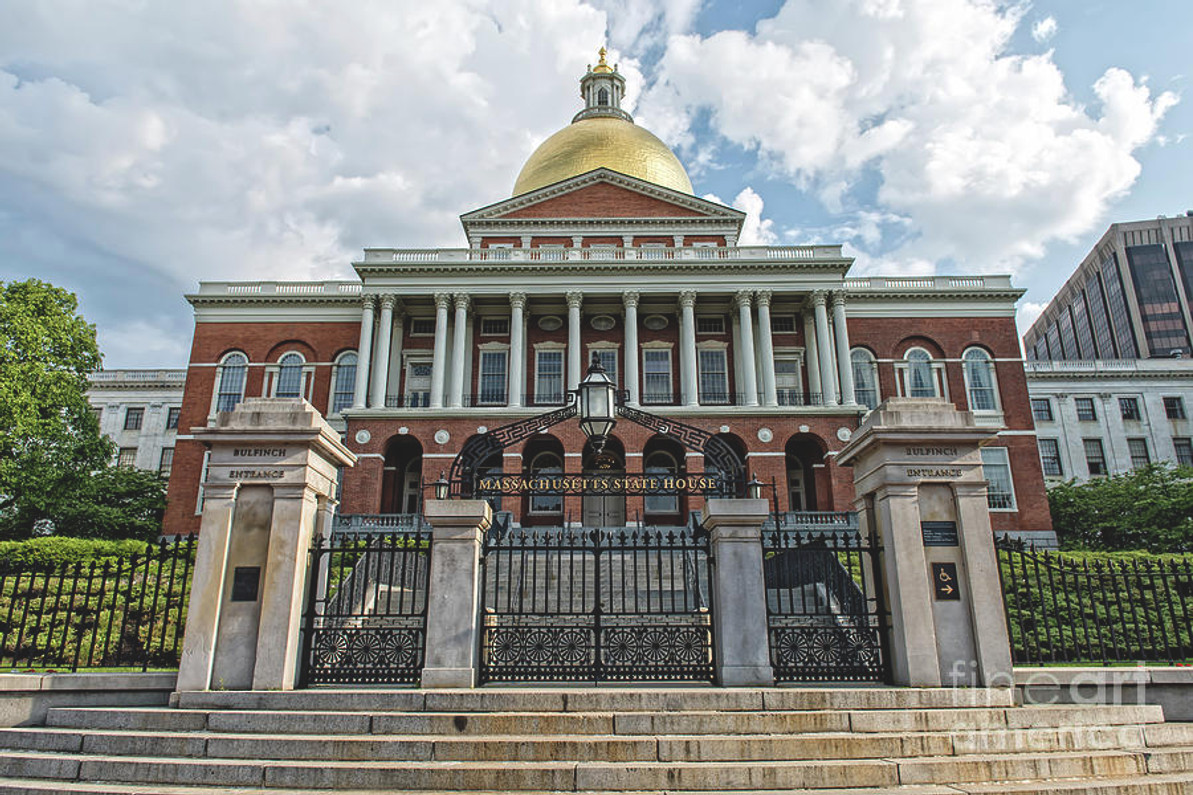
Sources: State flag questions and answers, State symbols, Massachusetts State House.
The flag evolved, and proposals are not enacted designs
The state seal, coat of arms and flag are related but are not the same object. Massachusetts has used colonial and Revolutionary seals as well as its Commonwealth seal. A seal in a document or stained-glass display does not establish that an identical flag was officially flown at the same time.
The current two-sided arrangement dates to the 1971 flag law, effective November 1 of that year. Previously, the reverse carried a pine tree rather than the arms. That makes a historic example with different front and back designs understandable, not necessarily incorrect for its own period.
Massachusetts has also established a commission to recommend changes to its seal, flag and motto. Official material confirms the advisory process and a June 2026 meeting. A proposal or commission recommendation is not itself a newly enacted state flag. Readers comparing designs should consult current official law and distinguish an authorized emblem from a submission, advocacy design or historical reproduction.
Sources: State flag questions and answers, Seal, Flag and Motto Advisory Commission, Commission meeting June 25, 2026.
Seeing the history for yourself
A meaningful Massachusetts history trip can begin with a local question. What happened along this stretch of the Battle Road? Who worked in this mill? Whose name appears on this memorial? Why was this seal chosen? Primary sources and historic places turn those questions into something more substantial than a list of firsts.
The State House’s Hall of Flags adds another lesson: old textiles need conservation. The colors associated with military service are historical objects, not disposable decorations. Their preservation honors the people who carried them and protects evidence that future generations can study.
February 6 offers a natural occasion to remember Massachusetts’ federal ratification. Patriots’ Day and other commemorations illuminate different chapters. A thoughtful display can celebrate the state’s contribution to American liberty while recognizing that the story is larger than any single anniversary, leader or symbol.
Sources: Hall of Flags.
Bring state history into your display
A state flag can make a history lesson, civic anniversary or family connection visible. Choose a flag that fits your pole, setting and intended use, and compare the actual size, material and attachment details on the product listing. Explore FORTISVEX Massachusetts state flags for available options.
Recent Posts
-
Maryland Flag Half-Staff for Dennis C. McCoy on November 12, 2026
The Maryland flag is to be flown at half-staff from sunrise to sunset on Thursday, November 12, 2026 …Nov 12th 2026 -
Cord-and-Tassel Rings: Wood or Aluminum Pole, Same Outside Diameter
Two cord-and-tassel rings can share the same listed outside diameter without being the same replacem …Nov 9th 2026 -
Pressure-Cooker Lemon Chicken and Rice
Lemon belongs at the end of this pot of chicken and rice. Stirring in the zest and juice after press …Nov 9th 2026